A 30-minute video is too long for one conversation. This guide walks the 8-step Skill that locks the narration and one look, then gives each 3-minute segment to a fresh sub-agent, five at a time, and polishes the cut in an empty-context session.
The folder structure behind my AI agent team, the Herdr setup where Grok Build, Claude Code and Kimi Code work side by side, and the two live tasks from the video: an article published by voice and a three-model front-end test.
Eight folders of plain Markdown, a CLAUDE.md index in each, and seven prompts that make your agent interview you. Every prompt, template and command from the video, in order.
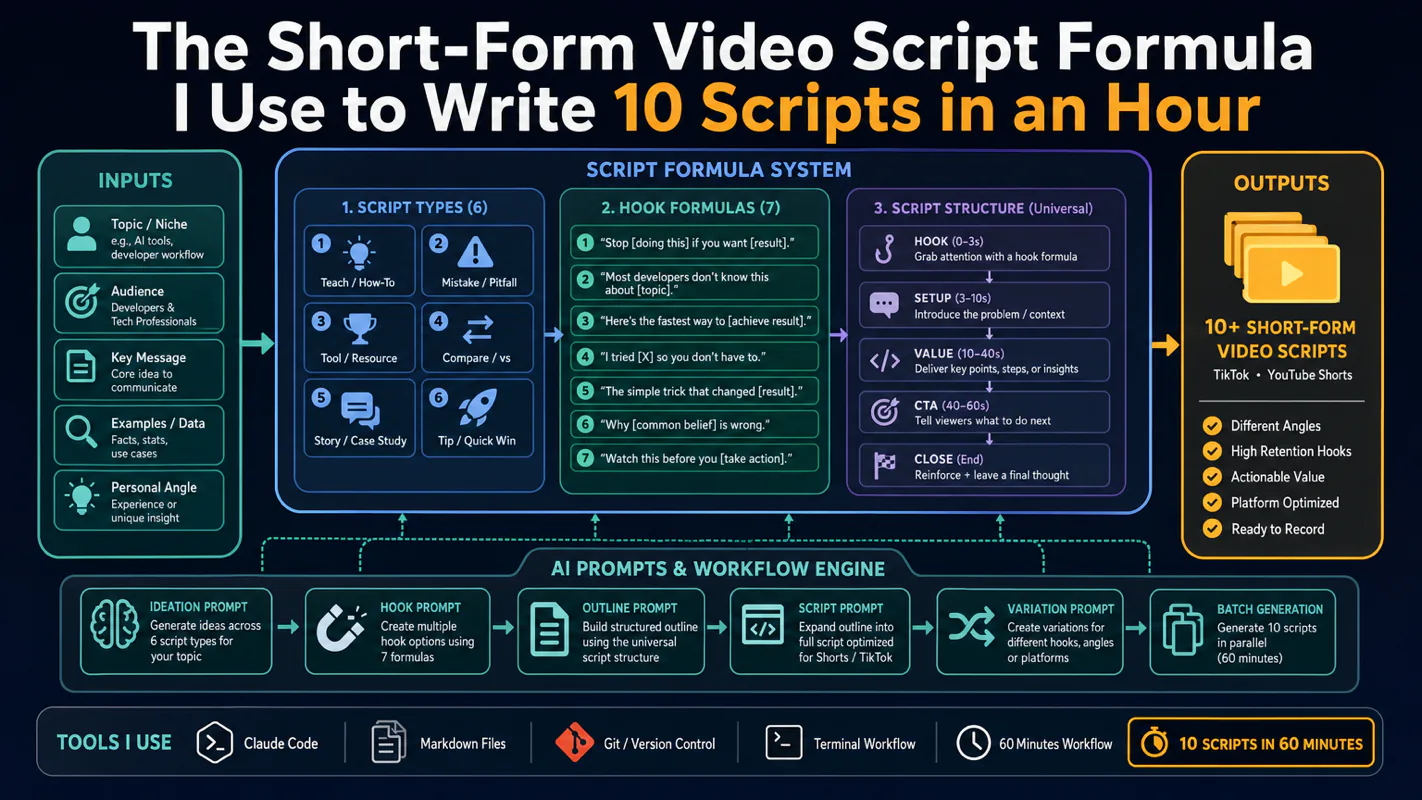
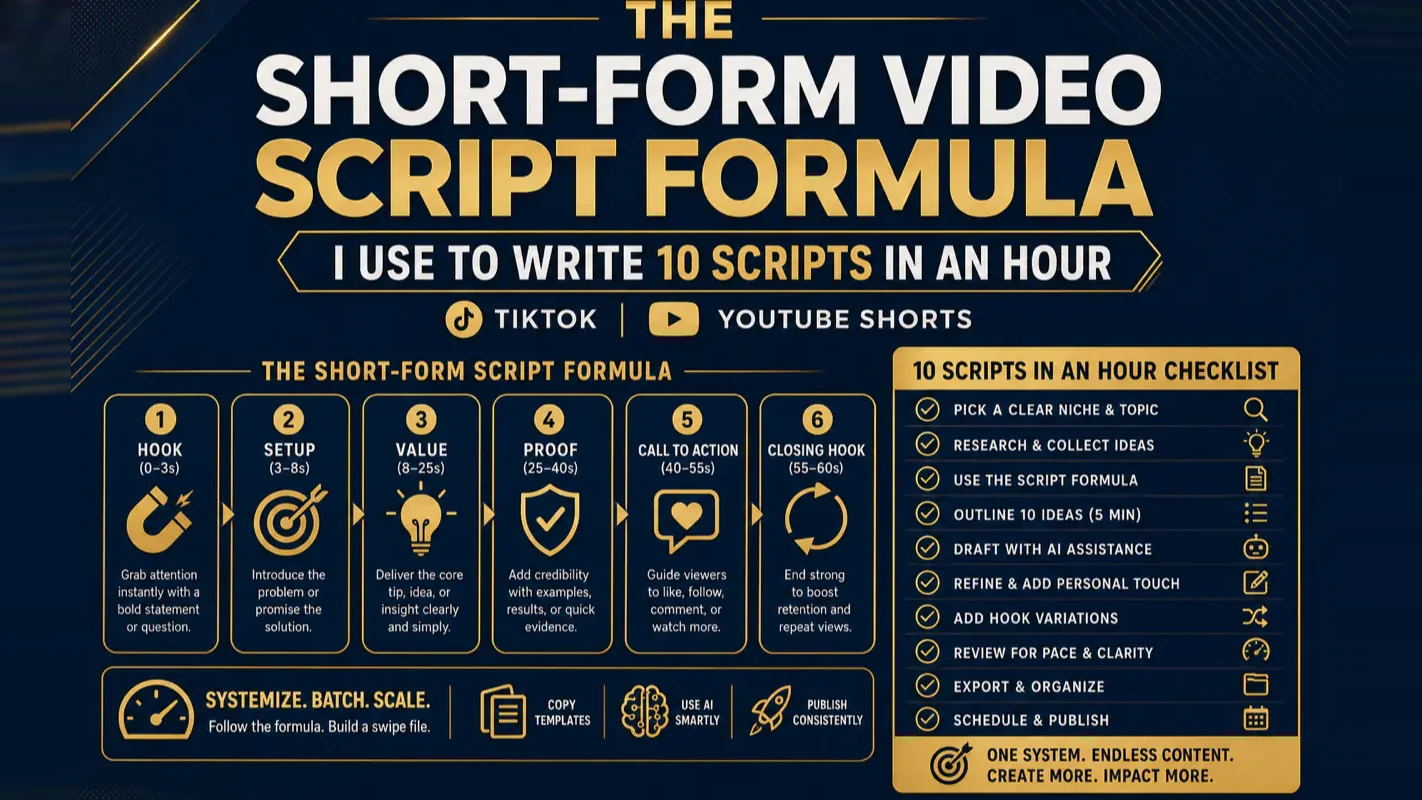
The Short-Form Video Script Formula I Use to Write 10 Scripts in an Hour
Thursday afternoon, fourteen product ideas, a Monday filming slot, no scripts. Six script shapes and seven hook formulas turn that hour into finished drafts — and the business rule stays: rewrite at least 30% before anything ships.
A viral short-form video script averages 150 words. Writing those 150 words takes longer than filming the actual video. Most creators stall not because they lack camera skills, but because they have no short-form video script formula -- no repeatable system for turning raw ideas into publish-ready scripts.
I spent six months building a repeatable formula that combines six proven script frameworks with AI-assisted drafting. The result: I now write 10 publish-ready scripts in about an hour, across TikTok, YouTube Shorts, and Instagram Reels.
This guide breaks down every piece of that short-form video script formula -- the script types, the hook frameworks, the AI prompts, and the platform-specific adjustments that make the same idea perform differently on each channel.
TL;DR
Six script types cover every short-form format: voiceover explainer, mini-drama, product review, edutainment, emotional story, and listicle
The first 3 seconds determine everything -- seven hook formulas give you a reliable starting point
AI writes the skeleton; you add the soul. Modify at least 30% of any AI draft before publishing
TikTok, YouTube Shorts, and Reels each demand different pacing, tone, and CTA placement
The biggest AI scripting mistake is feeding it a topic without platform rules and audience context
It is Thursday afternoon. Someone at a small brand has fourteen product ideas, a filming slot booked for Monday, and not one script. Filming was never the constraint — a hundred and fifty words per video is, repeated fourteen times, each opening needing a hook that survives three seconds. That hour is what this guide is written for: six script shapes, seven hook formulas, and a drafting prompt that produces the skeleton, with a hard rule that you rewrite at least thirty per cent before anything ships. Drafting is the step to hand over when you automate business processes around content. Deciding which fourteen ideas deserve a Monday is not.
Why Short-Form Video Scripts Still Matter in 2026
According to YouTube's official Creator Academy, YouTube Shorts now pulls over 200 billion daily views. Shorts engagement sits at 5.91%, outperforming both TikTok (5.75%) and Instagram Reels (~2%). On a vertical feed, viewers make the stay-or-swipe decision in under two seconds -- faster than they can read a full sentence.
These numbers point to one uncomfortable truth: your opening line carries more weight than your entire production budget. The same principle applies to YouTube titles and emotional hooks — the first words determine whether anyone watches at all.
Metric
Data
What It Means
YouTube Shorts daily views
200 billion
Short-form demand keeps growing
Average viral video retention
76% (vs. 73% normal)
A 3% retention gap creates massive reach differences
Shorts engagement rate
5.91%
Higher than TikTok and Reels
Optimal hook window
First 2-3 seconds
Miss it and viewers swipe
10% retention improvement
~25% more impressions
Retention is the algorithm's top signal
I was wrong about something important early on. I assumed script quality meant writing beautifully. It does not. Script quality in short-form video means writing efficiently -- every word must either hook, deliver value, or drive action. There is no room for transitions, warm-up lines, or "hey guys, welcome back" openers. Those phrases are the equivalent of handing viewers a reason to leave.
What Are the 6 Types of Short-Form Video Scripts?
Not every short video follows the same blueprint. After analyzing hundreds of high-performing videos across platforms, I categorize scripts into six distinct types. Each has its own structure, difficulty level, and sweet spot for AI assistance.
Script Type
Core Trait
Best For
Difficulty
AI Assist Level
Voiceover Explainer
High information density + narration
Tutorials, news breakdowns, faceless channels
Medium
High
Mini-Drama
Story conflict + twist ending
Comedy sketches, brand campaigns, emotional clips
High
Low
Product Review
Real experience + pros/cons balance
Unboxings, tool comparisons, honest reviews
Medium
Medium
Edutainment
Complex ideas made simple + metaphors
Fun facts, science explainers, myth-busting
Medium
High
Emotional Story
Emotional arc + universal resonance
Inspirational clips, human-interest pieces
High
Low
Listicle
Clear structure + direct info delivery
Top-5 lists, step-by-step tips, rankings
Low
Very High
These types are not mutually exclusive. Some of the best-performing short videos blend two or three -- a product review wrapped in a story, or edutainment delivered as a listicle. Hybrid formats tend to outperform pure ones.
If you are starting out, begin with listicles and voiceover explainers. They have the most predictable structure, the highest AI assistance potential, and the lowest risk of failure. Save mini-dramas and emotional stories for later -- those formats demand storytelling instincts that take dozens of published videos to develop.
How Do You Write a Hook That Stops the Scroll?
The hook is not a casual opening. It is a deliberately designed attention trap. I keep a library of seven hook formulas, and I pick the right one based on the script type and the platform I am targeting.
Hook Type
Example
Works Best For
Counter-intuitive fact
"90% of people charge their phone wrong"
Explainers, edutainment
Direct question
"Do you know why your feed gets more accurate every day?"
Tech breakdowns, tutorials
Suspense
"What I'm about to show you could change how you use AI"
Tool walkthroughs
Number shock
"This one AI tool saves me 40 hours a month"
Productivity, reviews
Pain point
"Ever spent all day writing scripts and none of them worked?"
Creator tips, workflows
Controversial take
"Posting daily is actually the worst strategy"
Strategy, opinion pieces
Urgency
"This free tool goes paid next month"
Tool recommendations
Here is what I learned after testing hooks across 200+ videos: the best hook type varies by platform. On TikTok, counter-intuitive facts and controversial takes perform strongest because they create instant cognitive friction. On YouTube Shorts, number shocks and direct questions win because the audience tends to be more information-driven.
My process: for every video, I write three to five hook variations, then pick the shortest and most punchy one. If a hook exceeds 10 words, I trim it. Viewers process roughly 2-3 words per second in the first moments of a video. Anything longer than 10 words risks losing them before the message lands.
The voiceover explainer formula
Structure: Hook (0-3s) --> Core information (dense value delivery) --> CTA (drive action)
This is the workhorse of faceless channels and the format where AI provides the most leverage. The script relies entirely on words -- visuals serve as support, not the main event.
AI prompt template for voiceover scripts:
You are a short-form video scriptwriter. Write a 60-second TikTok voiceover script.
Topic: [your topic]
Target audience: [describe who they are]
Requirements:
- Open with a strong hook (question / counter-intuitive fact / suspense)
- Provide 3 different hook variations to choose from
- Keep every sentence under 15 words
- High information density without feeling overwhelming
- Place a "mini-hook" at the 20-second and 40-second marks to prevent drop-off
- End with a clear call to action
- Conversational tone, like talking to a friend
- Note the estimated time (in seconds) for each line
Key production notes: Keep sentences under 15 words. Natural speaking pace for short-form runs 180-200 words per minute; longer sentences break that rhythm. Place a retention hook every 15-20 seconds -- lines like "but that's not even the best part" keep viewers who were about to swipe. And sync your visual cuts with your script transitions. When the narration shifts to a new point, the visuals should shift at the same moment. I mark [CUT] in my scripts at every topic transition and enforce it during editing.
A good 45-second drama completes a full emotional arc: empathy, tension, release. The writing challenge is compression -- telling a complete story in under 200 words.
Timestamp
Content
Purpose
0-5s
Character + predicament
Build empathy
5-15s
Conflict unfolds
Create tension
15-25s
Conflict intensifies
Push emotions higher
25-35s
Twist or reversal
Emotional peak
35-45s
Resolution + CTA
Leave an impression
My approach: write the story at two minutes first, then cut it to 45 seconds. The rule is ruthless -- if removing a sentence does not break the plot, the sentence goes. This compression process hurts, but it produces scripts with extraordinary density.
The listicle formula
The lowest barrier to entry. Structure is fixed, logic is linear, and AI can generate 80% of a usable draft.
AI prompt template for listicles:
Write a "5 [topic] tips" script for YouTube Shorts.
Requirements:
- Open with a counter-intuitive fact as the hook
- Rank tips from least to most important (save the best for last)
- Each tip = one summary sentence + one explanation sentence
- Use transition phrases between tips to build momentum
- End with a follow CTA
- Total length: 45-60 seconds
The secret to a good listicle is emotional escalation. Most beginners lay out items flat -- equal weight, equal energy. High-performing listicles build toward the finale. Use transitions like "but the next one is what actually changed things for me" to create a ramp. If the energy stays flat, viewers leave by item two.
How Do You Adapt One Script Across Platforms?
Posting the same video everywhere without adjustments is leaving views on the table. I tested this directly: platform-adapted content outperformed direct cross-posts by 40-60% in average views.
The adaptation does not require reshooting. It means adjusting the opening, tone, pacing, and CTA -- work that takes about ten minutes per platform.
Dimension
TikTok
YouTube Shorts
Instagram Reels
Best length
15-30 seconds
30-60 seconds
15-45 seconds
Tone
Extremely casual, fast energy
Slightly formal, info-rich
Polished, aesthetic
Hook style
Visual impact + text overlay
Question + suspense
Pain point + solution
CTA style
"Follow for more"
"Subscribe + bell"
"Save this + follow"
Caption placement
Center-top of frame
Bottom third
Flexible
My workflow: Write the YouTube Shorts version first (60 seconds, highest information density). Then:
Cut to 30 seconds for TikTok -- faster pacing, punchier language
Adjust tone and add visual polish notes for Reels
The core message stays identical; only the packaging changes
What Are the Biggest Mistakes in AI Video Scripting?
I have made every mistake on this list. Each one taught me something that AI tutorials rarely mention.
Mistake
What Happens
Fix
Asking AI to write the full script in one shot
Generic, personality-free output
Break it into steps: topic first, then outline, then script
Skipping audience context
Content misses the target viewer
Always include audience description in your prompt
Using the first draft as-is
Sounds like AI wrote it (because it did)
Edit at least 30% of the wording
Ignoring visual direction
Confusion during filming
Add shot descriptions directly in the script
No platform adaptation
Same content, inconsistent performance
One version per platform
Skipping the read-aloud test
Unnatural pacing, run-on sentences
Read every script out loud before filming
No data tracking
Cannot improve what you do not measure
Log retention rate and drop-off points per video
The TikTok Creator Portal echoes this finding. The deepest trap is paradoxical: AI scripts that sound too polished actually perform worse. AI generates grammatically flawless, logically smooth text. That perfection strips out the imperfections that make content feel human. Short-form audiences want warmth, personality, and even minor rough edges -- those signals tell them a real person is speaking.
My editing rule: after getting an AI draft, I deliberately add conversational fragments, replace formal phrasing with casual equivalents, and inject at least two lines of genuine personal experience. Changing "this method is highly effective" to "I tried this last week and it genuinely surprised me" is the kind of edit that transforms an AI skeleton into something viewers trust.
How Do I Actually Use AI in My Scripting Workflow?
Here is the exact sequence I follow for a batch session:
Step 1: Topic selection (5 minutes). I pick 10 topics from my content calendar. Each topic gets a one-sentence description and a target platform.
Step 2: Outline generation (10 minutes). I feed all 10 topics to AI with audience context and platform rules. The output is 10 outlines, each with a hook, three key points, and a CTA.
Step 3: Script drafting (20 minutes). I run each outline through a platform-specific prompt template. AI produces 10 rough drafts.
Step 4: Human editing (25 minutes). This is where the real work happens. I read each script aloud, mark anything that feels stiff, inject personal anecdotes, and trim to target word count. Every script gets at least 30% rewritten.
Total time: roughly 60 minutes for 10 scripts. That is the short-form video script formula in action -- AI handles the structural work (hook generation, information ordering, CTA phrasing) while I handle the personality layer. Neither works well without the other.
The Edutainment Script: Making Complex Ideas Simple
Edutainment scripts require a specific technique I call the three-layer translation:
Layer
Expression Style
Example (explaining "machine learning")
Technical
Jargon + formulas
Optimizing a loss function through training data
Plain language
No jargon
AI learns patterns by studying thousands of examples
Metaphor
Everyday analogy
Like a child who sees 1,000 cat photos and learns to recognize new cats
Short-form video uses the metaphor layer. Your audience does not need to remember terminology. They need to walk away thinking "oh, that's how it works." If your script requires explaining more than one technical term, the topic is too broad for a single short video -- split it into a series or find a tighter angle.
What Makes Emotional Scripts Go Viral?
Emotional short videos get shared 3-5x more than other types. The psychology behind sharing is not "this video made me feel something" -- it is "this video says something I want to express but cannot articulate myself."
Emotional Trigger
Example Theme
Sharing Power
Unexpected kindness
Stranger helping stranger
Extremely high (top share rate)
Loss and recovery
Reunion after years apart
High
Underdog reversal
From rock bottom to success
High
Cross-generational love
Parents and children
Extremely high (top save rate)
The selection criterion for emotional topics is not "what story is most moving" but "what emotion do most people want to express but feel awkward saying directly." A clip about a parent's quiet sacrifice gets shared massively because the person sharing it is using the video to tell their own parent "I noticed."
Ready-to-Use Prompt: Generate a Platform-Ready Short-Form Video Script
What this does: Takes a raw idea, sorts it into one of six script types, writes a 3-second hook from seven formulas, drafts a tight ~150-word script, and adapts it across TikTok, YouTube Shorts, and Instagram Reels. Based on: The Short-Form Video Script Formula I Use to Write 10 Scripts in an Hour — https://aiworkflowpro.com/ai-short-video-script-guide-tiktok-youtube/ Time to run: ~3 minutes
Copy this prompt into Claude Code, ChatGPT, or any AI assistant:
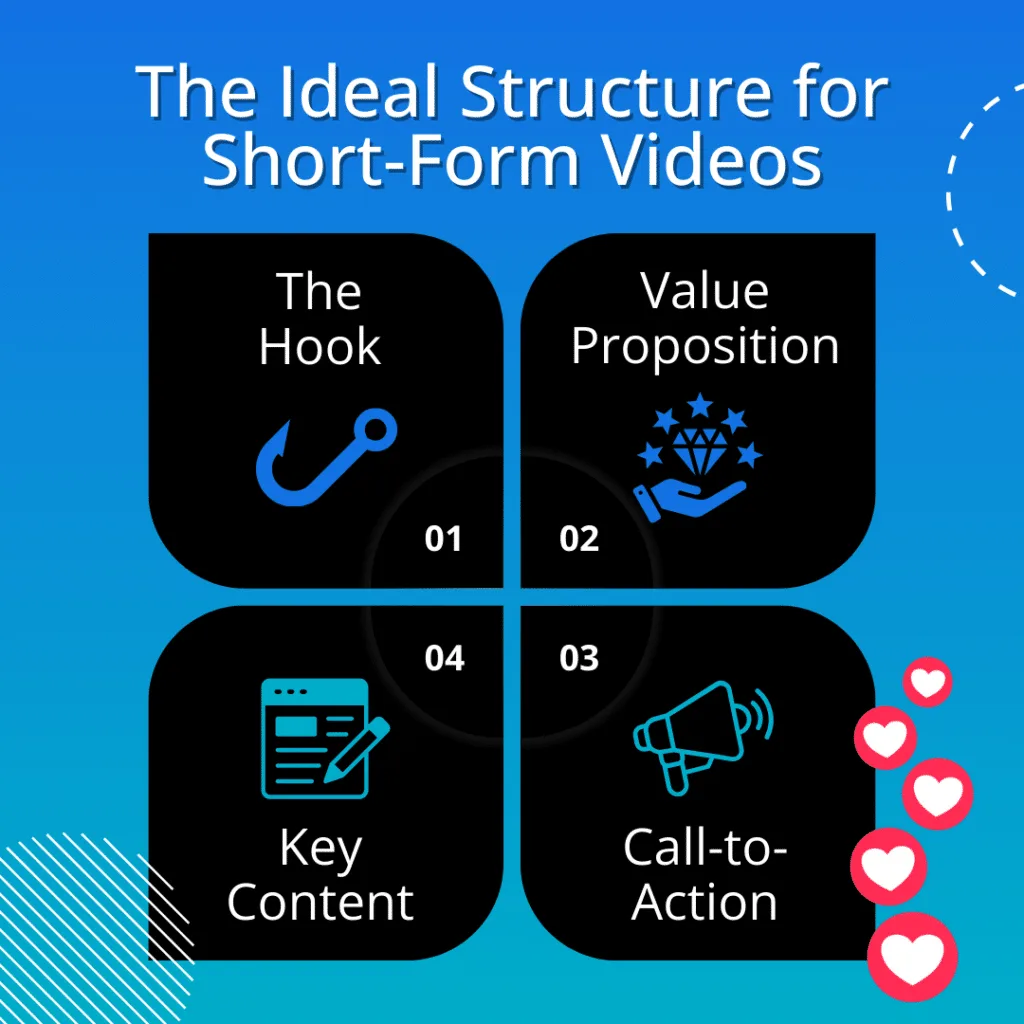
ROLE: You are a Short-Form Video Script Writer. Your job: turn a raw idea into a tight, hook-led, ~150-word script and adapt it across platforms — fast enough to draft ten in an hour.

CONTEXT — SHORT-FORM SCRIPT FORMULA:
A viral short-form script averages about 150 words, and writing those 150 words takes longer than filming — creators stall without a repeatable formula. The formula combines six script types (voiceover explainer, mini-drama, product review, edutainment, emotional story, listicle) with seven hook formulas that win the first 3 seconds, the only part that decides if anyone watches. Draft one script per type against a fixed hook → setup → payoff → CTA structure, then adapt the same idea across TikTok, YouTube Shorts, and Instagram Reels with platform-specific tweaks. AI accelerates the drafting, but the writer — not the model — picks the type and the hook.

INPUTS (fill in before running):
- IDEA: [The raw idea or topic for the video]
- PLATFORMS: [Which platforms — TikTok / YouTube Shorts / Instagram Reels]
- AUDIENCE: [Who the video is for]
- ANGLE: [Any tone or constraint — e.g. deadpan, ≤30 seconds, no on-camera face]

METHOD — 4 STEPS:

Step 1 — Classify the Idea into One of 6 Script Types
Match IDEA to the best-fitting type: voiceover explainer, mini-drama, product review, edutainment, emotional story, or listicle. State the type and one line why it fits IDEA and AUDIENCE.

Step 2 — Pick a Hook Formula and Write the First 3 Seconds
Choose one of seven hook formulas: (1) Contrarian — "Everyone says X; they're wrong"; (2) Mistake — "You're doing X wrong"; (3) Number — "3 things that…"; (4) Curiosity — "This cost me $X"; (5) Question — "Ever wonder why…?"; (6) Bold Result — "I did X in Y time"; (7) Pattern Interrupt — a stop-scroll line. Write the first 3 seconds, 15 words or fewer.

Step 3 — Draft the Full ~150-Word Script
Write the full script in the chosen type's structure: hook → setup → payoff → CTA. Hit 130–170 words. Score it 0–2 on three dimensions — hook strength, payoff delivery, CTA clarity — and regenerate any dimension scoring 0.

Step 4 — Adapt Across Platforms
For each platform in PLATFORMS adjust: TikTok (trend-native captions, 15–60s), YouTube Shorts (searchable title, payoff-first, ≤60s), Instagram Reels (aesthetic framing, 15–30s). State the per-platform length and one framing change.

RULES:
- Never let the hook exceed 3 seconds or 15 words — the opening decides retention.
- Never exceed ~170 words — short-form scripts are tight by definition.
- Never copy the same script verbatim across platforms — each gets a framing tweak.

OUTPUT FORMAT:
Output a markdown report with:
1. Script Type + Hook — the chosen type, the hook formula, and the 3-second line
2. Full Script — the ~150-word script inside a fenced text block, with the word count
3. Quality Score — markdown table, columns: Dimension | Score (0–2) | Note
4. Platform Adaptations — markdown table, columns: Platform | Length | Framing Change
Save as @templates/ai-short-video-script-guide-tiktok-youtube.md and run whenever you turn a raw idea into a publish-ready short-form script.
Frequently Asked Questions
How long should a short-form video script be?
For TikTok, target 50-100 words (15-30 seconds of spoken content). For YouTube Shorts, 100-200 words (30-60 seconds). For Instagram Reels, 50-150 words (15-45 seconds). The natural speaking pace for short-form content is 180-200 words per minute, so a 60-second Shorts script lands around 180 words. Keep individual sentences under 15 words -- anything longer breaks the conversational rhythm that short-form audiences expect.
Can AI fully replace human scriptwriters for short videos?
Not yet, and I do not see that changing in the next few years. AI excels at structure -- generating hook options, organizing information logically, producing multiple draft variations quickly. What it cannot do is judge what will resonate with a specific audience, deliver timing that lands a joke, or inject the kind of authentic personal experience that builds viewer trust. The winning formula treats AI as a drafting partner that handles 60-70% of the structural work, while you contribute the 30-40% that gives the script a voice.
What is the best hook formula for TikTok videos?
Counter-intuitive facts and controversial opinions consistently outperform other hook types on TikTok. They work because TikTok's ultra-fast scroll environment rewards cognitive friction -- statements that make a viewer pause and think "wait, really?" For YouTube Shorts, number-driven hooks and direct questions perform better because the audience leans more informational. My workflow: write 3-5 hook variations for every video and select the shortest one. If a hook exceeds 10 words, it needs trimming.
How many short video scripts can you write per day with AI?
With a refined system, 10-15 rough drafts per hour is realistic. But raw drafts are not publish-ready. Each script requires 15-20 minutes of human editing for voice, accuracy, and platform fit. In a focused 3-4 hour session, expect 5-8 scripts that are genuinely ready to film. Quality matters more than quantity -- one video that retains 76% of viewers will outperform ten videos with 50% retention every time.
What to do next: Pick one script type from this short-form video script formula guide -- I recommend listicles if you are just starting. Use the AI prompt template to generate three variations. Read them aloud, edit the best one, and publish it. You do not need a perfect script. You need a shipped script, because audience feedback teaches faster than any formula.
A 30-minute video is too long for one conversation. This guide walks the 8-step Skill that locks the narration and one look, then gives each 3-minute segment to a fresh sub-agent, five at a time, and polishes the cut in an empty-context session.
The folder structure behind my AI agent team, the Herdr setup where Grok Build, Claude Code and Kimi Code work side by side, and the two live tasks from the video: an article published by voice and a three-model front-end test.
Eight folders of plain Markdown, a CLAUDE.md index in each, and seven prompts that make your agent interview you. Every prompt, template and command from the video, in order.
Stop briefing your AI from scratch. One free folder holds your background, your rules and your voice. Eight prompts build it, no code, and any AI can read it.