Monitoring a competitor who publishes no feed is the case every RSS guide skips. Twenty-one platforms sorted by which of three jobs they do, and the finished setup is business process automation you own outright, with no seat licence to renew.
Blaming the content is the reflex when a post underperforms, and it is usually the wrong diagnosis. A second reader decides distribution before any human sees the post, and most of what it checks is mechanical enough to automate business processes around, on five platforms at once.
Gloves on, tape measure in hand — nobody types a query. Three voice surfaces for ai automation tools (terminal, Telegram, Discord), 10 TTS and 6 STT providers compared on cost and latency, plus a setup that costs nothing.
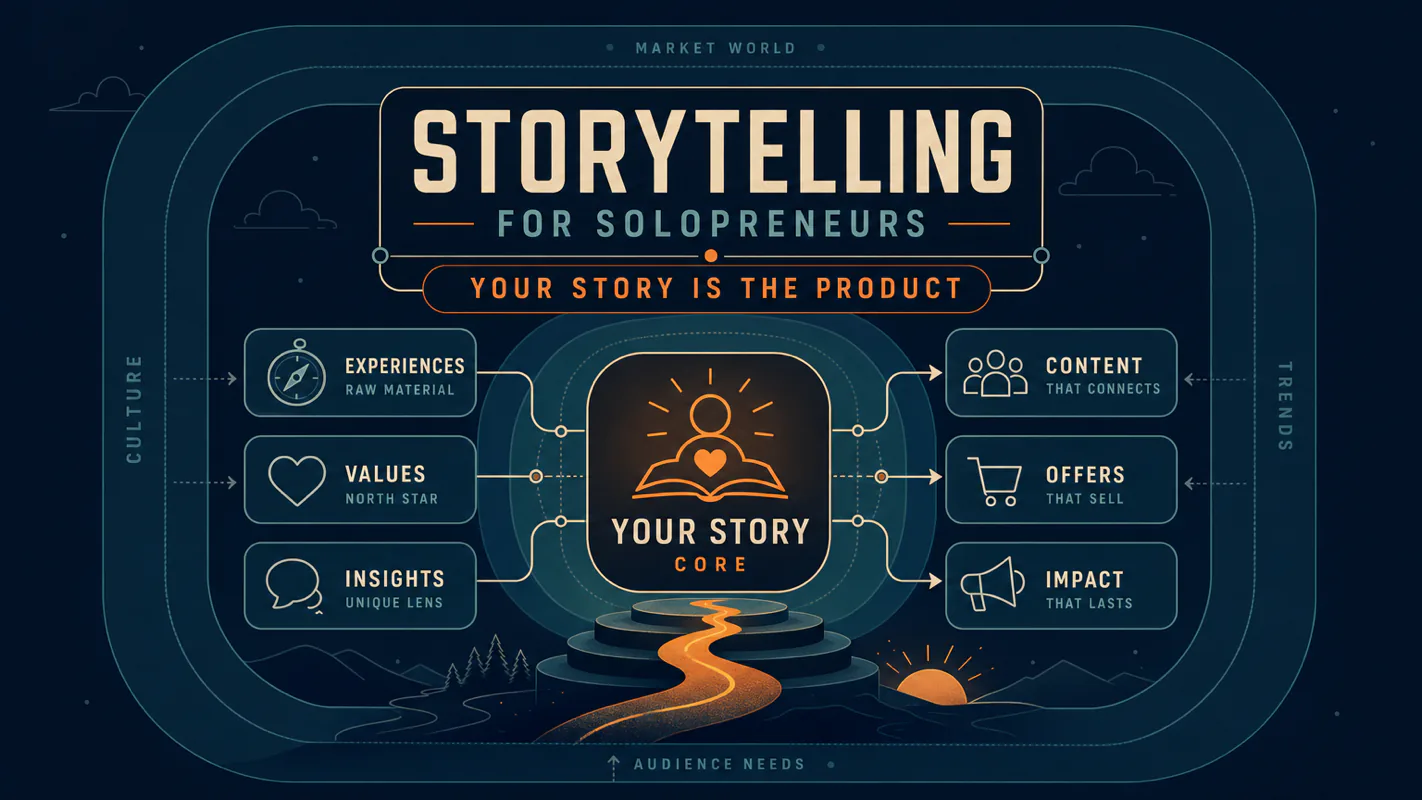
Storytelling for Solopreneurs: Your Story Is the Product
Your story is not an About page decoration. It is the sequence that lets a stranger decide whether your small business understands their problem. Customer as hero, you as guide, the offer as the plan, plus a one-liner, a five-second clarity test, and the page order that follows from it.
Your story is not an About page decoration. It is the structure that helps a stranger understand why your offer matters.
For a solopreneur, story has three jobs: make the customer feel seen, make your judgment credible, and make the next step obvious.
The cleanest frame is simple: the customer is the hero, you are the guide, the offer is the plan.
Below is the full system: StoryBrand, the Epiphany Bridge, One-Liner, 5-second clarity test, landing page order, and AI prompts for building the whole story workspace.
A bookkeeping practice rebuilt its site and opened the page with a founder paragraph: twelve years in corporate finance, a CPA, a move back home in 2019. Traffic held. Inquiries went to nearly zero. Nothing on that page was false. It was in the wrong order, answering who am I before answering is this for me. Story here is not decoration or founder mythology. It is sequence -- the arrangement that lets a stranger decide, in about five seconds, whether you understand their problem and what to do next. The frames below fix the order. The founder paragraph gets to stay, later.
In Part 1, we made the case for the one-person business. In Part 2, we picked the thing. In Part 3, we built the personal brand foundation.
Now comes the part most solopreneurs avoid because it feels soft.
Story.
Not fiction. Not founder mythology. Not the long About page where you explain every career turn since college.
I mean story as a business tool.
The way you arrange information so a stranger can answer four questions quickly:
Is this for me?
Does this person understand my problem?
Do I trust the plan?
What do I do next?
If your page, profile, pitch, or offer cannot answer those four questions, the buyer does not think "interesting but unclear."
They leave.
Storytelling for Solopreneurs in 2026: A Market Snapshot
The opportunity to tell a clear founder story is bigger than ever. So is the noise.
The macro signal: Donald Miller's Building a StoryBrand has crossed 1 million copies sold since its 2017 release, and the StoryBrand Guide Certification currently costs $9,999. Translation: businesses keep paying to install one specific story shape into their messaging because feature lists alone do not move buyers.
The search-side signal: a 2026 spot check for "storytelling for solopreneurs" mostly returns generic brand-storytelling guides (Magnt, InfluenceFlow, Outbrand, Brainz Magazine, and others). The common pattern frames story around abstract "pillars" and feeling: emotional connection, authenticity, hero's journey.
None of them attach the framework to a working file system you can run on Monday morning. None of them ground their advice in real revenue numbers from the founders they cite. The gap is not "more storytelling theory." The gap is a story system that turns the strategy into pages, profiles, and offers a buyer can act on. That is what this guide is.
Why Story Is Sequence, Not Decoration
Everyone says story is something you add after the useful work is done. Actually, the order is the work. The sequence buyers see is the story.
Here's why this matters: a beautiful bio inside a poorly sequenced page never converts. A plain bio inside a clean buyer-first sequence usually does.
The failure mode I have watched most often in solo founders looks the same. They spend three weeks rewriting the About page: tightening the bio, swapping verbs, hunting for the right adjective, but never touch the hero section. Six months later the page reads beautifully and still does not convert, because no stranger ever needed a more poetic founder bio. They needed to know who the offer was for and what it changes. The polish was real work, just not the kind that moves a buyer forward.
First the product. Then the features. Then the price. Then, if there is room, a nice human story somewhere near the bottom.
That order sounds rational. It is also why many pages feel cold.
The opposite mistake is just as bad. Some founders hear "story sells" and start the page with their childhood, their values, their struggle, their why, their late-night coffee, their dog, and the moment they "knew they had to build this."
Now the page feels human, but the buyer still does not know what is being sold.
So let me make the rule clear:
Story does not mean starting with your life story. Story means organizing the buyer's problem, risk, guide, plan, and future in the right order.
That is the difference.
One Reddit founder described the tension perfectly. Their transactional landing page was performing modestly, but people loved the more human About page. They wondered whether the landing page should start with shared human problems and history, or stay focused on product benefits and CTA.
The answer: start with buyer clarity. Then earn the founder story.
Before this rule, you write a poetic About page that converts at 0%. After: you write a useful hero section that converts, and the About page becomes a deepening signal for buyers who already trust the offer.
If you've been stuck rewriting the same About paragraph for three weeks, skip ahead to the landing-page order table below. If you're starting from scratch, read on.
The page order should usually look like this:
Page moment
What the buyer needs
Story role
First screen
What is this, who is it for, what result do I get?
Make the buyer the hero
Pain section
Does this person understand my problem?
Name the conflict
Guide section
Why should I trust you?
Show empathy and competence
Plan section
What happens if I say yes?
Reduce risk
Founder/story section
Why did you build this and why do you care?
Build deeper trust
CTA
What should I do now?
Move the story forward
FAQ/objections
What might go wrong?
Remove fear
That is story.
It is not fluff.
It is sequence.
Why Story Beats Feature Lists on a Solopreneur Landing Page
Your reader is filtering.
Every second, they are deciding what matters and what can be ignored. A list of features forces them to do the organizing work:
Which feature matters to me?
Which pain does this solve?
Why should I trust it?
What happens if I try it?
What happens if I do nothing?
Most people will not do that work for you.
A story structure reduces the load. It gives the brain roles, conflict, movement, stakes, and resolution.
This is why Stanford GSB teaches founder storytelling as a practical founder skill, not a creative luxury. In its entrepreneurship communication material, Stanford frames a new venture as a set of hypotheses: who the customer is, what pain point you solve, how you solve it, how you go to market, and how you make money. Story helps people understand those hypotheses in a way they can remember and test.
The classroom evidence is sharper than the often-quoted folk wisdom about story. In Made to Stick, Chip and Dan Heath describe a Stanford experiment: ten minutes after a series of one-minute pitches on inner-city crime, only 5% of students could recall any individual statistic, but 63% remembered the stories. The widely circulated "stories are 22 times more memorable than facts" claim, by contrast, has no traceable academic source. The honest takeaway is the smaller and better one: when memory has to choose between a stat and a scene, the scene wins by an order of magnitude.
For a solopreneur, that matters even more.
You do not have a big brand behind you.
You do not have a sales team.
You do not have a long procurement process where six people can explain the offer.
Often, you have one page, one profile, one email, one DM, one intro call.
If the story is unclear, the business feels unclear.
What Real Founder Stories Do for a Solopreneur Business
This is the part where many articles about storytelling stay too abstract. They say "tell your story," but they do not show what a useful founder story does in the market.
For storytelling for solopreneurs, the test is simple:
Does the story make the buyer understand the problem, the method, and the next step faster?
If not, it is just content.
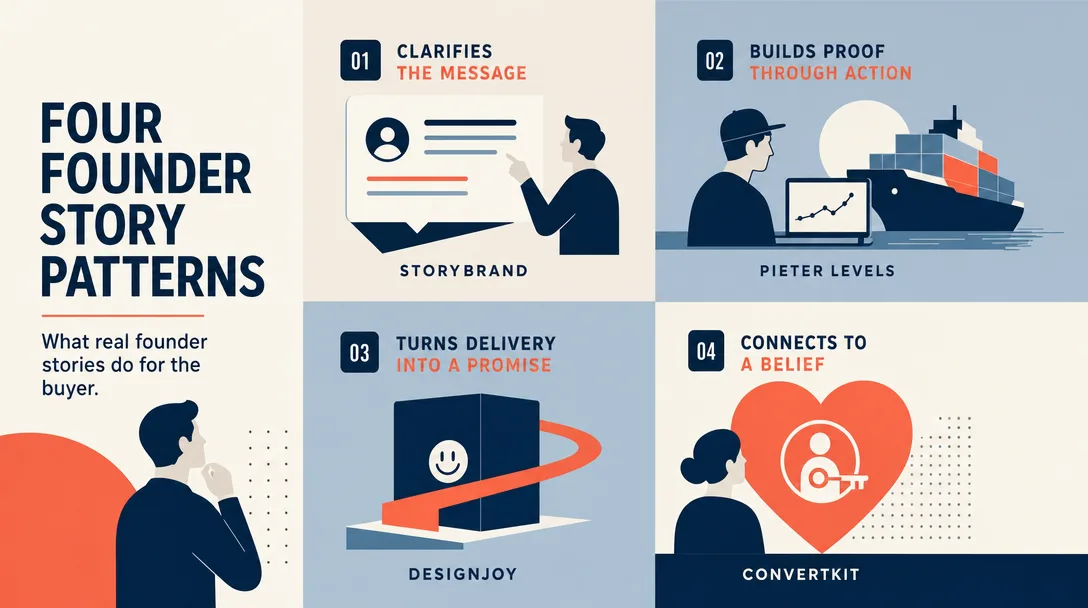
Here are four real examples worth studying.
StoryBrand makes the customer the hero.
Donald Miller's StoryBrand framework became popular because it gives businesses a clean way to stop talking about themselves first. The structure is simple: the customer wants something, faces a problem, meets a guide, gets a plan, is called to act, avoids failure, and reaches success. That is not just a copywriting trick. It is a brand storytelling framework that forces the founder to answer the buyer's question before the founder's ego gets involved. The numbers anchor it: Building a StoryBrand has crossed 1 million copies sold since its 2017 release, and the StoryBrand Guide Certification currently costs $9,999. Proof that businesses keep paying to install one specific story shape into their messaging.
For a solopreneur, the method is useful because it keeps the page from becoming a biography. The buyer does not need your full life story on the first screen. They need to know whether you understand the problem and can guide them to a safer result.
Pieter Levels turns visible shipping into the story.
Pieter Levels is remembered less for a polished origin story and more for a public pattern: build, launch, show the work, learn from the market, and keep what survives. His "12 startups in 12 months" project made the process itself memorable. Nomad List and Remote OK later became proof that the story was not only about ambition; it was about repeated public execution.
The method to copy is not "launch 12 startups." Most people should not. The useful lesson is that a technical founder can make the artifact carry the story. If you build in public, the product, changelog, revenue notes, failed attempts, and user feedback become a trust trail.
Designjoy productizes the founder's skill.
Designjoy is a strong example for service-based solopreneurs because the story is not "Brett Williams is a talented designer." The stronger story is: design can be bought like a subscription, requested through a queue, delivered without the usual agency friction, and run by one focused designer. The official positioning says Designjoy is still run entirely by Brett, and Latka's tracker puts the operation at $3.1M in 2024 revenue from a one-person team, currently priced at $4,995/month (regular $5,995). That makes the operating model itself part of the brand.
That is solopreneur branding at its best. The founder is visible, but the buyer remembers the delivery model. This is exactly what many solo consultants miss. They write about their values and experience, but they never turn the way they work into a named promise.
Kit/ConvertKit makes the creator the hero.
Nathan Barry's ConvertKit story is useful because the brand is not framed as "email software with features." The long-running idea is that creators should own their audience and earn a living from their work. Even the rebrand story around Kit points back to creators, fans, and audience ownership. By Barry's own 2024 year-end review, Kit ended 2024 at roughly $46M in annual revenue with ~49,000 paying customers (founder-reported), narrowly missing his $53M target. Sacra's independent estimate puts end-of-year ARR at $43M (14% YoY from $38M in 2023). The gap reflects the difference between annual revenue and end-of-year ARR; both numbers point to the same picture: a creator-economy SaaS at meaningful scale. The story travels in either telling, because the product is the plan, but the creator is the hero.
For a solo founder, this is the difference between "I built an email tool" and "you should not have your livelihood trapped inside an algorithm you do not control." The second version gives the buyer a problem, a risk, a belief, and a future.
The pattern across these examples is clear.
Example
Story job
Method to copy
StoryBrand
Make the buyer the hero
Lead with the customer's want, problem, plan, and success
Pieter Levels
Turn public shipping into proof
Let the work, failures, and iterations become the trust trail
Designjoy
Make the delivery model memorable
Productize the skill into a promise buyers can repeat
Kit/ConvertKit
Connect product to buyer identity
Tie the feature set to a larger belief the customer already cares about
None of these examples works because the founder "shares more." They work because the story does a job.
That is the standard for this article.
How to Borrow Founder Story Methods Without Copying the Person
The wrong way to use examples is to copy the surface.
You see Pieter Levels publish revenue screenshots, so you publish revenue screenshots even when you have no audience, no product, and no reason for the reader to care.
You see Designjoy use a subscription model, so you add a monthly plan to a service that still needs custom discovery, custom scoping, and custom delivery every time.
You see Kit talk about creators owning their audience, so you write a manifesto before you have named the specific risk your buyer is trying to escape.
That is cargo-cult storytelling.
The better move is to copy the function, not the form.
Ask these five questions:
What problem does this story make easier to understand?
What risk does it reduce for the buyer?
What belief does it make more memorable?
What behavior does it ask the buyer to take?
What proof makes the story believable?
When you answer those questions, the examples become useful.
Pieter Levels is not useful because every solopreneur should become a public indie hacker. He is useful because his story shows how visible work can replace abstract credibility. If you are a solo AI consultant, your version might be a public teardown of one workflow every week. If you are a newsletter operator, it might be a monthly "what I tested and what failed" post. If you are a template seller, it might be a changelog that shows how user feedback changed the product.
Designjoy is not useful because every service should become "unlimited requests." It is useful because Brett made the buying model easy to remember. A solo editor might say, "one draft in, one edited version out, within 48 hours." A Notion consultant might say, "one messy workspace becomes one clean operating dashboard in two weeks." A launch strategist might say, "one offer, one landing page, one email sequence, one test group." The story is the delivery shape.
Kit is not useful because every creator needs email software. It is useful because the product story is tied to a belief the buyer already feels: rented audiences are fragile. That gives the feature set emotional weight. A solopreneur can do the same without becoming dramatic. If you sell a course, the belief might be "people should not need a full agency to launch a serious project." If you sell templates, the belief might be "good operators should not rebuild the same system from scratch every month." If you sell coaching, the belief might be "a founder should not stay stuck because they cannot hear their own message clearly."
This is where storytelling for solopreneurs becomes practical.
You are not looking for a famous founder to imitate. You are looking for a story function your business needs.
If your offer feels...
Borrow this story function
What to build
Too abstract
StoryBrand's buyer-first sequence
A clearer customer-problem-plan-success page
Unproven
Pieter Levels' visible work trail
A public archive of attempts, decisions, and iterations
Too custom
Designjoy's productized delivery model
A named process with a simple queue, scope, or timeline
Too feature-heavy
Kit's buyer-belief story
A sharper reason the buyer should care now
The test for any example you borrow is the Monday-morning test: could a real solopreneur use this on Monday to fix their About page, hero section, or sales email? If yes, it belongs in your story system. If no, it is decoration, even if the founder behind it is famous.
The Core Flip: Your Customer Is the Hero, Not You
This is the most important sentence in the whole article:
Your customer is the hero. You are the guide.
This is the rule for most solopreneur offers. The exception is the personal-brand creator whose audience genuinely follows them for who they are — Oprah, Joe Rogan, Naval. If that is your model, your bio can carry the page. Most solo operators are not in that category until they have proof, and pretending to be early is what makes pages feel forced.
Most solopreneurs get this backwards.
They talk like this:
"I built..."
"I believe..."
"My method..."
"My journey..."
"My years of experience..."
"My product..."
None of that is wrong. But if it appears too early, the buyer has to fight for space inside your story.
A customer does not wake up hoping to join your founder journey.
They wake up with a problem.
They want the problem to end.
Your job is to enter their story as the person who understands the terrain and can point to a safer path.
Here is the practical difference:
Founder-as-hero copy
Guide copy
"I spent 10 years mastering content strategy."
"You need a content system you can run even when client work gets busy."
"My framework combines psychology and AI."
"You get a clear message, a simple plan, and reusable prompts."
"I left corporate to follow my passion."
"If your story feels scattered, this gives it a buyer-ready structure."
"I built the best tool for solo founders."
"You can test demand before you waste another month building in private."
Notice the guide copy is not humble in a weak way.
It is strong because it is useful.
Yoda does not need to tell Luke his full resume.
He shows Luke the path.
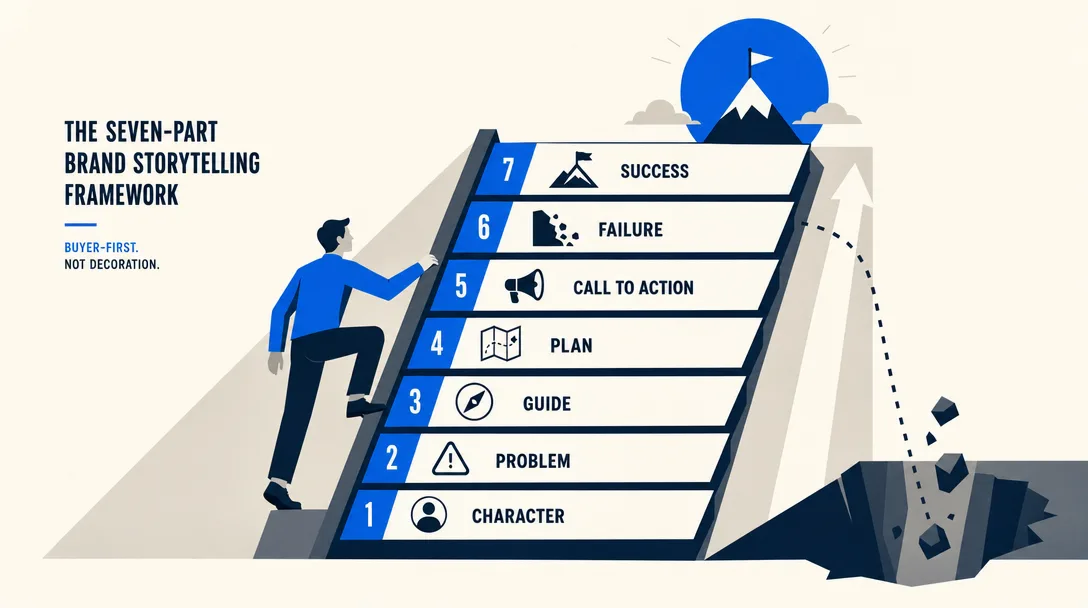
The Seven-Part Brand Storytelling Framework
The StoryBrand framework is useful because it turns fuzzy messaging into a sequence.
The simplified version:
A character wants something, faces a problem, meets a guide, receives a plan, is called to act, avoids failure, and reaches success.
For solopreneurs, I would translate it like this.
Step
Question
What to write
1. Character
What does your customer want?
A concrete outcome, not a vague desire
2. Problem
What blocks them?
External, internal, and philosophical pain
3. Guide
Why should they trust you?
Empathy plus proof
4. Plan
What simple path do they follow?
3-4 steps
5. Call to action
What should they do now?
Direct and transitional CTA
6. Failure
What happens if nothing changes?
The cost of delay
7. Success
What does life look like after?
A specific future scene
Each step in detail.
1. Character: what does your customer want?
Do not start with what you sell.
Start with what your customer wants.
Weak:
I sell a brand storytelling workshop.
Better:
You want strangers to understand why your offer matters in under five seconds.
Weak:
I help with AI automation.
Better:
You want a one-person business that ships every week without turning your life into a task board.
The customer want must be concrete enough to test.
If the reader cannot picture the result, it is not clear enough.
2. Problem: name all three layers
Most people only write the external problem:
"Your landing page does not convert."
"Your offer is unclear."
"Your story is scattered."
That is useful, but incomplete.
You need three layers.
Layer
Meaning
Example
External
The visible problem
The landing page does not explain the offer clearly
Internal
How it feels
You feel competent, but strangers do not seem to get it
Philosophical
What should not be true
Good work should not be ignored because the message is muddy
The internal layer is where trust starts.
If you can describe the buyer's private frustration better than they can, they assume you understand the work.
The philosophical layer gives the story weight.
Not melodrama. Weight.
3. Guide: empathy plus proof
A guide needs two things:
Empathy: I understand the problem.
Competence: I can help.
Many solopreneurs choose only one.
Empathy without proof feels nice but weak.
Proof without empathy feels impressive but cold.
Use both.
Examples:
Empathy
Proof
"I know how frustrating it is when your work is strong but your page sounds generic."
"This same story audit gets applied to public posts before they ship."
"I know the feeling of rewriting a bio 20 times and still hating it."
"The framework below turns the message into eight markdown files."
"I know you do not want to become a hype marketer."
"The 5-second test keeps the story clear without making it fake."
You do not need to sound like a giant agency.
You need to sound like someone who has been there and can guide the next step.
4. Plan: put stones across the stream
Buying feels risky because the path is unclear.
Your plan reduces that risk.
For a solopreneur offer, the plan should be short:
Clarify the customer and problem.
Write the story structure.
Turn it into a page, profile, or offer.
Test it with real people.
That is enough.
Do not give people a 17-step process before they trust you. A long plan looks thorough to you and exhausting to them.
5. Call to action: ask clearly
Your reader should never have to hunt for the next step.
Two types of CTA matter:
CTA type
Purpose
Example
Direct
The business action
Book a story audit
Transitional
Low-risk trust step
Download the BrandScript worksheet
The direct CTA should use action language.
Not "Learn more."
Not "Get in touch."
Use the next action:
Book a call
Start the audit
Download the worksheet
Join the course
Get the template
If that feels pushy, check whether the offer is clear. Clear CTAs feel pushy only when the promise is vague.
6. Failure: use fear like salt
If nothing bad happens when the customer ignores you, there is no reason to act.
But fear has to be used carefully.
Too much fear feels manipulative.
No fear feels irrelevant.
For this topic, the failure is simple:
People keep misunderstanding what you do.
Your page gets traffic but no trust.
You keep explaining on calls what the page should have explained.
You build more product because the story did not sell the current one.
You sound like everyone else in your category.
That is enough salt.
7. Success: paint the after picture
Do not stop at "clearer messaging."
Show the result.
Before
After
Your page starts with a clever line
Your page says who it helps and what changes
Your story is hidden on the About page
Your story supports the buyer's decision
Your offer sounds like a list of features
Your offer sounds like a path out of a problem
People ask "so what do you do?"
People repeat your one-liner back to you
Sales calls start cold
Sales calls start with context
That is the product.
Not the story itself.
The clarity the story creates.
Where the Founder Story Belongs: After Buyer Relevance
Here is the landing page rule I would use:
The buyer story comes before the founder story.
That does not mean hiding the founder.
It means earning attention first.
If your first screen is all founder story, a cold visitor may not know whether they are in the right place. But if your first screen names their problem clearly, the founder story becomes useful later because it answers a different question:
Why are you the right guide?
So the order is:
Customer problem.
Desired result.
Simple plan.
Proof.
Founder story as guide credibility.
CTA.
FAQ and objections.
A founder story should not be a biography.
It should be a bridge between the customer's pain and your guide role.
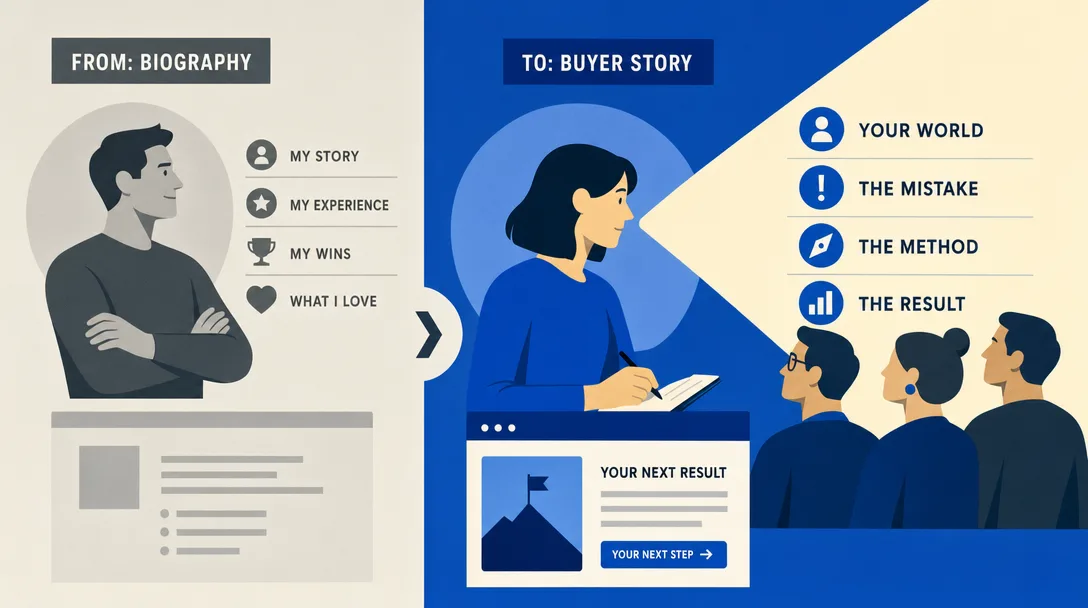
Worked Example: From Solopreneur Biography to Buyer Story
Back when landing-page convention meant a long About-first design, the bottleneck was attention span. Now the bottleneck is the same one Stanford GSB has been teaching since the early 2010s: a stranger needs to know who, what, and why-now before any biography earns the right to land.
Most solopreneur About sections start like this:
I am a strategist, writer, and consultant with ten years of experience helping startups, creators, and small businesses grow. I am passionate about clarity, systems, and meaningful work. After working with dozens of clients, I created my own framework to help founders tell better stories.
Nothing there is evil.
It is also forgettable.
The buyer has to translate every phrase:
"strategist" into what kind of help?
"clarity" into what kind of outcome?
"systems" into what kind of work?
"meaningful work" into what kind of decision?
"better stories" into what changes on the page?
Now rewrite it through the buyer's problem:
Most solo founders do not have a story problem. They have a sequence problem. They explain their background before the buyer understands the offer, so the page feels human but still unclear. I help them turn scattered founder experience into a buyer-first landing page: problem, proof, plan, story, and CTA. The result is a page a stranger can understand in five seconds.
This version is less poetic.
It is much more useful.
It names the buyer, the mistake, the method, and the result. It also shows the founder's judgment without forcing the reader through a full career history.
Here is the same rewrite as a landing page block:
Section
Weak version
Buyer-first version
Hero
"Tell your story with confidence."
"Turn your founder story into a landing page buyers understand in five seconds."
Problem
"Your brand deserves to be seen."
"Your page sounds professional, but strangers still cannot tell what you do."
Guide
"I have ten years of brand strategy experience."
"I have seen strong solo founders lose trust because their story appears before the buyer knows why it matters."
Plan
"We create your brand narrative."
"We clarify the buyer, rewrite the story order, and test the page with real readers."
CTA
"Get in touch."
"Book a 45-minute story audit."
The difference is not vocabulary.
The difference is responsibility.
The weak version asks the buyer to interpret. The strong version does the interpreting for them.
You can use the same move on a LinkedIn bio:
Weak:
Founder storytelling coach. Helping creators and entrepreneurs tell better stories.
Better:
I help solo founders turn messy experience into landing pages, bios, and offers buyers can understand in five seconds.
You can use it in a sales email:
Weak:
I wanted to share my background and why I built this.
Better:
I built this because I kept seeing the same problem: strong solo founders had useful products, but their pages made strangers work too hard to understand the offer.
You can use it in a podcast intro:
Weak:
Tell us your founder journey.
Better:
Tell us the moment you realized your customers did not need more features. They needed a clearer path through the problem.
That is the point of a brand storytelling framework. It gives your story a job before it gives it a style.
The Epiphany Bridge: A Founder Story That Makes the Method Click
The eight-part Epiphany Bridge comes from Russell Brunson's Expert Secrets. Brunson tells the ClickFunnels origin story the same way every time, and it is itself the cleanest example of the framework: he was the non-technical marketer drowning in developer fees. The product only existed because Todd Dickerson, the technical co-founder who had already worked with Brunson largely for free in 2011-2012, agreed to build it with him in 2013. They launched in October 2014, took zero outside money, and by 2023 had crossed $265M in annual revenue with 150,000 paying customers. That is a believable founder story because it names a real wall (developer fees), a real partner (Todd), and a real result (a product the founder could not have built alone).
The Epiphany Bridge is a story that lets the reader experience the same turning point you experienced.
It is not:
"Here is my background."
"Here is why I am passionate."
"Here is my inspirational journey."
It is:
I believed X. Then Y happened. I realized Z. That changed what I built.
That structure matters because people rarely buy from logic alone. They feel the shift first, then use logic to justify the decision.
Here is the eight-part script.
Step
Question
Keep it concrete
1. Before
Where were you before the realization?
Scene, not summary
2. Desire
What did you want?
External goal plus internal pressure
3. Wall
What was not working?
Specific failure
4. Epiphany
What did you realize?
One sentence
5. Plan
What did you try next?
Simple path
6. Conflict
What still went wrong?
Honest obstacle
7. Result
What changed?
Concrete evidence
8. Transformation
How did it change your judgment?
New belief
Example for a solopreneur:
I thought my landing page needed better design. I spent two weekends changing colors, spacing, fonts, and screenshots. The page looked better. It still did not convert. Then I watched three strangers read it and realized the problem was not design. They could not tell who it was for. That was the epiphany: my story was not missing emotion; it was missing sequence. I rewrote the page around the customer, the problem, the plan, and the result. The copy got plainer. The page got clearer. That is now the first thing I fix before touching design.
That is a useful founder story.
It contains a mistake, a moment, and a changed rule.
The One-Liner: Your Story in Problem-Plan-Result Form
When someone asks "what do you do?", most solopreneurs either overexplain or underexplain.
The One-Liner fixes that.
Use three parts:
Problem - plan - result.
That is it.
Examples:
Weak
Better
"I do brand strategy."
"I help solo consultants turn scattered expertise into a clear landing page story that buyers understand in five seconds."
"I build AI workflows."
"I help non-technical solopreneurs use AI to turn messy ideas into shipped articles, offers, and launch plans."
"I teach storytelling."
"I help founders explain what they sell without sounding vague, cold, or fake."
Good One-Liners are not poetic.
They are portable.
The test is whether a customer could repeat it to a friend.
One more test helps: remove your company name and read the line out loud.
If ten other people in your category could say the same sentence, the line is still category copy. It may be accurate, but it is not yet yours.
The fix is usually not more adjectives. It is more specificity:
Name a narrower buyer.
Name a more recognizable pain.
Name a more concrete result.
Name the mechanism only when it helps the buyer understand the path.
For example, "I help teams communicate better" is too large to remember. "I help remote engineering managers turn vague project updates into weekly decision memos" is smaller, but much stronger. A solopreneur can win with that kind of narrowness because narrow language creates trust faster than broad positioning.
The One-Liner is not your whole brand.
It is the handle people use to carry your brand around.
Build a Story Inventory, Not One Perfect Story
One more trap: people try to write "the brand story."
Singular.
That creates pressure. You try to make one story explain the whole business, prove your credibility, show your values, describe the customer, sell the offer, answer objections, and sound memorable.
No story can do all of that.
What you need is a small story inventory.
Story type
Job
Where to use it
Origin story
Why you care and why you noticed the problem
About page, founder section, podcast intro
Customer pain story
Show that you understand the buyer's situation
Landing page problem section, sales email
Failure story
Show what you tried that did not work
Blog post, newsletter, webinar
Epiphany story
Explain the moment your method changed
Sales page, offer page, launch email
Proof story
Show a before/after result
Case study, testimonial section
Method story
Explain why your process is different
Product page, course page, consultation page
Values story
Show what you refuse to do
FAQ, manifesto, pricing page
For a solopreneur, this is liberating. You do not have to make your whole life into content. You need a small set of honest, repeatable stories that each do a different job.
The best place to start is with five raw notes:
The moment you realized the problem was real.
The mistake you made before you understood the better way.
The first time a customer or reader said the problem in their own words.
The old belief you no longer trust.
The result you want the customer to experience after working with you.
Do not polish these yet.
Collect them.
Then map them to the page.
When you sit down to draft any one of these stories, Paul Smith's Sell with a Story gives you the smallest checklist that still works. Smith argues a sales story must contain six essential features: a specific time, a specific place, a main character, an obstacle, a goal, and a sequence of events. If your draft is missing any of the six, the listener cannot picture it, and the story collapses back into generic claim. Use the six as a pre-flight check before any story leaves your drafts folder.
Where each story belongs
Story placement matters as much as story quality.
An origin story in the hero section can feel self-absorbed.
The same origin story after the problem section can feel like trust.
A proof story before the buyer understands the problem can feel random.
The same proof story after the plan can reduce risk.
Use this placement map.
Page section
Story to use
What to avoid
Hero
Buyer problem and desired result
Full founder biography
Problem
Customer pain story
Abstract market commentary
Guide
Short origin or credibility story
Awards without relevance
Plan
Method story
Explaining every detail
Proof
Before/after story
Vague praise
Founder section
Epiphany story
Chronological life history
FAQ
Values story and objection story
Defensive answers
Final CTA
Success story
New claims not mentioned earlier
This is why "story first or product first" is the wrong question.
The better question is:
Which story does this section need to help the buyer take the next step?
That question keeps story useful.
It also keeps you from over-sharing.
The 5-second clarity test
Put your homepage, profile, offer page, or bio in front of a person who does not know you.
Give them five seconds.
Then ask:
What do I sell?
Who is it for?
What problem does it solve?
What changes after using it?
What should I do next?
If they cannot answer, do not add more design.
Rewrite the story.
This test is blunt, which is why it works.
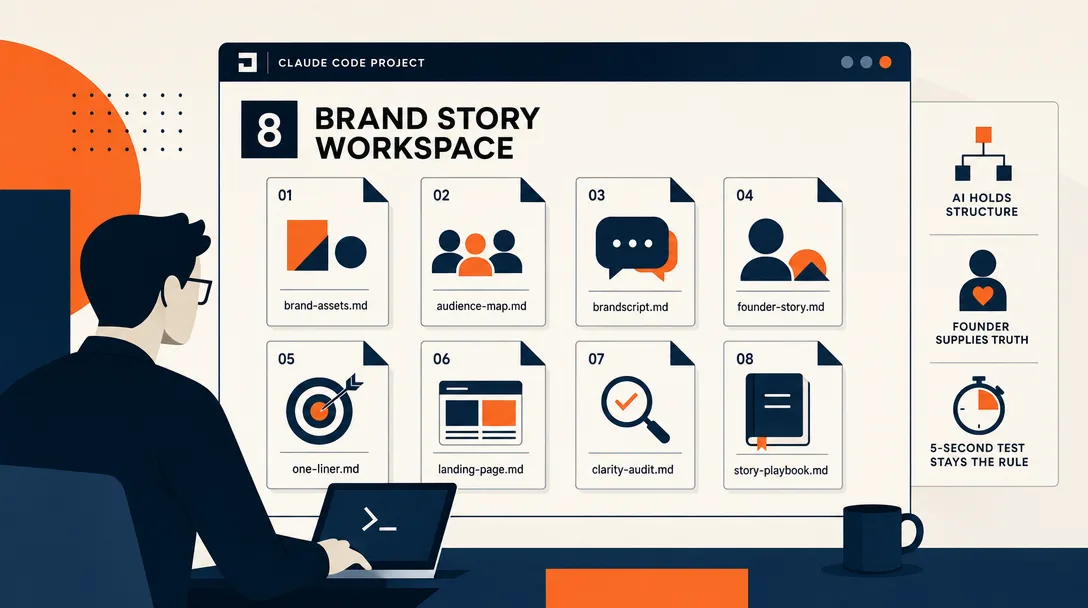
The Brand Story Workspace: 8 Markdown Files
You can run the whole story system as a Claude Code project. Open a folder, walk through the prompts below, and let the assistant turn each strategic decision into a markdown file you can revise later. The goal is not to let AI invent your story. It is to let AI hold the structure while you supply the truth.
Create a folder called brand-story/. Then generate these files.
File 1: BrandScript
Create brand-story/brandscript.md.

Use the seven-part brand story framework:
1. Character: what my customer wants
2. Problem: external, internal, and philosophical problem
3. Guide: empathy and proof
4. Plan: 3-4 steps
5. Call to action: direct and transitional
6. Failure: what happens if nothing changes
7. Success: what life looks like after

Ask me questions before writing.
Use plain English.
Do not make my brand the hero. Make the customer the hero.
Sample output (snippet):
Step
Filled-in answer (story-coach example)
Character (want)
Solo consultants want a landing page strangers can understand in 5 seconds
Problem (external)
The page sounds professional but does not explain who it is for
Problem (internal)
The founder feels competent and unseen at the same time
Problem (philosophical)
Good work should not be ignored because the message is muddy
Guide (empathy + proof)
"I have rewritten 40+ solopreneur pages and the same fix works"
Plan
(1) clarify buyer (2) rewrite story order (3) test with 5 readers (4) ship
CTA (direct / transitional)
Book a 45-min audit / Download the BrandScript worksheet
Failure
More features, more redesigns, same flat page
Success
Strangers describe the offer back in their own words
If the first pass returns generic items ("good communication", "trusted advisor"), reject the output and ask for answers that include a specific buyer, a specific failure, or a specific result. Vague is the failure mode here.
File 2: customer problems
Create brand-story/customer-problems.md.

For each target customer, analyze:
- external problem
- internal feeling
- philosophical belief
- words the customer would actually use
- proof that the problem is real
- what my offer must say to make them feel understood

Avoid jargon. Use buyer language.
File 3: guide positioning
Create brand-story/guide-positioning.md.

Build my guide role:
1. Five empathy statements
2. Five proof points I can honestly show
3. Three credibility gaps I need to fill
4. A 50-word guide statement
5. A rule for what I should not claim yet

Make it honest, not inflated.
File 4: Epiphany Bridge
Create brand-story/epiphany-bridge.md.

Write my founder story using this structure:
1. Before
2. Desire
3. Wall
4. Epiphany
5. Plan
6. Conflict
7. Result
8. Transformation

Write one 700-word version, one 250-word version, and one 60-second spoken version.
Use simple language and specific scenes.
File 5: One-Liner
Create brand-story/one-liner.md.

Generate 10 One-Liners using:
problem - plan - result.

For each one, include:
- best use case
- why it works
- what might confuse a stranger

Pick the strongest version and explain why.
File 6: landing page copy
Create brand-story/landing-page.md.

Using the files above, write a landing page in this order:
1. Hero: what it is, who it helps, what changes
2. Problem: external, internal, philosophical
3. Guide: empathy and proof
4. Plan: 3-4 steps
5. Founder story: short Epiphany Bridge
6. Success: before/after
7. CTA
8. FAQ

Do not start with my biography.
Start with the buyer's problem.
File 7: clarity audit
Create brand-story/clarity-audit.md.

Audit the BrandScript, One-Liner, and landing page.

Run these checks:
1. Can a stranger explain what I sell in five seconds?
2. Is the customer clearly the hero?
3. Is the problem specific?
4. Does the guide section show empathy and proof?
5. Is the plan short enough?
6. Is the CTA direct?
7. Does the founder story support the buyer story?
8. Are there claims I cannot prove?

Return a pass/fail table and the top 10 fixes.
File 8: story playbook
Create brand-story/story-playbook.md.

Summarize the whole system:
- final One-Liner
- BrandScript one-page version
- founder story short version
- landing page order
- five phrases I should repeat
- five phrases I should avoid
- weekly story review checklist
- where to use each story: homepage, email, profile, sales call, post

This should be the document I read before publishing any offer.
The point is not to let AI invent your story.
The point is to make AI hold the structure while you supply the truth.
A Storytelling Audit for Your Current Page
Before you rewrite everything, audit what you have.
Use this table.
Question
Pass/Fail
Fix
Does the first screen say who it is for?
Does it name the customer's problem in their language?
Is the customer the hero?
Do you show empathy before proof?
Is the plan three to four steps?
Is the CTA specific?
Is the founder story placed after relevance?
Does the page describe what happens if nothing changes?
Does it show the after picture?
Could a customer repeat your One-Liner?
If you fail more than three rows, do not redesign yet.
Fix the message first.
Key Takeaways
Storytelling for solopreneurs is sequence, not decoration. Story arranges the buyer's problem, risk, guide, plan, and future in the right order.
Make the customer the hero and yourself the guide. Founder-as-hero copy forces the buyer to fight for space inside your story.
Use the seven-part brand storytelling framework: character, problem, guide, plan, CTA, failure, success. The plan should be 3-4 steps, not 17.
Place the founder story after relevance. The hero section earns the right to a founder bio later, never the other way around.
Build a story inventory of 7 reusable types (origin, customer pain, failure, epiphany, proof, method, values), each placed where it does the most work.
Audit before you redesign. If a stranger cannot answer "what do you sell, who is it for, what changes" in 5 seconds, the message is the problem, not the layout.
Ready-to-Use Prompt: Build a Buyer-First Solopreneur Story
What this does: Applies the core flip (customer = hero, you = guide, offer = plan), builds the seven-part StoryBrand framework, compresses it into a Problem-Plan-Result One-Liner with the founder story placed after buyer relevance, and runs the 5-second clarity test against a per-channel story inventory. Based on: Storytelling for Solopreneurs: Your Story Is the Product — https://aiworkflowpro.com/solopreneur-your-story-is-product/ Time to run: ~5 minutes
Copy this prompt into Claude Code, ChatGPT, or any AI assistant:
ROLE: You are a Solopreneur Story Architect. Your job: turn a founder bio into a buyer-first story — customer as hero, you as guide, offer as plan — never an About-page decoration.

CONTEXT — STORYBRAND + ONE-LINER METHOD:
For a solopreneur, story is not About-page decoration — it's the structure that helps a stranger understand why your offer matters. Story has three jobs: make the customer feel seen, make your judgment credible, make the next step obvious. The core flip: the customer is the hero, you are the guide, the offer is the plan (StoryBrand). Build the seven parts — a hero with a problem meets a guide who gives a plan and a call to action that avoids failure and ends in success. Compress it into the One-Liner (Problem-Plan-Result). Place the founder story AFTER buyer relevance — lead with the buyer's problem, earn credibility once they care. Build a story inventory, not one perfect story.

INPUTS (fill in before running):
- OFFER: [What you sell]
- CUSTOMER_HERO: [Who the customer is and their problem]
- FOUNDER_STORY: [Your background/epiphany — why your judgment is credible]
- CHANNEL: [Where the story lives — landing page / about / social]

METHOD — 4 STEPS:

Step 1 — Apply the Core Flip
Cast CUSTOMER_HERO as the hero with a problem, yourself (from FOUNDER_STORY) as the guide, and OFFER as the plan. Score 0–2: customer is the hero (not you), the problem is theirs, the plan is your offer.

Step 2 — Build the 7-Part StoryBrand Framework
Lay the seven parts: hero → problem → guide → plan → call to action → failure avoided → success won. Each part must do one of story's three jobs (feel seen, build credibility, make the next step obvious).

Step 3 — Write the One-Liner + Place the Founder Story
Compress to the One-Liner: Problem (the hero's problem) — Plan (your offer) — Result (the success). Place the founder story AFTER buyer relevance — the buyer's problem leads, your credibility follows once they care.

Step 4 — 5-Second Test + Story Inventory
Run the 5-second clarity test: can a stranger state the problem you solve and the result you deliver in 5 seconds? Then build a story inventory — a set of story assets per CHANNEL, not one perfect story.

RULES:
- Never make yourself the hero — the customer is the hero, you are the guide, the offer is the plan.
- Never lead with the founder story — it goes after buyer relevance, not before.
- Never chase one perfect story — build an inventory of assets per channel.

OUTPUT FORMAT:
Output a markdown report with:
1. Core Flip — hero/guide/plan cast + score (0–2)
2. 7-Part Framework — markdown table, columns: Part | Content | Job It Does
3. One-Liner + Founder Placement — the Problem-Plan-Result line + where the founder story sits
4. 5-Second Test + Inventory — the clarity verdict + the per-channel story inventory
Save as @templates/solopreneur-your-story-is-product.md and run when writing or rewriting a landing page, About page, or brand story.
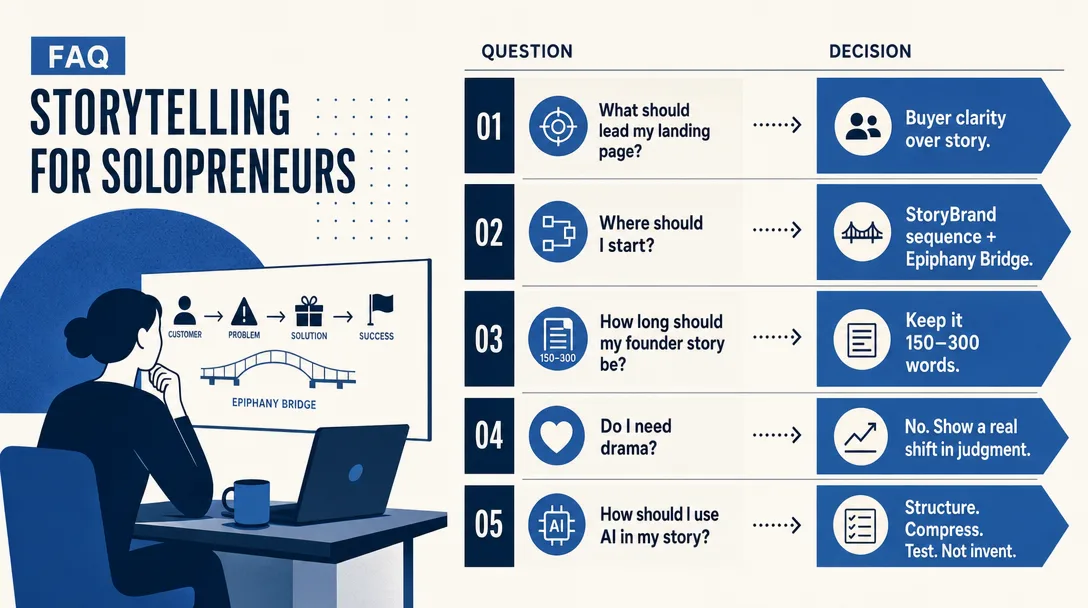
Frequently Asked Questions
Should my landing page lead with story or product?
Lead with buyer clarity. In the hero section, say who the offer is for, what problem it solves, what result it creates, and what the next action is. Use founder story after the buyer understands relevance. Story should support clarity, not replace it.
What is the best storytelling framework for solopreneurs?
The most useful starting point is the StoryBrand-style sequence: customer, problem, guide, plan, call to action, failure, and success. For a one-person business, add the Epiphany Bridge so your founder story explains why you are a credible guide.
How long should my founder story be?
On a landing page, short. Think 150-300 words in the main page, with a longer version available on the About page or in email. The story should show the turning point that made your method credible. It should not become a complete autobiography.
What if I do not have a dramatic personal story?
You do not need drama. You need a useful change in judgment. A good founder story can be as simple as: I believed the problem was X, then I watched users struggle with Y, so I built Z. The shift matters more than the drama.
Can AI write my brand story for me?
AI can help structure, question, compress, and test your story. It should not invent the truth. Give it real customer language, real failed attempts, real proof, and real limits. Use AI as the editor of the system, not the source of the story.
What Comes Next in the Series
You have the story system. Next, in Part 5: Solopreneur Content Engine, we install the publishing rhythm that turns the One-Liner, Epiphany Bridge, and seven-part framework into weekly outputs you can sustain. Then in Part 6: Irresistible Offer for Solopreneurs, we wrap the story around an offer buyers cannot misread.
If you arrived here without reading the foundation, Part 3: Personal Brand for Solopreneurs sets up the position, audience, and weekly loop that this story system slots into.
This series is part of the One-Person Company AI Playbook, the complete guide to building a solo business with AI tools.
Your story is the structure that lets a stranger understand the buyer, the problem, the guide, the plan, the risk, and the better future.
For a solopreneur, that structure is part of the product.
Because before someone buys your product, they buy the clarity of your explanation.
Make the customer the hero.
Show up as the guide.
Give them a plan.
Ask clearly.
Then let the story do its job.
Before you close this tab: open your current homepage or About page in another window and run the 5-second test on yourself. Write down the first three things a stranger would not be able to answer. Save it as clarity-gap.md. Tomorrow, rewrite the hero section to answer those three questions in plain language. That is Day 1 of your story system.
Monitoring a competitor who publishes no feed is the case every RSS guide skips. Twenty-one platforms sorted by which of three jobs they do, and the finished setup is business process automation you own outright, with no seat licence to renew.
Blaming the content is the reflex when a post underperforms, and it is usually the wrong diagnosis. A second reader decides distribution before any human sees the post, and most of what it checks is mechanical enough to automate business processes around, on five platforms at once.
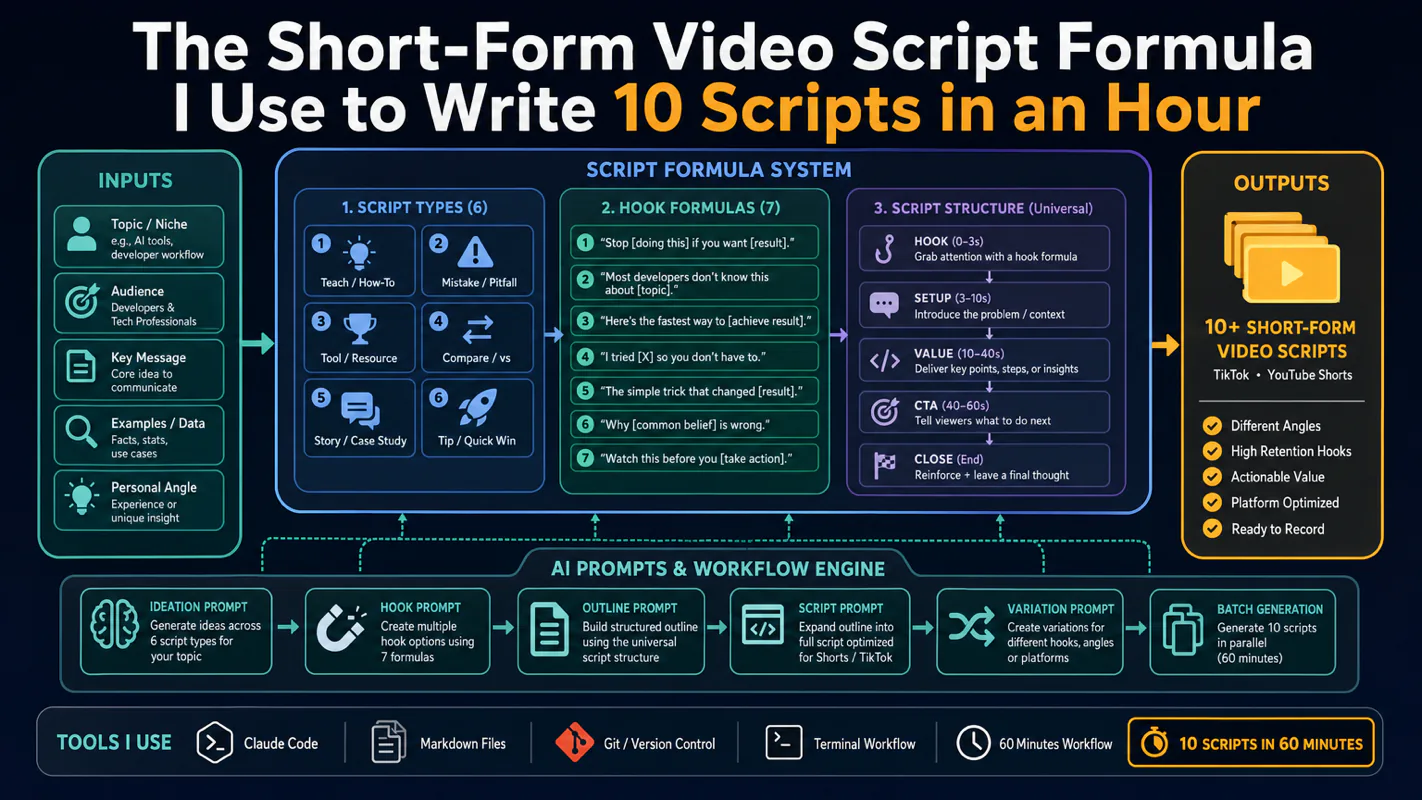
Thursday afternoon, fourteen product ideas, a Monday filming slot, no scripts. Six script shapes and seven hook formulas turn that hour into finished drafts — and the business rule stays: rewrite at least 30% before anything ships.
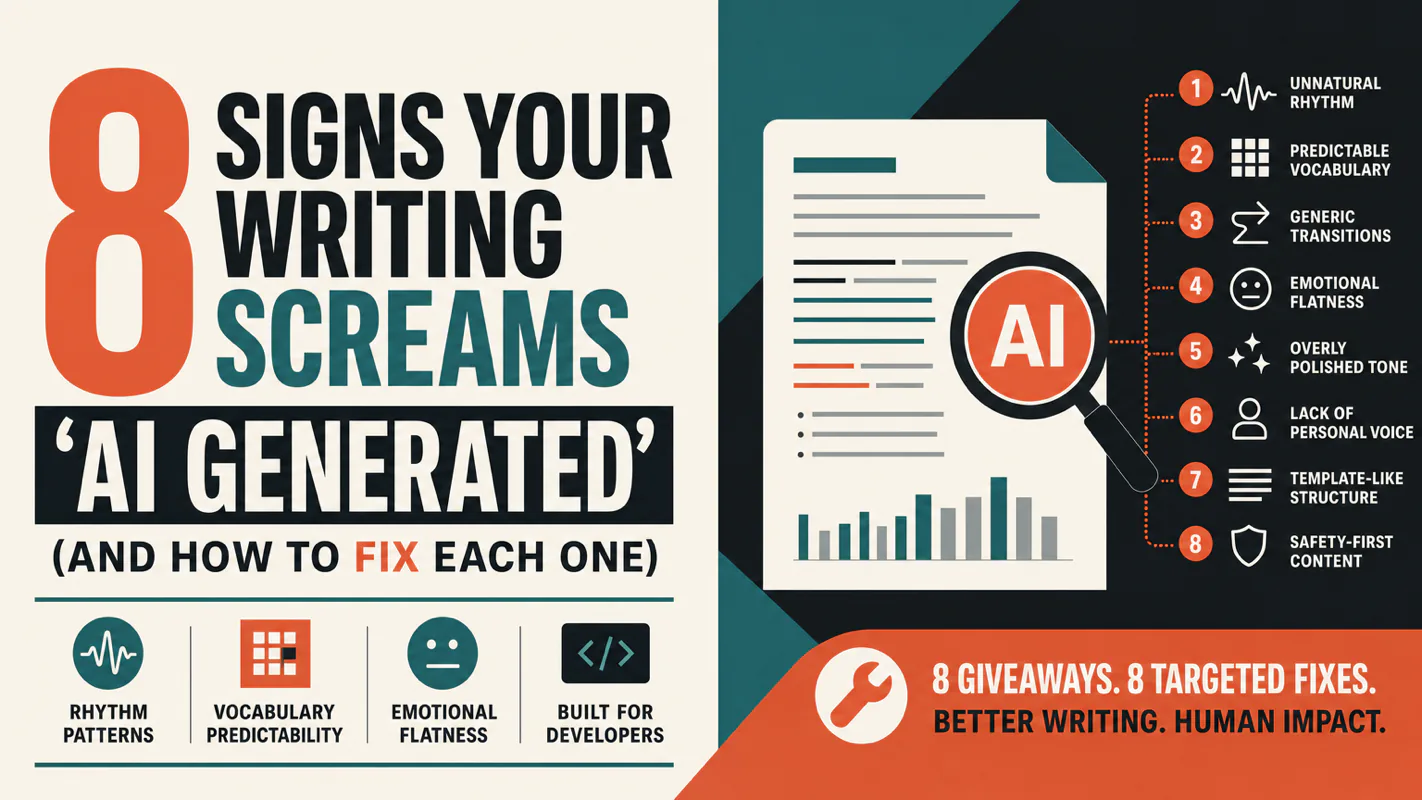
A detector score cannot survive a conversation with the freelancer it just cost three weeks of payment. What holds up is the specific thing on the page: rhythm, vocabulary, missing detail. Eight of them here, and the reason review stays human when you automate business processes.