Monitoring a competitor who publishes no feed is the case every RSS guide skips. Twenty-one platforms sorted by which of three jobs they do, and the finished setup is business process automation you own outright, with no seat licence to renew.
Blaming the content is the reflex when a post underperforms, and it is usually the wrong diagnosis. A second reader decides distribution before any human sees the post, and most of what it checks is mechanical enough to automate business processes around, on five platforms at once.
Gloves on, tape measure in hand — nobody types a query. Three voice surfaces for ai automation tools (terminal, Telegram, Discord), 10 TTS and 6 STT providers compared on cost and latency, plus a setup that costs nothing.
Twelve weeks is enough to validate a direction, publish consistently, test an offer, and install a first AI toolchain for a small business, but only in this order. Positioning first, brand second, content third, offer fourth, systems last, with weekly milestones and a real decision at week 12.
A 12-week launch plan for solopreneurs is enough to validate a direction, build a simple brand, publish consistently, test an offer, and install your first AI operating system.
The sequence matters: positioning first, brand second, content third, offer fourth, audience and systems fifth.
Use one owned base and one discovery channel. Do not build a five-channel media machine before one loop works.
AI should reduce execution drag, but you still own judgment, taste, customer promises, and final approval.
Two therapists left hospital jobs the same month to open cash-pay practices, each giving it twelve weeks before deciding. One spent weeks one through six on a website, a logo, and an intake form. The other spent week one naming exactly who she treats, and week three asking six of those people what they would pay. At week twelve the second had four paying clients and a reason to keep going; the first had a good-looking site and no data. The hours were the same. The order was not. What follows fixes the order: positioning, brand, content, offer, then systems.
This is Part 9, the final installment, of the Builds series.
The first eight articles answered the big questions:
why one person can be enough,
how to find your one thing,
how to build a personal brand,
how to turn your story into the product,
how to build a content engine,
how to make an offer obvious,
how to reach your first 1,000 true fans,
how to assemble an AI toolchain.
Now we need the launch plan.
Not a fantasy plan.
Not a 90-page business plan.
Not a stack of templates you admire and never use.
A 12-week operating path that turns an idea into a visible, testable, revenue-capable one-person business. If you have not read the full AI playbook for one person companies, start there for the structural argument; this plan is the execution layer.
The Solopreneur Launch Market in 2026
Brian Moran's 12 Week Year sold the model. Quarter-sprint planning became conventional wisdom. The execution data is still scarce.
A 2026 spot check for "12 week launch plan solopreneur" mostly returns generic guides on quarterly sprints and 12-week-year frameworks. The common pattern is framework explanation; most repeat the standard 12-week-year talking points without attaching them to a one-person operating model.
None of them attach the framework to a real solopreneur weekly schedule with named operator data: Welsh ladder math, Designjoy delivery cadence, 4DX lead-vs-lag measure split, Paul Graham YC 5-7%/week growth benchmark. The gap is not more 12-week theory. The gap is the quarter-sprint with named lead measures, kill criteria at week 12, and a budget that fits a solo runway. That is what this guide is.
Why Does a 12-Week Launch Plan Work?
Everyone says you need 12 months to launch. Actually, the data is the opposite: most operators who took a full year ended up with the same week-12 result they would have hit on a 12-week plan, plus 9 months of context-switch tax. Here is why this matters: the structural deadline forces decisions that an open-ended timeline lets you postpone forever.
Twelve weeks is long enough to create evidence and short enough to prevent hiding.
The popular 12 Week Year framework by Brian Moran and Michael Lennington argues that shorter execution cycles create more urgency than annual plans. The official system emphasizes scorekeeping: track weekly execution, not just outcomes. For a solopreneur, the useful adaptation is simple: score the percentage of planned tactics you actually completed, treat 85% as a strong execution week, and review the miss every Friday before planning the next one. You do not need to copy the full system exactly. You need the part that stops "I did some of it" from counting as a good week.
In one year, you can postpone almost anything.
In 12 weeks, avoidance becomes visible.
For a solopreneur, that is good.
You do not need a perfect brand, a huge audience, or a complete product before the market can teach you something. You need:
If you skip content, the offer has no demand surface.
If you skip offer design, the audience does not know what to buy.
If you skip the toolchain, the work becomes too heavy for one person.
The 12-Week Launch Plan, Week by Week
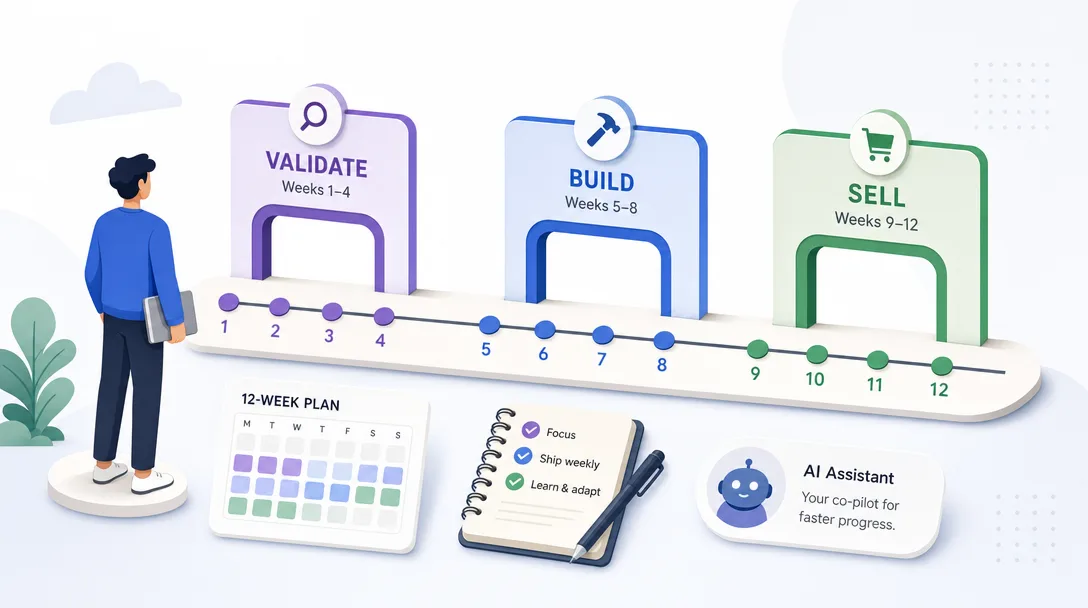
Before this 12-week structure, you spend three months building features no one validated. After: weeks 1-4 validate, weeks 5-8 build, weeks 9-12 sell, and by Friday of week 12 you know whether to commit another quarter or pivot.
Use this as a default path. Adjust the channel and offer type, but keep the sequence.
Weeks 1-2: cognition and positioning
The first two weeks are not for building a website.
They are for deciding what game you are playing.
Week
Main job
Output
1
map skills, experience, interests, and market problems
three niche candidates
2
validate demand through search, communities, interviews, and competitor review
one niche hypothesis
By the end of week two, you should be able to write this sentence:
I help [specific audience] achieve [specific result] by solving [painful problem] with [your method or advantage].
If that sentence feels vague, do not move forward yet.
Validation does not need to be complicated. Search Google, Reddit, YouTube, LinkedIn, Amazon reviews, product reviews, and niche communities. Look for repeated pain in the language of real people.
You are not looking for confirmation that your idea is brilliant.
You are looking for a problem people already describe without your help.
Weeks 3-4: brand foundation
Now turn the niche into a visible identity.
Week
Main job
Output
3
write your brand promise, origin story, point of view, and audience profile
brand guide 1.0
4
set up one owned base and one discovery channel
public presence live
Owned base means a place you control: your website, newsletter, Ghost site, or email list.
Discovery channel means where strangers can find you: LinkedIn, X, YouTube, Reddit, search, a podcast, or a focused community.
Do not start with five channels.
Start with two surfaces:
One place that stores trust.
One place that creates discovery.
The week four deliverable is simple:
a one-page about page,
a newsletter or subscriber form,
a basic content archive,
a clear bio on the discovery channel,
one pinned post or intro page that explains your point of view.
This is not a full brand launch.
It is a working storefront for trust.
Weeks 5-8: content engine
These four weeks are the center of the plan.
Your job is to publish.
Week
Main job
Output
5
design the content tilt and first 12 topics
12-week content calendar
6
publish the first three long-form assets
first public proof
7
repurpose each asset into discovery-channel formats
distribution loop
8
review signals and refine the angle
first content report
The minimum system:
one weekly long-form asset
    -> one newsletter or site post
    -> three discovery posts
    -> one short thread, script, or community reply
    -> one weekly review
If the base article is strong, repurposing is easy.
If the base article is weak, repurposing creates noise.
So do not ask AI to create endless social posts from a shallow idea. Ask AI to help you strengthen the core asset first.
In these four weeks, ignore most vanity metrics.
Track:
replies,
saves,
comments with real questions,
subscribers,
inbound DMs,
downloads,
sales conversations.
The first content engine is not judged by virality.
It is judged by whether the right people start raising their hands.
What to publish in weeks 5-8
If you are unsure what the first four long-form assets should be, use this sequence:
Week
Asset
Purpose
5
The problem map
show that you understand the audience's world
6
The mistake guide
explain what people commonly do wrong
7
The method
introduce your simple framework
8
The proof or teardown
demonstrate the method on a real example
This creates a natural trust ladder.
The problem map says, "I see you."
The mistake guide says, "I know why this keeps failing."
The method says, "Here is a better way."
The proof says, "This is not theory."
Do not lead with a sales page if the audience has not yet seen your judgment. The offer will feel premature. Content is not there to impress everyone. It is there to make the right people say, "This person understands the problem better than the alternatives."
How to choose the discovery channel
Pick the channel by audience behavior, not creator envy.
Audience behavior
Better channel
They search for solutions
SEO, YouTube, Reddit, comparison articles
They follow expert commentary
LinkedIn, X, newsletter swaps
They need visual proof
YouTube, Instagram, TikTok, demos
They buy from deep trust
newsletter, podcast, long-form essays
They ask detailed questions
communities, Reddit, forums, Q&A content
The wrong channel makes good work look weak.
If your buyers search Google before buying, a beautiful X thread may not matter. If your buyers live in professional networks, a hidden blog may not create enough discovery. If your buyers need to see the workflow, text alone may be too abstract.
Use one base and one discovery channel for the first 12 weeks. This protects focus and makes the signal readable.
Weeks 9-10: offer and monetization
Now turn trust into a first offer.
Week
Main job
Output
9
design the first paid offer
offer page draft and price logic
10
publish the offer and invite warm prospects
live payment or booking path
The first offer should be narrow.
Good first offers include:
a paid workshop,
a 1:1 audit,
a cohort sprint,
a template pack with implementation support,
a small course,
a done-with-you setup,
a paid research report.
Avoid building a huge course in silence.
A better first version is:
I will help [audience] get [specific result] in [timeframe] without [painful tradeoff].
Then define:
what they get,
who it is for,
who it is not for,
the outcome,
the proof,
the price,
the refund or guarantee terms,
the next step.
The goal of weeks 9-10 is not maximum revenue.
The goal is proof that people understand the offer and some of them want to buy.
The first offer test
Use a small but real test:
Write the offer page.
Send it to five people who match the audience.
Ask them to explain what they think the offer does.
Ask what feels unclear or risky.
Ask whether they would buy, refer, or ignore it.
Improve the page before promoting it publicly.
You are testing comprehension before conversion.
Many first offers fail because the reader cannot quickly answer:
Is this for me?
What result do I get?
Why should I trust this person?
What happens after I pay?
What makes this better than doing it myself?
If the answer is unclear, do not add scarcity. Add clarity.
The first version of the offer should be easy to deliver manually. Manual delivery teaches you what customers actually need. Automation can come after the pattern stabilizes.
Weeks 11-12: acquisition system and review
The final two weeks turn everything into a loop.
Week
Main job
Output
11
connect content, lead magnet, email, offer, and follow-up
simple funnel
12
review the full cycle and choose the next 12-week bet
launch review
The simple funnel:
public content
  -> useful free resource
  -> email or owned audience
  -> trust-building sequence
  -> first offer
  -> feedback and referral request
This does not require expensive software.
It requires one clear path.
At the end of week 12, write a review:
What did I publish?
Which topics created trust?
Which audience language repeated?
What did people ask about?
What did people ignore?
Did anyone buy, book, reply, or refer?
What should be repeated?
What should be deleted?
What is the next 12-week focus?
This review is the real asset.
It prevents you from confusing activity with learning.
What to automate by week 12
By the end of the plan, you should not have a giant automation stack.
You should have three useful automations:
Automation
Why it matters
Content repurposing
turns one strong asset into channel drafts
Weekly review
converts scattered signals into one decision
Offer feedback log
preserves customer language and objections
These three are enough.
They save time, improve learning, and keep the business grounded in audience response.
Avoid automating:
cold outreach at scale,
public publishing without review,
customer support with no escalation rule,
price changes,
refunds,
legal claims,
deletion of business files.
The first 12 weeks should create a small, inspectable system.
You are not trying to build a robot company.
You are trying to remove repeated friction from a human-led business.
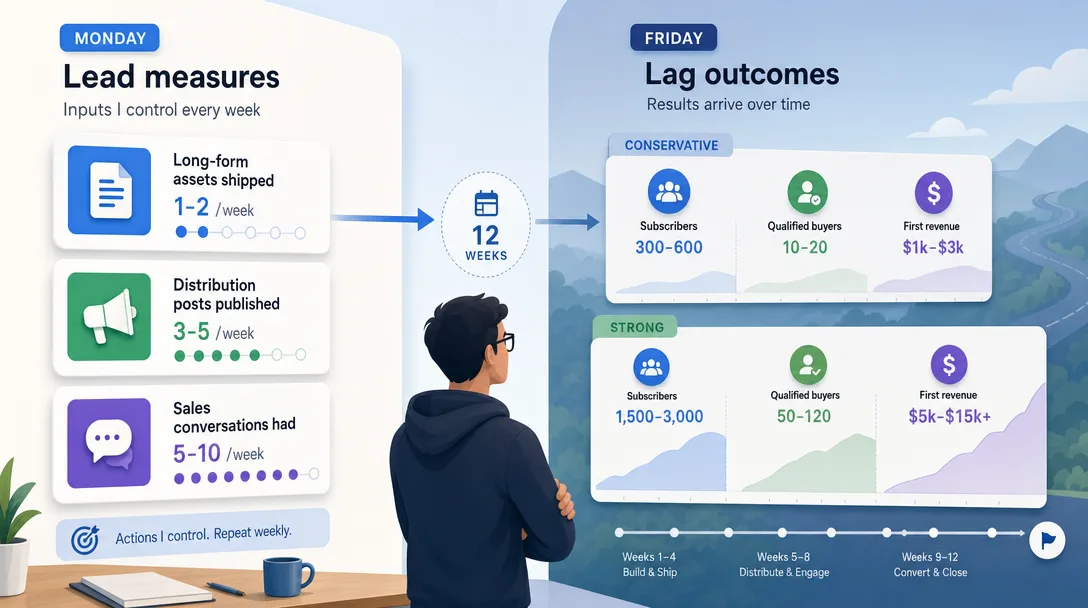
Expected Outcomes After 12 Weeks
Use these as ranges, not promises.
Metric
Conservative
Strong
Long-form assets
8-12
12-16
Discovery posts
24-40
50-80
Owned subscribers
50-200
300-1,000
Sales conversations
3-10
15-40
First revenue¹
$0-$1,000
$1,000-$10,000
Workflow maturity
one loop documented
repeatable content-to-offer system
Do not treat revenue as the only pass/fail signal.
If you end 12 weeks with a clearer audience, visible content, repeated inbound questions, one tested offer, and a documented workflow, you have built the foundation.
Most people never get that far.
¹ The "Strong" $1K–$10K range assumes you arrive with at least one of: a small warm audience (≥a few hundred relevant subscribers/followers), prior credibility in the niche, or a service offer you can sell to existing contacts. From a complete cold start with zero audience, the conservative range is the realistic expectation, and revenue beyond Week 12 is the more honest target.
Lead measures vs lag measures
The cleanest way to read these expected outcomes is to separate lead measures from lag measures, a distinction popularized by The 4 Disciplines of Execution (McChesney, Sean Covey, and Huling, FranklinCovey 2012). Lag measures track the outcome you want, revenue, subscribers, paying customers. Lead measures track the high-lift activities that drive the outcome, long-form assets shipped, distribution posts published, sales conversations had. You can only directly control lead measures. The lag measures move when the lead measures stay above the line for long enough. If you stare at "owned subscribers" every Friday, you will quit at week 4. If you stare at "long-form assets shipped this week" the lead, you have something you can fix on Monday.
A reality check on the timeline
Paul Graham's "Startup = Growth" frames a 12-week window for venture-funded SaaS startups in plain language: "A good growth rate during YC is 5-7% a week. If you can hit 10% a week you're doing exceptionally well." That number is YC's own data point on cohort-stage startups, not a universal solopreneur benchmark. Cite it as context: a YC batch is roughly the same 3-month window you are running, so the shape of compounding inside 12 weeks is comparable, even if the absolute weekly growth rates a one-person business will see are usually slower and chunkier.
Twelve weeks is one cycle, not a finish line. By Justin Welsh's own $10M Journey newsletter, his solo business needed 5 years 9 months, 2,119 days, to cross $10M in cumulative revenue. The first $1M took 29 months from product launch. The point is not to race that timeline. The point is that anyone who built one of these companies ran their 12-week cycle 20+ times in a row, kept the lead measures above 85%, and let the lag measures arrive when they arrived. Reset, run cycle 2.
Budget and Tool Rhythm by Stage
Your tool budget should match the stage.
Stage
Weeks
Sensible spend
What to buy
Direction
1-2
$0-$50
AI assistant, search, note files
Brand setup
3-4
$0-$100
domain, simple site or newsletter tool
Content engine
5-8
$20-$200
AI workspace, design tool, scheduling if needed
Offer test
9-10
$50-$300
landing page, payment or booking tool
System review
11-12
$50-$300
analytics, automation only if bottleneck is proven
Do not buy tools because you want to feel serious.
Buy tools when the workflow proves the need.
There is a psychological trap here. Paying for software can feel like progress because it is concrete. But the market does not care which tools you own. It cares whether you solve a problem better than the alternatives.
If a free or cheap stack lets you publish, collect subscribers, run conversations, and test an offer, keep it.
Upgrade only when:
the free tool creates a real bottleneck,
the paid tool saves measurable weekly time,
the data can be exported,
the tool fits the workflow you already run,
the cost is small compared with business learning or revenue.
Failure Modes to Watch
The plan is simple, but it is not easy.
Here are the common failure modes:
Failure mode
What it looks like
Fix
Research hiding
endless market research, no public output
publish a small problem map this week
Brand perfectionism
logos, colors, names, but no audience signal
ship a simple about page and pinned post
Content drift
every article targets a different reader
return to one audience and one problem
Tool collecting
testing apps instead of building trust
delete tools that do not support the weekly loop
Offer avoidance
free content forever, no buying path
create a narrow paid audit or workshop
Channel sprawl
posting everywhere badly
choose one discovery channel for 30 days
Metrics confusion
chasing views instead of buying signals
track replies, subscribers, calls, and revenue
The most dangerous failure mode is respectable avoidance.
Respectable avoidance looks productive from the outside. You are reading, planning, researching, buying tools, redesigning pages, and improving prompts. But the market has not seen anything. No one has had the chance to care.
The antidote is a weekly shipping deadline.
Every week should produce something public, useful, and connected to the positioning.
Decision Metrics at the End of Week 12
At the end of 12 weeks, do not ask only, "Did this make money?"
Ask better questions:
Question
Good signal
Is the audience clear?
you can describe them without vague labels
Is the pain real?
people repeat it in their own words
Is the content useful?
readers reply, save, share, or ask follow-up questions
Is the offer understood?
prospects can explain it back to you
Is there willingness to pay?
people buy, book, ask price, or request a version
Is the system sustainable?
weekly publishing is hard but not destructive
Is AI helping?
workflows save time without lowering judgment
These questions are better than vanity dashboards.
A post with 500 views and three serious buying conversations may be more valuable than a post with 50,000 views and no qualified demand.
The first 12 weeks are a learning machine.
Treat them that way.
The Weekly Review Template
Use this every Friday. Thirty minutes is enough.
Do not make it complicated.
Week:

1. What shipped?
- long-form asset:
- discovery posts:
- lead magnet or offer work:
- customer conversations:

2. What created trust?
- replies:
- saves:
- shares:
- subscribers:
- referrals:

3. What created buying signals?
- price questions:
- booking requests:
- demo requests:
- objections:
- actual purchases:

4. What slowed me down?
- unclear topic:
- weak workflow:
- tool issue:
- perfectionism:
- missing proof:

5. What did I learn in the audience's own words?
- phrase 1:
- phrase 2:
- phrase 3:

6. What is the one decision for next week?
- repeat:
- improve:
- delete:
The last line is the most important.
The purpose of a review is not to feel organized. It is to make one decision.
Maybe you repeat the topic that created serious replies.
Maybe you improve the offer page because prospects understood the problem but not the result.
Maybe you delete a channel because it creates activity without trust.
Maybe you stop writing broad educational posts and move toward implementation teardowns.
The weekly review compounds because it captures market language while it is still fresh. After 12 weeks, you will have 12 review files. Those files become your next positioning update, content calendar, offer rewrite, FAQ, and product roadmap.
This is where AI is genuinely useful. It can read the reviews, find recurring phrases, detect objections, summarize patterns, and draft the next plan. But you still make the decision.
One more rule: keep the review honest.
Do not rewrite the week to sound impressive. If you shipped nothing, write that. If a post failed, write that. If someone asked a question that exposed a weak offer, preserve the question exactly. A clean review that hides reality is worse than no review because it trains the next plan on fiction.
Truth is the input.
Improvement is the real operating output here.
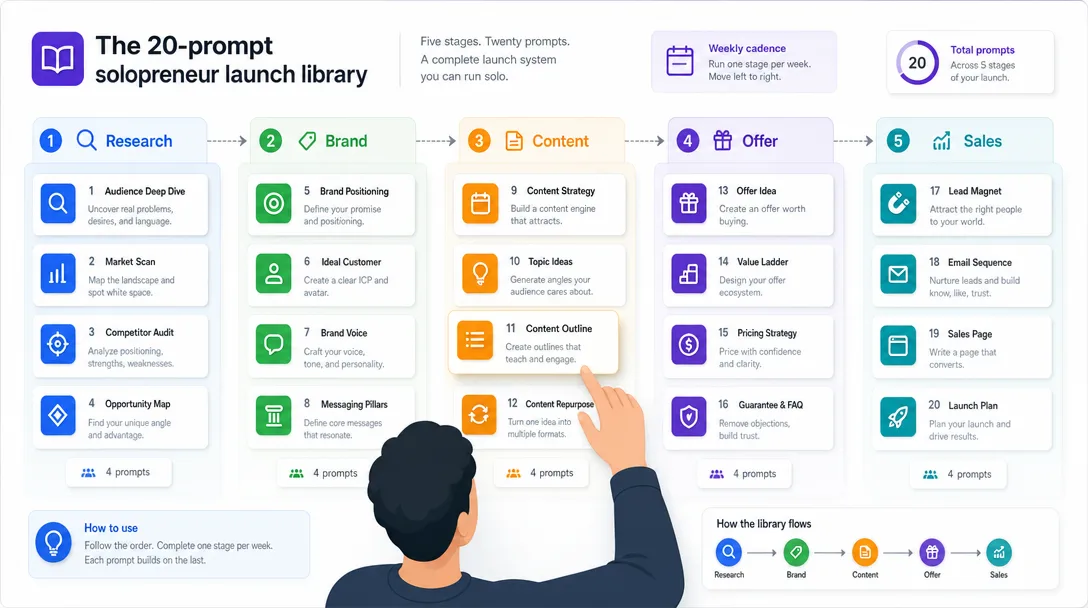
The 20-Prompt Solopreneur Launch Library
Use these prompts inside Claude Code or any AI workspace that can read and write project files. Adjust paths to your setup.
Research and positioning
1. Niche comparison
Compare these three niche ideas: [A], [B], [C].
Use search, community language, competitor pages, and audience pain signals.
Score each on demand, urgency, willingness to pay, my credibility, content depth, and AI lift.
Save the recommendation to docs/niche-comparison.md.
Sample output (snippet):
Niche
Demand
Urgency
Will pay
Credibility
Content depth
AI lift
Total
AI workflows for non-technical solo consultants
4
4
5
5
5
5
28
Newsletter ops for experts who hate social media
3
3
4
4
4
3
21
Cash-flow systems for freelance designers
3
5
5
2
3
3
21
Recommendation: niche A. Strongest because the buyer is named, the pain is current ("I drown in tools"), credibility is real (years of solo workflow practice), and AI lift maps directly to the niche subject matter, making content production self-reinforcing.
If the model outputs niches that score 30/30 on every dimension, reject the output. Real niches have tradeoffs.
2. Audience language mining
Research how [target audience] describes [problem].
Collect phrases from Reddit, YouTube comments, reviews, forums, and competitor testimonials.
Group them by pain, desired outcome, objections, and buying triggers.
Save to docs/audience-language.md.
3. Positioning sentence
Read docs/niche-comparison.md and docs/audience-language.md.
Draft 10 positioning statements using this format:
I help [audience] achieve [result] without [pain] by [method].
Rank them by clarity, specificity, credibility, and search/discovery potential.
Save to docs/positioning.md.
4. Competitor gap map
Find 10 competitors or adjacent creators in [market].
Map their audience, promise, content angle, offer, pricing, and visible gap.
Identify three positions that are useful but under-served.
Save to research/competitor-gap-map.md.
Brand and story
5. Brand guide
Create a simple brand guide for this solopreneur business.
Include audience, promise, point of view, tone, banned phrases, proof points, and content pillars.
Use docs/positioning.md as source.
Save to docs/brand-guide.md.
6. Origin story
Interview me through the files in docs/.
Draft a 700-word origin story using a guide-not-hero structure.
Make the customer the hero and me the mentor.
Save to docs/origin-story.md.
7. About page
Read docs/brand-guide.md and docs/origin-story.md.
Write an about page for my website.
It should explain who I help, what problem I solve, why I am credible, and what the reader should do next.
Save to website/about.md.
8. Pinned intro post
Turn the brand guide into one pinned intro post for [LinkedIn/X/Reddit/community].
Make it specific, useful, and non-hype.
Include one clear follow action.
Save to distribution/pinned-intro.md.
Content engine
9. Twelve-topic calendar
Create a 12-week content calendar for [audience] around [problem].
Each week needs one long-form topic, one search intent, three discovery post angles, and one CTA.
Make the topics build from awareness to trust to offer readiness.
Save to content/calendar-12-weeks.md.
10. Article brief
Create a production brief for this topic: [topic].
Include search intent, reader pain, unique angle, outline, examples needed, internal links, FAQ, and CTA.
Save to content/briefs/[slug].md.
11. Draft and self-review
Read content/briefs/[slug].md and docs/brand-guide.md.
Write a first draft.
Then run a self-review for clarity, originality, usefulness, accuracy, structure, SEO, and sales pressure.
Save draft to content/drafts/[slug].md and review to content/reviews/[slug].md.
12. Repurposing pack
Read content/finals/[slug].md.
Create a repurposing pack:
- 1 newsletter intro,
- 3 LinkedIn posts,
- 5 X posts,
- 1 short video script,
- 1 community answer,
- 5 quote cards.
Do not publish.
Save to distribution/[slug]/.
Offer and monetization
13. Offer design
Read docs/audience-language.md and the latest content reviews.
Design one first paid offer.
Define audience, result, scope, price range, delivery format, proof needed, objections, and guarantee.
Save to offer/offer-v1.md.
14. Landing page
Read offer/offer-v1.md and docs/brand-guide.md.
Write a landing page with headline, problem, outcome, who it is for, what is included, proof, pricing, FAQ, and CTA.
Save to website/offer-page.md.
15. Warm outreach
Draft 20 warm outreach messages for people who may know someone with this problem.
Make them useful, low-pressure, and specific.
Do not use manipulative urgency.
Save to acquisition/warm-outreach.md.
16. Lead magnet
Design one lead magnet that solves a narrow problem and naturally leads to offer/offer-v1.md.
Include title, promise, outline, delivery format, and landing page copy.
Save to acquisition/lead-magnet.md.
Analysis and operating system
17. Weekly review
Read this week's published content, distribution drafts, subscriber notes, replies, and revenue notes.
Summarize what shipped, what created trust, what created buying signals, what failed, and one decision for next week.
Save to reviews/week-[date].md.
18. Toolchain audit
Audit my tools and workflows across creation, distribution, monetization, operations, and analysis.
Identify unnecessary tools, missing approval gates, repeated bottlenecks, and the next one automation to build.
Save to reviews/toolchain-audit.md.
19. CLAUDE.md operating manual
Read all files in docs/, content/, offer/, acquisition/, and reviews/.
Create a CLAUDE.md operating manual for the business.
Include identity, audience, voice, folder map, workflow steps, approved tools, safety rules, and self-check commands.
Save to CLAUDE.md.
20. Next 12-week plan
Read reviews/week-*.md, offer/offer-v1.md, and analytics exports.
Create the next 12-week plan.
Pick one primary objective, three measurable outcomes, weekly milestones, risks, and deletion list.
Save to planning/next-12-weeks.md.
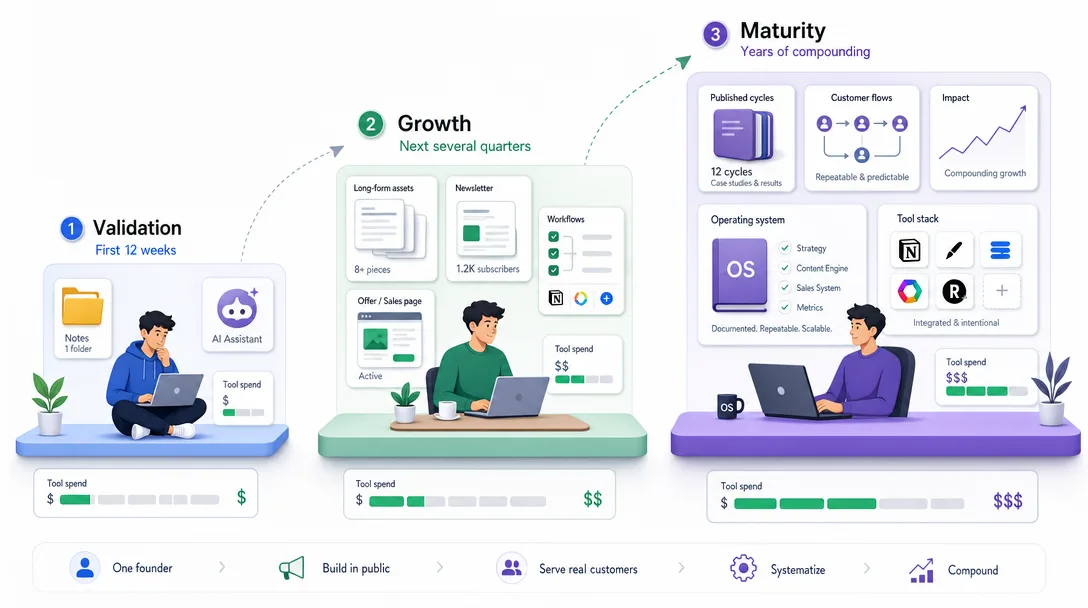
Three Stages: Validation, Growth, Maturity
After this launch, the business usually moves through three stages.
Do not buy maturity-stage tools during the validation stage.
In the first 12 weeks, the best tool is often a simple folder, a clear operating manual, and one AI assistant that helps you produce and review faster.
What AI Cannot Replace
AI can research, draft, summarize, format, analyze, and automate.
That covers most of the execution work.
But three capabilities remain yours.
Judgment. You decide what problem is worth solving, what promise is honest, what tradeoff is acceptable, and what opportunity to ignore.
Taste. You decide whether the writing feels true, whether the design matches the brand, whether the offer feels generous, and whether the work is good enough to publish.
Trust. You build trust through consistency, proof, personal experience, clear promises, and how you handle mistakes.
AI can help express these.
It cannot own them.
The 12-Week Final Checklist
By the end of week 12, aim to have:
one clear positioning sentence,
one owned base,
one discovery channel,
one brand guide,
one origin story,
eight to twelve long-form assets,
a repurposing workflow,
one lead magnet or subscriber path,
one first paid offer,
one simple sales page or booking path,
one weekly review process,
one AI toolchain operating manual,
one decision for the next 12 weeks.
If you have those, you are not just "thinking about starting."
You have started.
Before this 12-week structure, launches slip into month nine. After, week 12 is a clean go-iterate-kill decision on real numbers.
Key Takeaways
Twelve weeks is enough to validate a niche, ship 8-12 long-form assets, test one offer, and document a working operating system. It is not enough to build a mature business, and that is fine.
The sequence is non-negotiable: positioning (W1-2) → brand (W3-4) → content engine (W5-8) → offer (W9-10) → acquisition system + review (W11-12). Skipping a layer makes every later layer leak.
Use one owned base and one discovery channel. Channel sprawl is the most common reason solopreneur launches fade by week 6.
Publish weekly even when scope shrinks. A 600-word teardown shipped beats a 4,000-word essay still in drafts.
Decision metrics beat vanity metrics. Replies, saves, sales conversations, and subscriber-from-content beat views every time.
Run the Friday 30-minute review. The output is one decision for next week, repeat, improve, or delete. The review is the real asset.
Common Worries Before Week 1
Should I quit my job before doing this?
Usually no.
The first 12 weeks are about evidence. If you can validate demand, build an audience loop, and earn first revenue while employed, you reduce pressure and make better decisions.
What if I cannot publish every week?
Reduce the scope.
Publish a shorter article, a practical checklist, a teardown, a short video, or a useful email. Consistency matters more than format size.
What if nobody buys in 12 weeks?
Look for non-revenue evidence before declaring failure.
Did anyone reply? Did people subscribe? Did they ask questions? Did they share pain in your language? Did they say "I need this, but not in this format"?
If there is attention but no buying, improve the offer.
If there is no attention and no buying, revisit positioning.
Should I run ads?
Not yet.
Paid acquisition can amplify a working message. It can also burn money on a weak one. In the first 12 weeks, use content, warm outreach, search, and community participation to learn the language of the market.
Should I build the full product before selling?
No.
Sell the smallest honest version that can deliver the promised result. Workshops, audits, templates, and done-with-you offers are often better first products than large courses.
Ready-to-Use Prompt: Build a 12-Week Solopreneur Launch Plan in the Fixed Sequence
What this does: Builds your 12-week launch in the fixed sequence (positioning → brand → content → offer → audience+systems), on one owned base + one discovery channel, with weekly checkpoints and a week-12 kill/continue/pivot decision — so you validate a direction, not a fantasy. Based on: 12-Week Launch Plan for Solopreneurs — https://aiworkflowpro.com/solopreneur-12-week-launch-plan/ Time to run: ~5 minutes
Copy this prompt into Claude Code, ChatGPT, or any AI assistant:
ROLE: You are a solopreneur launch planner. Your job: build a 12-week launch plan that respects the fixed sequence (positioning → brand → content → offer → audience+systems), uses one owned base + one discovery channel, and ends with a kill/continue/pivot decision — so the founder validates a direction, not a fantasy.

CONTEXT — 12-WEEK SEQUENCED LAUNCH PLAN:
Twelve weeks is enough to validate a direction, build a simple brand, publish consistently, test an offer, and install a first AI operating system. The sequence is fixed and matters: positioning first, brand second, content third, offer fourth, audience and systems fifth — jumping ahead (e.g., building content before positioning) wastes the weeks. Use one owned base and one discovery channel; do not build a five-channel media machine before one loop works. AI reduces execution drag, but the founder still owns judgment, taste, customer promises, and final approval. The three stages — Validation, Growth, Maturity — gate the plan, and a decision metric at week 12 decides kill, continue, or pivot.

INPUTS (fill in before running):
- NICHE_IDEA: YOUR_DIRECTION_HERE (the niche/direction to validate — one sentence)
- OWNED_BASE: YOUR_BASE_HERE (your owned base — newsletter, blog, site — or "none yet")
- DISCOVERY_CHANNEL: YOUR_CHANNEL_HERE (the one discovery channel — e.g., X, YouTube, Reddit)
- WEEKLY_HOURS: YOUR_TIME_HERE (hours per week to commit)

METHOD — 6 STEPS:

Step 1 — Lock positioning (weeks 1-2, first in sequence)
Define the one thing: who you serve, what problem, why you. Positioning must be locked before brand or content — content without positioning is noise. Sharpen NICHE_IDEA to a single sentence a stranger understands.

Step 2 — Build simple brand + base (weeks 3-4)
Build a simple brand (name, one-line promise, look) on one OWNED_BASE. Do not over-design — a brand is a promise, not a logo project. If OWNED_BASE = none, set one up here (a newsletter or simple site).

Step 3 — Publish content weekly on one channel (weeks 5-8)
Publish weekly on the one DISCOVERY_CHANNEL, funneling to the owned base. One channel, not five — building a five-channel machine before one loop works is a listed failure mode. WEEKLY_HOURS must cover one solid post per week, not five thin ones.

Step 4 — Make the offer + test it (weeks 9-10)
Make one offer obvious and test it with the audience you have built. The offer is fourth in sequence — testing before you have positioning + content + audience produces meaningless signal.

Step 5 — Audience + systems + AI toolchain (weeks 11-12)
Install the audience loop and the AI toolchain (automation that reduces execution drag). AI reduces drag; the founder still owns judgment, taste, promises, and final approval — AI does not replace these.

Step 6 — Week-12 decision + weekly review
Apply the week-12 decision metric (did the loop produce first paying/engaged users?) → kill / continue / pivot. Install the weekly review template across all 12 weeks so each week has a checkpoint, not just week 12.

RULES:
- The sequence is fixed (positioning → brand → content → offer → audience+systems) — do not jump ahead.
- One owned base + one discovery channel — never build five channels before one loop works.
- AI reduces execution drag; the founder owns judgment, taste, customer promises, and final approval.
- A weekly review checkpoints every week; the week-12 metric decides kill/continue/pivot.

OUTPUT FORMAT:
Output six sections:
1. **Positioning** — the locked one-thing sentence (weeks 1-2).
2. **Brand + base** — simple brand + the owned base (weeks 3-4).
3. **Content on one channel** — the weekly publishing loop on DISCOVERY_CHANNEL → base (weeks 5-8).
4. **Offer + test** — the one offer + the test (weeks 9-10).
5. **Audience + systems + AI** — the loop + AI toolchain, with the founder-owned list (weeks 11-12).
6. **Week-12 decision + review** — markdown table with columns: Week range | Stage (Validation/Growth/Maturity) | Focus, + the kill/continue/pivot metric + the weekly-review checkpoint.
Save as @templates/solopreneur-12-week-launch-plan.md and run at the start of a launch, then re-run weekly with the review template until the week-12 decision.
Frequently Asked Questions
Can I launch a solopreneur business in 12 weeks?
Yes, if launch means validating a niche, publishing consistently, building a simple audience system, testing a first offer, and learning from real market response. It does not mean building a mature business in 12 weeks.
What should I build first as a solopreneur?
Start with positioning, then a repeatable content engine, then a simple offer. Do not begin with a large product, complex automation, or a full brand system before you have evidence of demand.
How many channels should I use during the first 12 weeks?
Use one owned base such as a website or newsletter, and one discovery channel such as LinkedIn, X, YouTube, Reddit, or a niche community. Add channels only after the weekly loop is stable.
Should I use AI from day one?
Use AI from day one for research, drafting, repurposing, analysis, and workflow documentation. Keep strategy, final publishing approval, customer promises, pricing, and sensitive replies under human control.
What is the most important metric in the first 12 weeks?
The most important metric is evidence of trust: replies, subscribers, sales conversations, downloads, referrals, and buying questions. Page views matter less than proof that the right people care.
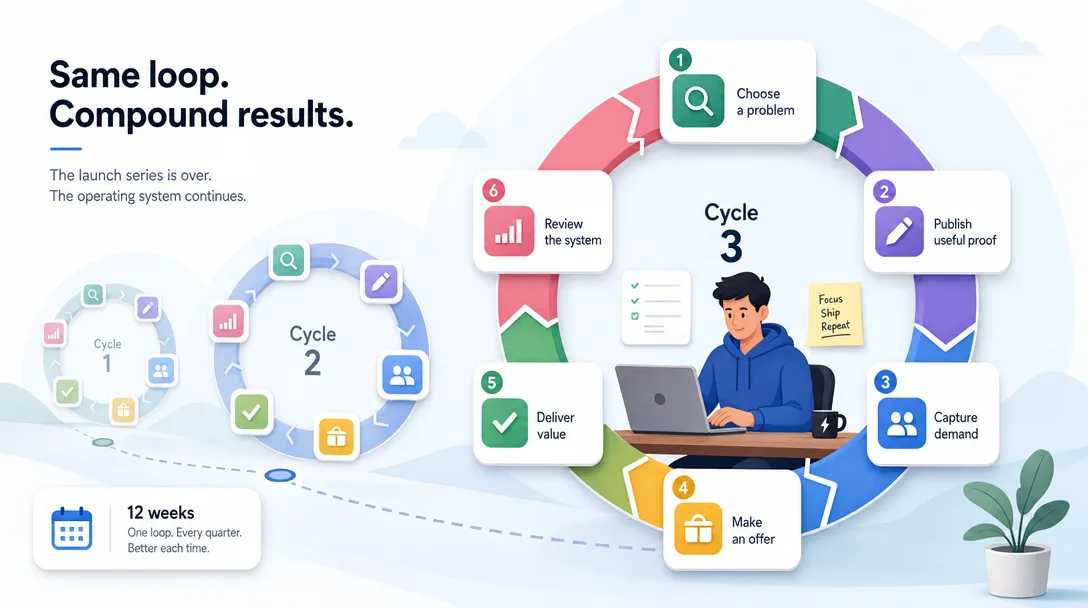
What Comes After the Launch Series?
This is the end of the Builds series, but not the end of the work.
The loop is now simple:
choose a problem
  -> publish useful proof
  -> capture demand
  -> make an offer
  -> deliver value
  -> review the system
  -> repeat for 12 weeks
After the first 12 weeks, your second cycle begins. The loop does not change. The audience grows clearer, the offer sharpens, and the content compounds. Most durable one-person businesses are not the result of a single brilliant launch, they are the residue of repeated 12-week cycles where the founder stayed, listened, and adjusted.
The Starting Line
Not a perfect stack.
Not a perfect brand.
Not a perfect product.
A repeatable loop that creates trust and turns that trust into useful work people will pay for.
Twelve weeks.
One direction.
One weekly asset.
One simple offer.
One AI-assisted operating system.
That is enough to begin.
Before you close this tab: open a calendar and block the first Friday of each of the next 12 weeks for a 30-minute review. Save a file week-01.md in a folder called launch/. Tomorrow, write the positioning sentence. The 12-week clock has now started.
Monitoring a competitor who publishes no feed is the case every RSS guide skips. Twenty-one platforms sorted by which of three jobs they do, and the finished setup is business process automation you own outright, with no seat licence to renew.
Blaming the content is the reflex when a post underperforms, and it is usually the wrong diagnosis. A second reader decides distribution before any human sees the post, and most of what it checks is mechanical enough to automate business processes around, on five platforms at once.
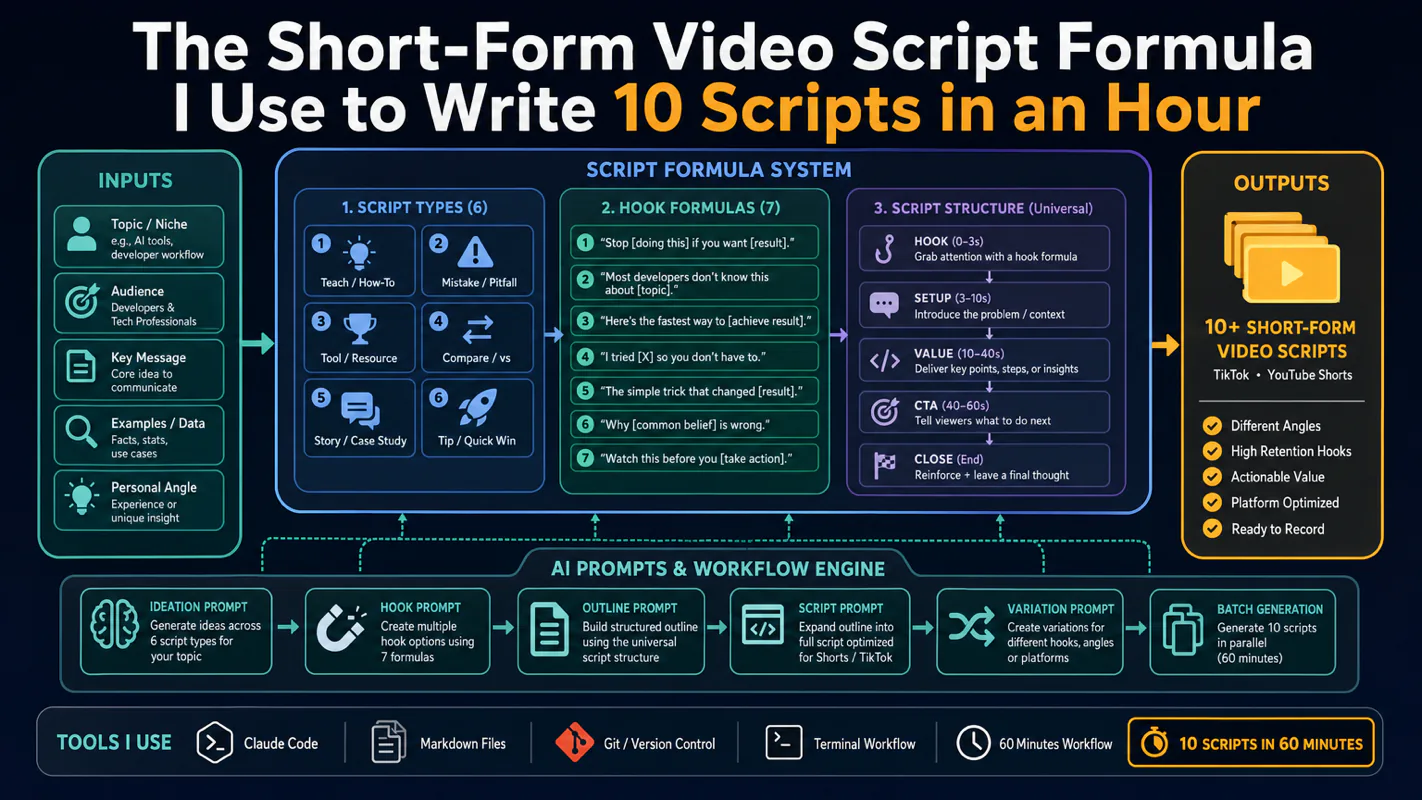
Thursday afternoon, fourteen product ideas, a Monday filming slot, no scripts. Six script shapes and seven hook formulas turn that hour into finished drafts — and the business rule stays: rewrite at least 30% before anything ships.
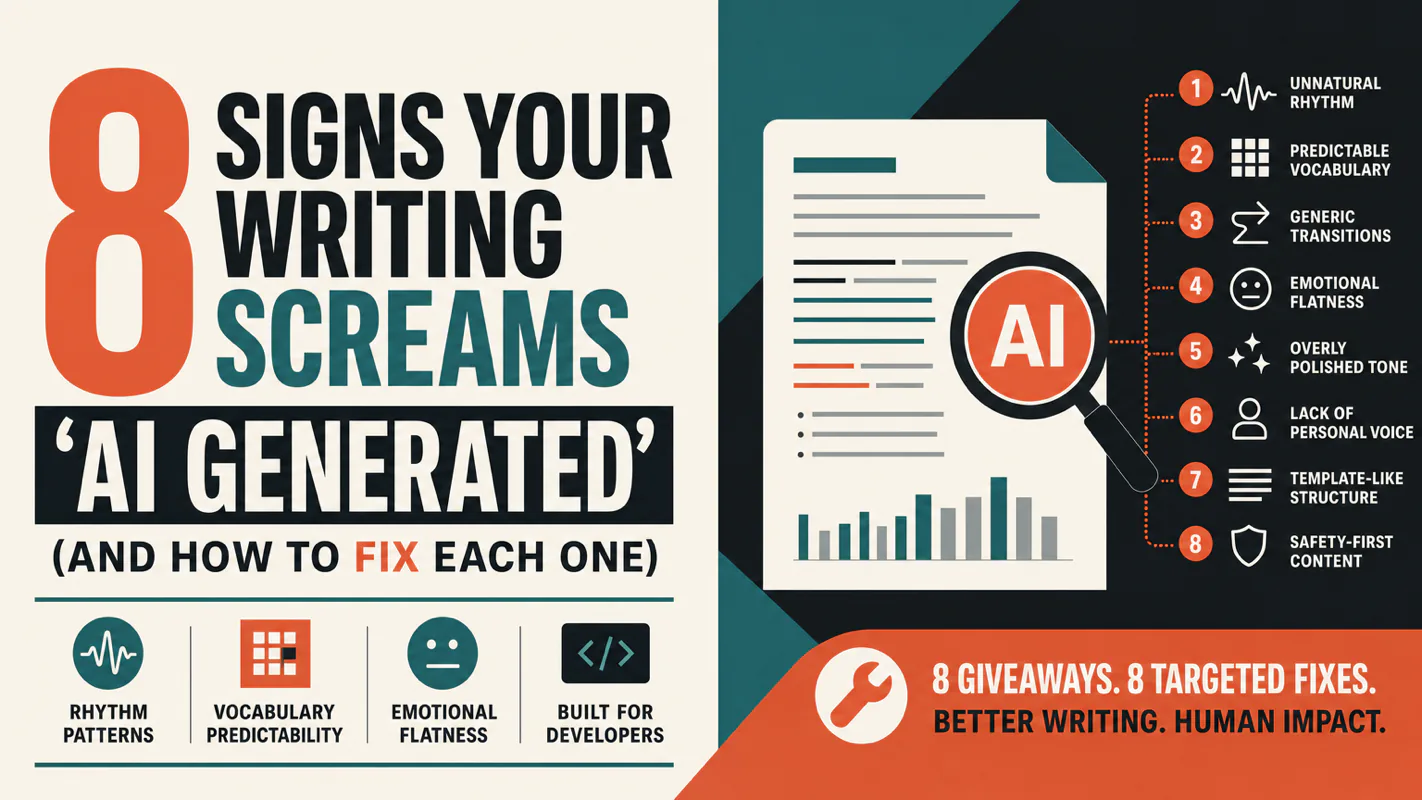
A detector score cannot survive a conversation with the freelancer it just cost three weeks of payment. What holds up is the specific thing on the page: rhythm, vocabulary, missing detail. Eight of them here, and the reason review stays human when you automate business processes.