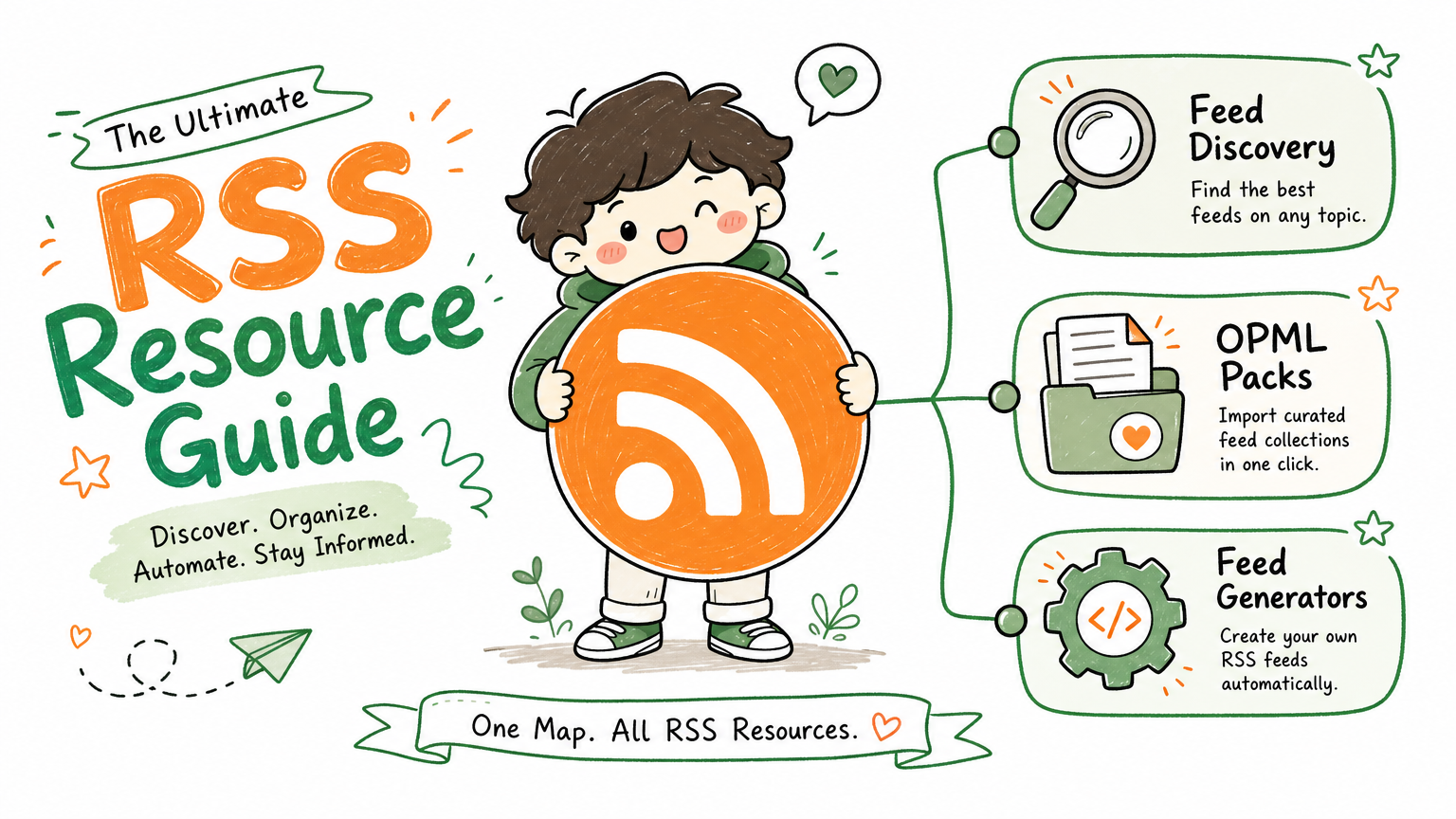
Monitoring a competitor who publishes no feed is the case every RSS guide skips. Twenty-one platforms sorted by which of three jobs they do, and the finished setup is business process automation you own outright, with no seat licence to renew.
Blaming the content is the reflex when a post underperforms, and it is usually the wrong diagnosis. A second reader decides distribution before any human sees the post, and most of what it checks is mechanical enough to automate business processes around, on five platforms at once.
Gloves on, tape measure in hand — nobody types a query. Three voice surfaces for ai automation tools (terminal, Telegram, Discord), 10 TTS and 6 STT providers compared on cost and latency, plus a setup that costs nothing.
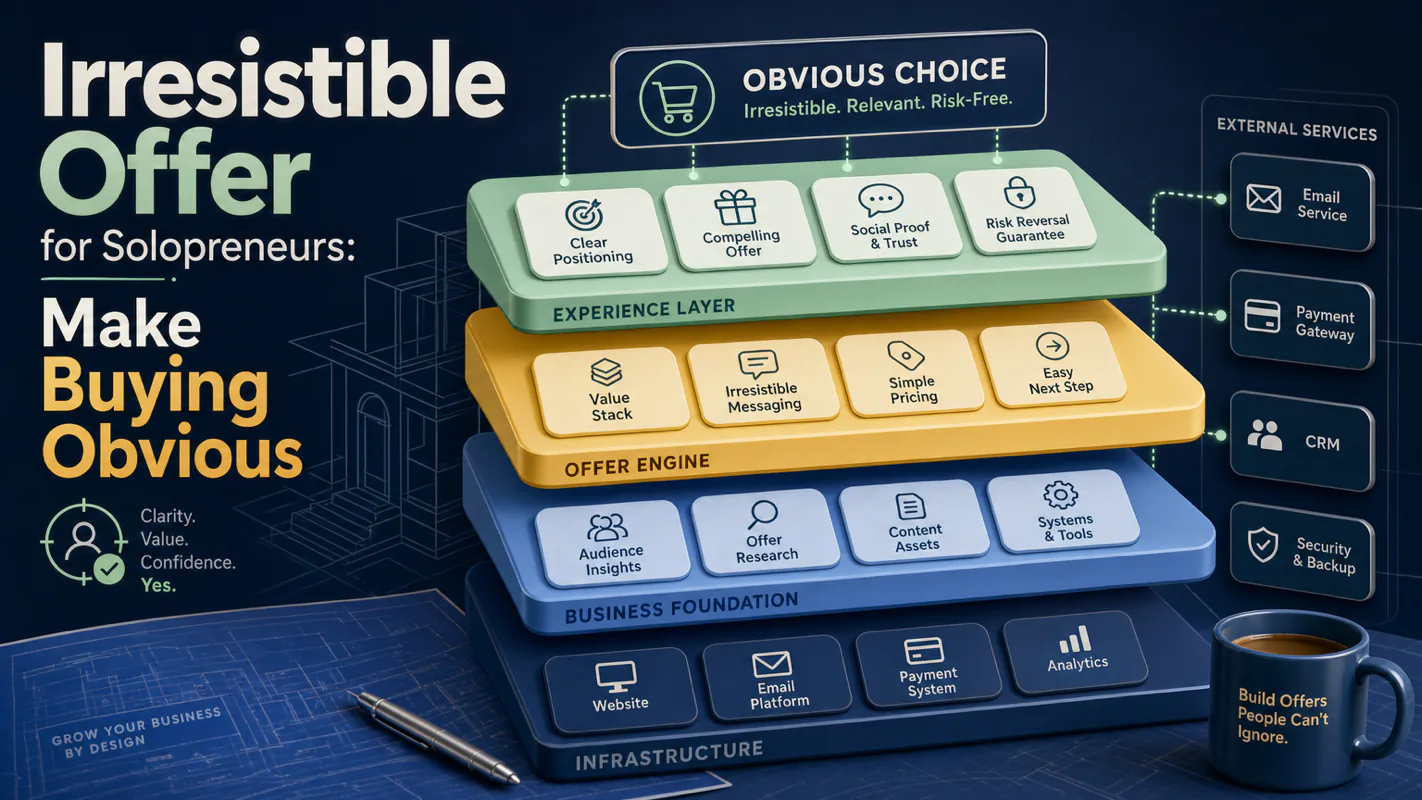
Irresistible Offer for Solopreneurs: Make Buying Obvious
A better product does not automatically sell, and a discount usually sets a number you cannot walk back. A better offer makes the outcome clearer, the risk lower, the wait shorter, and the buyer's own work smaller. That is what this guide builds for a one-person small business, lever by lever.
A better product does not automatically create a better sale. A better offer makes the result easier to understand and easier to believe.
The offer is not the product. It is the way the product is packaged, promised, delivered, de-risked, and named.
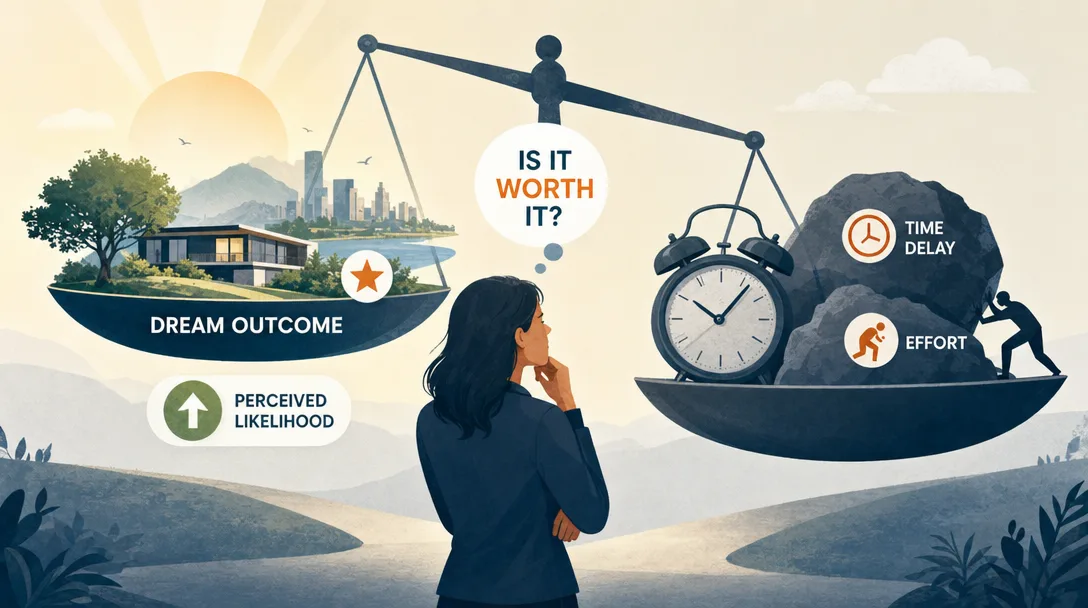
Use the value equation: increase dream outcome and perceived likelihood, reduce time delay and effort.
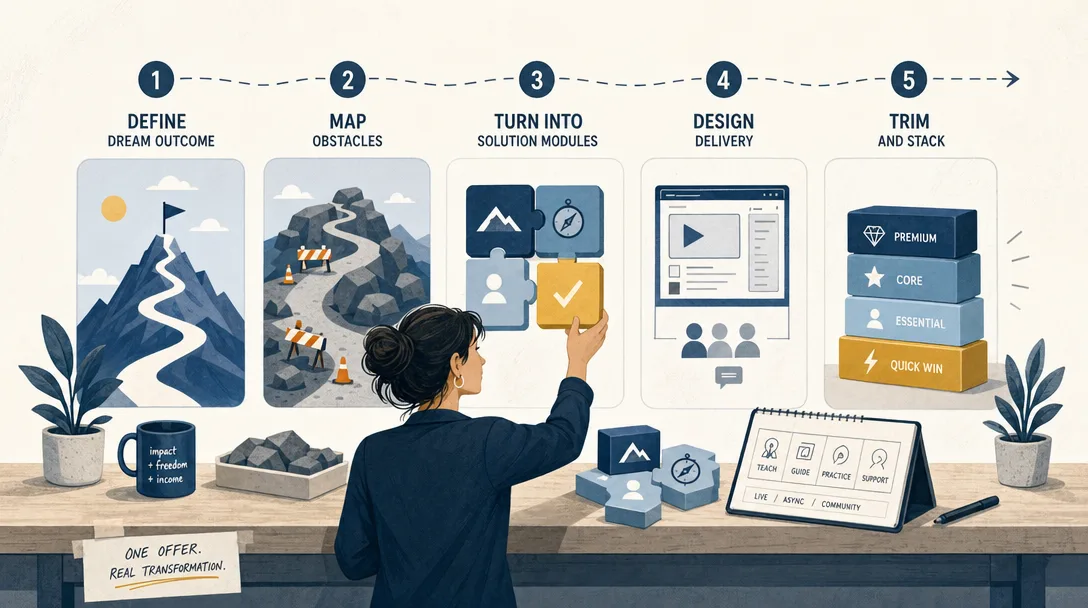
Below is the full system: obstacle mapping, delivery design, value stack, product ladder, guarantees, naming, pricing, and AI prompts.
A fractional CFO cut her monthly rate 30% to win a hesitant client. It worked, and it set the number for everything after: that client referred two more at the same rate, and eighteen months later she was carrying three accounts priced below what the work took. The discount had not made the offer easier to buy. It made the promise harder to believe and the price harder to defend. Everything below is the alternative -- the four levers that move a buyer without touching price: a visible outcome, proof instead of hype, a first-week win, and less work left on the buyer's desk.
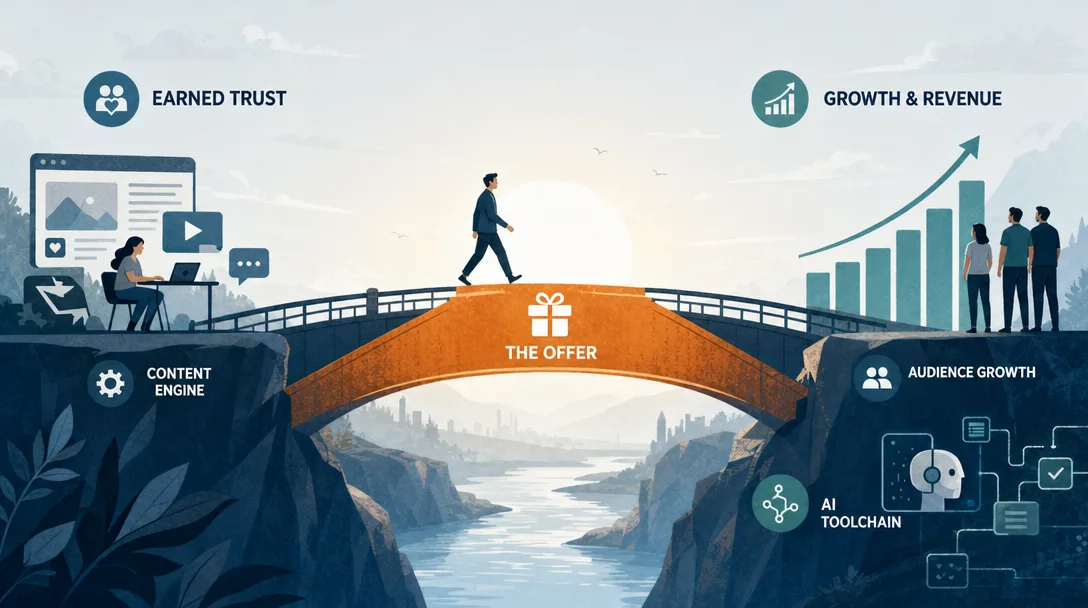
By now you have the direction, brand, story, and content engine. If you skipped ahead, read the previous piece on building a solopreneur content engine first. Content creates trust. The offer turns that trust into revenue.
Here is the uncomfortable part:
Many solopreneurs do the hard work and still fail to sell.
They create useful content. They build a decent product. They open a checkout page. Then nothing happens.
The easy conclusion is "my audience is too small" or "people do not want to pay." Sometimes that is true. But often the deeper problem is simpler:
The offer is not clear enough to buy.
The Irresistible-Offer Landscape in 2026
Hormozi's $100M Offers put the value equation into the mainstream. The market caught up. So did the noise.
A 2026 spot check for "irresistible offer" mostly returns generic $100M Offers and value-equation explainers (Uplify, Creator Economy, Course Unlocked, Fuel Your Digital). The common pattern is formula-first: dream outcome, likelihood, time delay, effort.
The useful gap for a solopreneur is more specific: apply the four levers to a one-person business with named operator data, like Designjoy at $4,995/month and $3.1M ARR running solo, Welsh's $10M product ladder, and the anti-patterns that kill solo offers (effort tax, time-delay tax). The gap is not "more Hormozi." The gap is the four levers tuned for solo operators with real numbers attached. That is what this guide is.
Why a Good Product Is Not the Same as an Irresistible Offer
Everyone says ship a great product and the buyers will come. Actually, the wrapper often changes the sale more than another month of product polish: a vague offer makes the buyer translate features into outcomes, while a sharp offer makes the result, proof, time frame, and risk reversal visible before the checkout page. Here's why this matters: most solopreneurs spend three months polishing the product and three weeks on the offer. The actual lift is usually reversed.
Imagine two courses.
Course A says:
30 video lessons, worksheets, community access, and weekly Q&A.
Price: $99.
Course B says:
In 90 days, build your first paid customer acquisition system. If you do the weekly assignments and cannot launch the system, I refund you.
Price: $999.
The actual lessons might overlap by 80 percent.
But the buying experience is completely different.
Course A sells inputs: videos, worksheets, community, Q&A.
Course B sells a result, a time frame, a path, and a risk reversal.
Most beginner solopreneurs sell Course A because it feels honest. They list what is inside. They assume the buyer will translate the pile of deliverables into a personal outcome.
That is a lot of work to ask from a buyer.
An offer does the translation for them.
Product thinking
Offer thinking
What is inside?
What changes for the buyer?
How many lessons?
What outcome happens by when?
What features do I include?
What obstacles do I remove?
What price feels fair?
What value does the buyer perceive?
How do I explain the product?
How do I make the decision obvious?
This is not manipulation.
It is clarity.
If your product genuinely helps, a weak offer hides that value. A strong offer reveals it.
The Value Equation: Buyer-Side Math Behind Every Irresistible Offer
A useful way to diagnose any offer is the value equation popularized by Alex Hormozi's offer work, laid out in $100M Offers, which has reportedly sold more than a million copies, and summarized in Acquisition.com's own [pricing and value checklist](
" download style="background:#333;color:#fff;padding:8px 16px;border-radius:6px;text-decoration:none;font-size:13px;white-space:nowrap">下载 PDF
?hsLang=en):
Value = (Dream Outcome x Perceived Likelihood of Success)
        / (Time Delay x Effort and Sacrifice)
It is not a physics formula. It is a buyer psychology map.
Four levers:
Lever
Buyer question
Direction
Dream outcome
What do I get if this works?
Increase
Perceived likelihood
Will this work for someone like me?
Increase
Time delay
How long until I see a result?
Decrease
Effort and sacrifice
What will this cost me in work, discomfort, risk, and attention?
Decrease
Most weak offers only work on one lever.
Hormozi himself flags this as the beginner trap. In $100M Offers he confesses: "In the beginning of my career, I focused all my attention on dream outcomes and the perception of achievement... the top side of the equation. That's where beginner marketers make bigger and bigger claims. It's easy, and it's lazy. The harder, and more competitive, are the Time Delay and Effort & Sacrifice. The best companies in the world focus all their attention on the bottom side of the equation." If your offer only inflates the dream, you are doing the easy half. The compounding work is the bottom half, collapsing time-to-result and removing effort.
They make the dream outcome bigger:
Become a better writer.
But they do not increase belief, shorten time, or reduce effort.
A stronger offer works on all four:
In 14 days, turn your messy expertise into a weekly newsletter system. Includes a topic bank, draft template, editing checklist, and two teardown sessions so you publish the first issue before the program ends.
Same general area.
Different perceived value.
Lever 1: Make the Dream Outcome Visible
The buyer does not want your method.
They want the after-state.
Do not sell "twelve modules on content strategy." Sell "a weekly content system that produces one article, five distribution assets, and subscriber growth without starting from a blank page."
Do not sell "brand consulting." Sell "a landing page message people understand in five seconds."
Do not sell "AI workflow templates." Sell "a one-person operating system that handles research, drafting, formatting, and publishing without rebuilding the process every week."
The dream outcome should pass three tests:
The buyer can picture it.
The buyer wants to be seen as the kind of person who has it.
The buyer can tell whether it happened.
Weak outcomes are vague:
clarity,
confidence,
growth,
productivity,
better marketing.
Strong outcomes are concrete:
publish one issue per week for 12 weeks,
get your first five sales calls,
build a landing page that states buyer, problem, result, proof, and CTA,
turn one article into ten distribution assets,
ship a paid diagnostic offer in seven days.
The more concrete the after-state, the easier the offer is to believe.
Lever 2: Increase Perceived Likelihood with Proof, Not Hype
The buyer is not only asking "do I want this?"
They are asking:
Will this work for me?
This is where proof matters.
Not hype.
Proof.
Proof type
Example
Case study
"A consultant used this framework to rewrite her offer and book 6 calls in 14 days."
Process proof
Show the exact steps, before the sale
Similarity proof
Testimonials from people like the buyer
Constraint proof
"Built for people with 5 hours/week, not full-time founders"
Risk proof
Guarantee, trial, or teardown before commitment
Authority proof
Credible source, public track record, published work
The most powerful proof for a solopreneur is often process proof.
You may not have hundreds of testimonials yet. But you can show the thinking. You can show the template. You can show the before and after. You can show the exact checklist you use.
This is why content and offer design connect.
Your content engine builds perceived likelihood before the sales page ever appears. Every useful article says:
This person understands the problem and has a way through it.
The offer simply concentrates that trust into a buying decision.
Lever 3: Shorten Time Delay with a First-Week Win
Buyers care about the final result, but they need an early win.
If the only payoff is six months away, belief decays.
So every strong offer should include a first-result milestone.
Offer
Weak time promise
Strong early win
Content system
"Build long-term consistency"
"Publish your first core article in 7 days"
Offer design
"Improve conversion"
"Rewrite your current offer into a one-page value stack this week"
Personal brand
"Become known"
"Ship your positioning page and 10 proof posts in 14 days"
AI toolchain
"Automate your business"
"Automate one repeated task by Friday"
The early win is not the whole transformation.
It is the proof that the path is real.
A useful rule:
Design the first visible win before you design the rest of the curriculum.
If your offer cannot create any meaningful progress in the first week, either the scope is too broad or the delivery model is too passive.
Lever 4: Reduce Effort and Sacrifice with Reusable Assets
The most common failure mode in solopreneur offers: requiring the buyer to do the assembly. A 12-step plan, a 40-page workbook, a "watch the videos and figure it out" course. The buyer abandons in week one, the refund email arrives in week two, and the offer's conversion data quietly tanks.
People often say they want the best solution.
In practice, they want the best believable solution that does not demand too much work.
This is why "done with you" and "done for you" offers often command higher prices than pure information products. The buyer does not only pay for knowledge. They pay to reduce the burden of execution.
For a solopreneur, this does not mean you should do everything manually.
It means you should identify the painful parts and remove them with assets:
Buyer obstacle
Asset that reduces effort
"I do not know where to start"
Diagnostic checklist
"I cannot write the page"
Fill-in sales page template
"I do not know what to say in outreach"
Message scripts
"I always overthink pricing"
Pricing worksheet
"I will fall behind"
Weekly accountability ritual
"I cannot tell if my offer is good"
Final validation scorecard
This is why templates are valuable.
Not because templates are magical. Because they reduce blank-page effort.
The Five-Step Solopreneur Offer Build
Back when "make an offer" meant a price tag and a "buy now" button, the bottleneck was traffic. Now AI compresses copywriting to minutes, but the offer-construction question is the same one Hormozi made famous: what does the buyer actually trade for, and what stops them from saying yes.
Before this five-step process, you list features and hope. After: you build the four levers in order (dream outcome, likelihood, time, effort), name the offer, and raise the conversion ceiling compared with "this is what you get" pages.
Now we turn the equation into an operating process.
Step 1: define the dream outcome
Write the buyer's desired result in their language.
Not your language.
The buyer does not want "strategic positioning architecture." They want "people understand what I sell."
Use this prompt:
The buyer starts at [current painful state].
They want to reach [specific desired state].
They care because [status, money, time, relief, identity, or opportunity].
The offer helps them get there by [mechanism].
The first visible win happens by [time frame].
Example:
The buyer starts with a vague consulting offer that people do not understand.
They want a one-page offer that makes the buyer, problem, promise, proof, price, and CTA obvious.
They care because unclear offers waste sales calls and make them look less credible.
The offer helps them get there by mapping objections into solution modules and building a value stack.
The first visible win happens by day 7: a rewritten offer page draft.
Now you have an offer direction.
Step 2: list every obstacle
Most offers are too thin because they solve only the obvious problem.
The buyer has more obstacles than that.
Map the journey from purchase to result. For each step, list obstacles in four categories:
Obstacle category
Buyer thought
Dream outcome
"Is this worth it?"
Likelihood
"Will it work for me?"
Time
"Will this take too long?"
Effort
"Will I actually do it?"
Example: a solopreneur offer-design program.
Step
Obstacles
Define target buyer
"My audience is too broad," "I do not know who pays," "I am afraid to niche down"
Map desired result
"My result is vague," "I sell process, not outcome"
List buyer objections
"I do not know what buyers are afraid of"
Build solution modules
"I keep adding lessons instead of removing friction"
Price the offer
"I feel guilty charging more"
Write the sales page
"I sound either boring or pushy"
Launch
"I do not know who to show it to"
Do not rush this step.
Every obstacle is a possible module, template, guarantee, bonus, FAQ, or proof asset.
Step 3: turn obstacles into solutions
Now convert each obstacle into a solution statement.
Use "How to..." language.
Obstacle
Solution module
"I do not know who pays"
How to identify the buyer most likely to pay now
"I am afraid to niche down"
How to narrow the offer without shrinking the market too far
"My result is vague"
How to turn a process into a visible buyer outcome
"I do not know objections"
How to build a 40-objection map from real buyer language
"I feel guilty charging more"
How to price around value, not hours
"I sound pushy"
How to write a sales page that explains instead of pressures
This is where the offer starts to become hard to compare.
You are no longer selling "a course about offers." You are selling a system that removes the buyer's exact obstacles.
Step 4: design delivery
For each solution module, decide how it should be delivered.
Not every module needs a video lesson.
In fact, many should not.
Solution type
Best delivery
Judgment
Short lesson, teardown, or decision tree
Repeated task
Template, script, calculator, or checklist
Emotional blockage
Story, example, or coaching session
Skill gap
Workshop, walkthrough, or practice assignment
Accountability gap
Weekly check-in, scorecard, or peer review
Implementation burden
Done-with-you sprint or automation
The solopreneur constraint is important:
Prefer assets you create once and reuse many times.
Templates, calculators, worksheets, teardown rubrics, prompt packs, and standard operating procedures are excellent because they increase perceived value without forcing you into unlimited custom labor.
High-touch elements can still exist, but they must be bounded:
one teardown,
two office hours,
three review slots,
fixed 14-day sprint,
maximum cohort size.
Boundaries are not selfish.
They are how the offer survives.
Step 5: trim and stack
At this stage, you may have too many modules.
Cut aggressively.
Use this matrix:
High customer value
Low customer value
Low delivery cost
Keep and stack
Usually cut
High delivery cost
Keep only if central
Cut first
Then name each retained module by outcome.
Not "Module 3: Pricing."
"The Price Confidence Worksheet."
Not "Bonus: Templates."
"The 7-Day Sales Page Draft Kit."
The stack should show total value clearly:
Module
Buyer value
Offer Diagnosis Scorecard
Finds the real leak before rewriting
Buyer Obstacle Map
Turns objections into modules
Value Stack Builder
Packages deliverables around perceived value
Pricing Decision Tree
Chooses a price range without guessing
Sales Page Draft Kit
Turns the offer into publishable copy
Launch Message Pack
Gives warm outreach and content prompts
Final Validation Rubric
Checks whether the offer is ready to sell
The goal is not to make the list longer.
The goal is to make the value easier to perceive.
Present the Value Stack: Reveal the Offer in Order
How you present the offer matters.
Do not dump every module at once.
Reveal the stack in order:
Name the desired result.
Name the main obstacle.
Introduce one module that removes it.
Explain what the module helps the buyer do.
Add its standalone value.
Repeat for the next obstacle.
Show the full stack.
Present the price.
This pacing lets the buyer feel the value accumulate.
Weak presentation:
You get 8 modules, 20 videos, 6 templates, and a community.
Better presentation:
First, we diagnose why your current offer is not converting. Then we map every buyer objection. Then we turn those objections into solution modules. Then we build the stack, price it, write the page, and validate it before launch.
One sells inventory.
The other sells a path.
Build a Solopreneur Product Ladder: Free, Low, Core, High
An irresistible offer should sit inside a product ladder.
For a solopreneur, the ladder keeps you from asking a cold stranger to buy the most expensive thing first.
A person who pays $19 for a useful template is psychologically different from a person who only consumes free content. They have crossed the payment line.
Do not despise low-ticket products. Their job is not always profit. Sometimes their job is qualification.
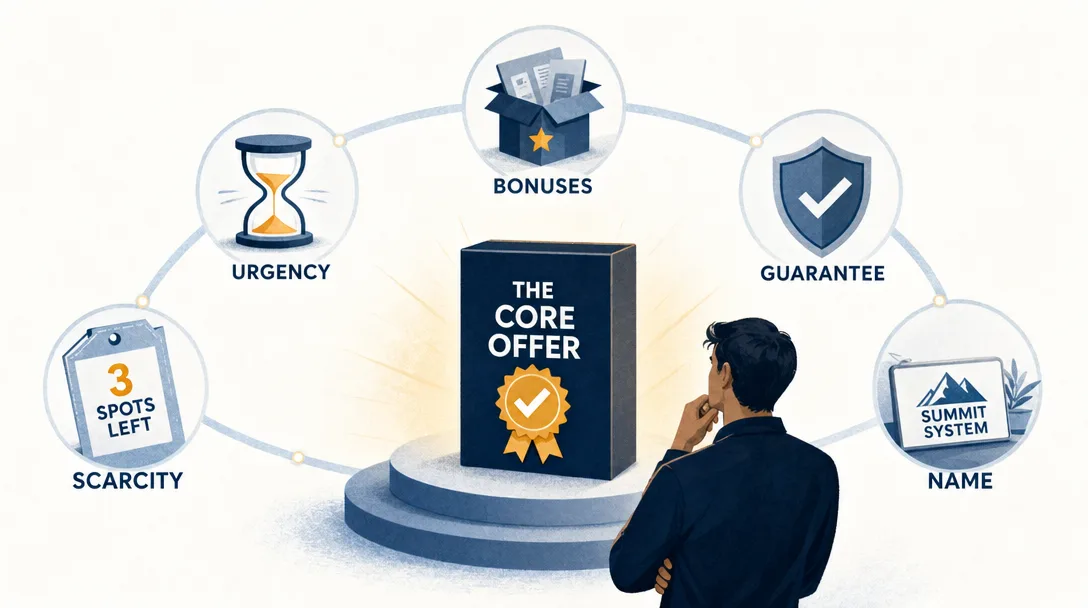
The Five Offer Enhancers: Scarcity, Urgency, Bonuses, Guarantee, and Name
Once the core offer is strong, five enhancers can improve conversion without changing the product itself.
1. Scarcity
Real scarcity is not fake countdown pressure.
Real scarcity comes from a true constraint:
limited teardown slots,
limited cohort size,
limited implementation capacity,
limited launch window,
limited founder attention.
For a solopreneur, scarcity is often honest. You cannot serve 500 people personally.
Say the limit plainly.
2. Urgency
Urgency gives people a reason to act now.
Use it carefully.
Good urgency:
cohort starts Monday,
bonuses close Friday,
teardown slots expire when filled,
early pricing ends after the beta cohort.
Bad urgency:
fake timers,
permanent "last chance" banners,
pressure that resets every visit.
Trust is more valuable than a short-term bump.
3. Bonuses
Good bonuses reduce effort.
Bad bonuses add homework.
Weak bonus
Strong bonus
"3 extra trainings"
"Sales page swipe file"
"Bonus video library"
"Pricing calculator"
"Community access"
"Launch message templates"
"More lessons"
"Done-in-one-page checklist"
People do not want more material.
They want fewer obstacles.
4. Guarantee
A guarantee reverses risk.
In the guarantees chapter of $100M Offers, Hormozi distills guarantees into four types and argues that a stronger guarantee can meaningfully lift conversion rates — sometimes by multiples — because risk reversal is one of the highest-leverage parts of an offer.
Hormozi type
What it means
Best for
Unconditional
"No questions asked" refund or trial, strongest, highest perceived risk reversal
Low-ticket digital products, trust building
Conditional
Refund or extension tied to "if you do the work" terms, most common
Courses, implementation programs
Anti-Guarantee
Explicit "all sales are final" stated honestly with reasoning
High-touch or immediately consumable material
Implied (performance-based)
Pay tied to result: revshare, profitshare, ratchets, monetary bonuses
When you can measure and control outcomes
The format he recommends as a base sentence: "If you do not get X result in Y time period, we will Z." Plug in your specific outcome, time frame, and remedy.
Do not offer a guarantee you cannot survive financially. Also do not hide behind "no refunds" because you are afraid of accountability, Hormozi's anti-guarantee works only when the reasoning is honest.
The guarantee should match the risk you can actually control.
5. Naming
Names matter because names create memory.
"Offer Course" is forgettable.
"7-Day Offer Rebuild Sprint" is clearer.
Use this naming structure:
[Time or constraint] + [buyer] + [desired result] + [container]
Examples:
7-Day Solo Offer Rebuild Sprint
First Paid Customer Workshop
Newsletter-to-Offer Lab
Sales Page Clarity Clinic
AI Workflow Launch Kit
The name should tell the buyer whether it is for them.
If the name needs a paragraph of explanation, it is not done.
Solopreneur Pricing: Why Higher Can Be Kinder
There is a dangerous kind of low price.
It feels generous, but it creates bad delivery.
Low price can mean:
you need too many customers,
you cannot afford support,
buyers do not commit,
you attract people who only want cheap access,
you burn out,
the product never improves.
Higher price can be kinder when it funds better delivery and attracts committed buyers.
That does not mean "charge high because confidence."
It means the price should match the value and the delivery burden.
For solopreneurs, the pricing question is not:
What is the cheapest price people will accept?
It is:
What price lets me deliver the promised result well without destroying the business?
That question usually leads to a more sustainable offer.
Two public examples make the point. By Justin Welsh's own $10M Journey newsletter, his two evergreen courses (priced at $150 and $200) helped his solo business cross $10M in cumulative revenue over 5 years 9 months at ~89% margins, the offers are tightly scoped, the delivery is asynchronous, and the buyer pool is large enough that he never has to discount. Designjoy, the one-person design subscription, charges $4,995/month (regular $5,995) for unlimited design and hit $3.1M in revenue in 2024 with zero employees — a deliberately higher price that funds a single founder doing focused work without agency overhead. Different business models, same lesson: price was chosen so the founder could deliver well, not so the page could feel cheap.
The 10-Point Irresistible Offer Audit Checklist
Before you launch, run this checklist.
Check
Pass condition
Dream outcome
A buyer can picture the result
Buyer specificity
The offer clearly says who it is for
Obstacle coverage
The biggest objections are addressed
Early win
The buyer sees progress in week one
Proof
At least one form of evidence supports the claim
Delivery
The work is bounded and sustainable
Stack
Modules are named by outcome, not inventory
Price
Price is justified by value and support needs
Guarantee
Risk reversal matches what you can control
CTA
The next step is obvious
If three or more fail, do not launch yet.
Rewrite the offer before you buy ads, redesign the page, or blame the audience.
Offer Design Traps to Avoid
Offer design has a dark side.
Once people learn the levers, they sometimes use them to create pressure instead of clarity. That may produce a few sales. It also damages the business.
Avoid these traps.
Trap
Why it fails
Fake scarcity
Buyers eventually learn that the limit was not real
Fake urgency
Permanent countdowns destroy trust
Inflated stack value
A "$9,997 value" that nobody would pay for is not value
Too many bonuses
More material often means more work for the buyer
Overpromising results
You create refunds, resentment, and legal risk
Hiding the workload
Buyers feel tricked when the work appears later
Copying a guru script
Your audience can feel borrowed language
The clean version is better:
Say what is truly limited.
Say what result you can actually help with.
Say what the buyer still has to do.
Say who should not buy.
Say what happens after purchase.
A good disqualification section often increases trust.
For example:
This is not for you if you want a passive course library. It is for you if you can spend five focused hours per week rebuilding one offer and shipping the page.
That sentence may reduce the number of buyers.
Good.
It also increases the quality of buyers. For a solopreneur, customer quality is not a small detail. Bad-fit customers consume the exact time and attention your whole business depends on.
The Smallest First Offer: Prove the Promise Before the Program
If you are starting from zero, do not build the biggest version of the offer first.
Build the smallest paid version that proves the promise.
I like fixed-scope diagnostic offers for this.
Example:
$149 Offer Teardown: I review your current offer page, score it against the value equation, and send back a one-page rewrite plan within 72 hours.
That is not a huge product. It is useful because it tests five things:
Will anyone pay for this problem?
Can you diagnose the problem quickly?
Do buyers use the language you expected?
Can you create a visible win?
Does the diagnostic naturally lead to a larger implementation offer?
Another example:
$49 Sales Page Draft Kit: a template, checklist, and 30-minute walkthrough that helps solo consultants rewrite their offer section.
This tests whether people want the asset before you build the full program.
The first offer should be small enough to ship in a week and real enough that people have to pull out a credit card.
Free feedback is noisy. Payment clarifies.
Use this decision table:
If you have...
Start with...
No audience
Warm outreach plus a paid diagnostic
Small audience
Template pack or teardown
Strong content response
Workshop or mini cohort
Repeated buyer questions
Core program
Existing proof and demand
Higher-ticket implementation sprint
This keeps you from building a $999 program when the market has not validated the $99 problem yet.
How Your Solopreneur Offer Connects Back to the Content Engine
The offer should not appear from nowhere.
It should emerge from the content engine.
Use content to test pieces of the offer before the sales page exists.
Content test
Offer signal
Article about the problem
Do readers recognize the pain?
Checklist post
Do people save the process?
Case teardown
Do people ask for their own teardown?
Pricing opinion
Do people argue, reply, or ask about their situation?
Soft CTA
Do people request the next step?
If a topic gets attention but no buying questions, it may be educational but not commercial.
If a topic creates replies like "can you look at mine?" you may have an offer.
That is the cleanest path:
Content reveals the pain. The offer packages the solution.
Read docs/current-offer.md, docs/product-info.md, and docs/audience.md.

Audit my offer using the value equation:
- dream outcome,
- perceived likelihood of success,
- time delay,
- effort and sacrifice.

Score each lever from 1 to 10.
Identify the weakest lever.
Give 5 concrete improvements.
Save to output/value-equation-audit.md.
Weakest lever: time delay. The buyer cannot picture when the result happens. Top 5 fixes: (1) add Day-7 milestone (2) compress curriculum (3) name the early win on the headline (4) show one finished example (5) add 14-day guarantee tied to the milestone.
Prompt 2: Obstacle map
Read output/value-equation-audit.md.

Map the buyer journey from purchase to desired result.
For each step, list obstacles in four categories:
- dream outcome doubt,
- likelihood doubt,
- time delay,
- effort and sacrifice.

Return at least 40 obstacles.
Save to output/obstacle-map.md.
Prompt 3: Solution modules
Read output/obstacle-map.md.

Turn every obstacle into a "How to..." solution module.
Group similar modules.
For each module, estimate:
- customer value,
- delivery cost,
- whether it improves dream outcome, likelihood, time, or effort.

Save to output/solution-modules.md.
Prompt 4: Delivery design
Read output/solution-modules.md.

Design the best delivery format for each module:
- template,
- checklist,
- calculator,
- lesson,
- workshop,
- teardown,
- done-with-you sprint,
- community support.
Prefer once-created, reusable assets when possible.
Flag anything that creates unlimited support risk.
Save to output/delivery-design.md.
Prompt 5: Stack and price
Read output/delivery-design.md.

Trim low-value modules.
Keep the strongest stack.
Name each retained module with an outcome-focused name.
Estimate standalone value.
Recommend a price range and explain why.
Save to output/value-stack.md.
Prompt 6: Product ladder
Read output/value-stack.md.

Design a four-level product ladder:
- free asset,
- low-ticket entry,
- core offer,
- high-ticket service.

For each level, define price, purpose, delivery, next-step CTA, and solopreneur workload.
Save to output/product-ladder.md.
Prompt 7: Offer enhancers
Read output/value-stack.md and output/product-ladder.md.

Design:
- 3 real scarcity options,
- 2 urgency options,
- 5 low-cost high-value bonuses,
- 2 guarantee options,
- 10 names using time, buyer, outcome, and container.

Reject fake scarcity.
Save to output/offer-enhancers.md.
Prompt 8: Sales page copy
Read every file in output/.

Write a complete sales page draft:
- headline,
- subheadline,
- problem,
- new opportunity,
- value stack,
- proof,
- price,
- guarantee,
- FAQ,
- CTA.

Use plain language.
Do not invent testimonials or revenue claims.
Save to output/sales-page-copy.md.
Prompt 9: Final validation
Read output/sales-page-copy.md.

Run the offer audit checklist:
- outcome clarity,
- buyer specificity,
- obstacle coverage,
- early win,
- proof,
- delivery sustainability,
- value stack,
- price logic,
- guarantee,
- CTA.

Mark pass/fail.
For every fail, rewrite the relevant section.
Save to output/validation-report.md.
Key Takeaways
An irresistible offer for solopreneurs is not a discount. It is a clearer dream outcome, higher belief, shorter time, and lower effort, all four levers, not just one.
Sell the result, not the inventory. "30 lessons + community + Q&A" is product thinking; "first paid customer system in 90 days, refund if you do the work" is offer thinking.
Run the 5-step build: dream outcome → obstacle map → solution modules → delivery design → trim & stack. Cut aggressively; name modules by outcome, not by inventory.
Stack 5 enhancers honestly: real scarcity, real urgency, useful bonuses, a guarantee you can survive, a name that tells the buyer who it's for.
Price so you can deliver well. Cheap offers underfund delivery and burn out solopreneurs. Higher prices fund better work and attract committed buyers.
Build the smallest paid version first ($49–$249 diagnostic / template kit) before the program. Free feedback is noisy; payment clarifies what people actually want.
Ready-to-Use Prompt: Turn Your Product Into an Irresistible Offer With the Value Equation and Four Levers
What this does: Applies the buyer-side value equation and its four levers (visible dream outcome, proof, first-week win, reusable assets) to your product, then presents the value stack, builds the Free/Low/Core/High product ladder, and adds enhancers and pricing — so buying becomes obvious without discounting. Based on: Irresistible Offer for Solopreneurs: Make Buying Obvious — https://aiworkflowpro.com/solopreneur-irresistible-offer/ Time to run: ~5 minutes
Copy this prompt into Claude Code, ChatGPT, or any AI assistant:
ROLE: You are a solopreneur offer architect. Your job: turn a product into an irresistible offer using the buyer-side value equation and its four levers, then present the value stack, product ladder, enhancers, and pricing — so buying becomes obvious, without discounting.

CONTEXT — VALUE-EQUATION OFFER BUILDER (4 LEVERS):
A better product does not automatically create a better sale — a better offer makes the result easier to understand and easier to believe. The offer is not the product; it is how the product is packaged, promised, delivered, de-risked, and named. The buyer-side value equation drives everything: value = (dream outcome × perceived likelihood) ÷ (time delay × effort & sacrifice). Raise the numerator with four levers: (1) make the dream outcome visible, (2) increase perceived likelihood with proof not hype, (3) shorten time delay with a first-week win, (4) reduce effort with reusable assets. Then present the value stack, build a product ladder (Free/Low/Core/High), and add enhancers — all without discounting.

INPUTS (fill in before running):
- PRODUCT: YOUR_PRODUCT_HERE (what you sell — one sentence)
- BUYER: YOUR_CUSTOMER_HERE (who buys, and their dream outcome)
- PROOF_ASSETS: YOUR_EVIDENCE_HERE (testimonials, results, demos — or "none")
- CURRENT_PRICE: YOUR_PRICE_HERE (current price, or "undecided")

METHOD — 6 STEPS:

Step 1 — Make the dream outcome visible (lever 1)
State the buyer's dream outcome in concrete, visible terms — not the product's features. BUYER buys the outcome, not the tool. If you cannot paint the visible end state, the offer is feature-listed, not outcome-led.

Step 2 — Increase perceived likelihood with proof (lever 2)
Attach PROOF_ASSETS (results, testimonials, demos) to raise belief — proof, not hype. Hype without proof lowers perceived likelihood; proof raises it. If PROOF_ASSETS = none, generate a first result/demo before launching the offer.

Step 3 — Shorten time delay with a first-week win (lever 3)
Design a first-week win — something the buyer achieves in week one — so the time-to-outcome collapses. Long time delay kills the value equation; a fast early win restores it.

Step 4 — Reduce effort with reusable assets (lever 4)
Bundle reusable assets (templates, checklists, scripts) so the buyer's effort/sacrifice drops. Effort is in the denominator — reducing it raises value without touching price.

Step 5 — Present the value stack + product ladder
Reveal the value stack in order (core + each bonus, each valued), so the buyer sees the stack before the price. Then set the product ladder: Free → Low → Core → High — giving buyers a path, not a single cliff.

Step 6 — Add enhancers + price (higher can be kinder)
Apply enhancers from the five (scarcity, urgency, bonuses, guarantee, name) — only the ones that are truthful. Then price: higher can be kinder (more commitment, better buyers, less support load) — do not default to discounting. State the price + the one enhancer that matters most.

RULES:
- The offer is not the product — it is the packaging, promise, delivery, de-risking, and naming.
- Use the value equation: raise dream outcome + perceived likelihood, cut time delay + effort.
- Proof raises perceived likelihood; hype lowers it — never substitute hype for proof.
- Higher can be kinder; do not default to discounting to create value.

OUTPUT FORMAT:
Output six sections:
1. **Dream outcome (lever 1)** — the visible end state the buyer gets.
2. **Proof (lever 2)** — the PROOF_ASSETS attached + any to generate first.
3. **First-week win (lever 3)** — the week-one outcome that collapses time delay.
4. **Reusable assets (lever 4)** — markdown table with columns: Asset | Effort it removes.
5. **Value stack + product ladder** — the ordered value stack + the Free/Low/Core/High ladder.
6. **Enhancers + price** — the truthful enhancers applied + the price (higher-can-be-kinder rationale) + the one enhancer that matters most.
Save as @templates/solopreneur-irresistible-offer.md and run when you build or re-price an offer, then re-run whenever you add proof, a bonus, or a ladder rung.
Frequently Asked Questions
What makes an offer irresistible?
An irresistible offer makes the desired outcome clear, increases the buyer's belief that they can succeed, shortens the time to first result, reduces effort, and reverses enough risk that buying feels like the obvious next step.
Is an irresistible offer just a discount?
No. Discounting lowers price. Offer design raises perceived value. A strong offer can often charge more because it solves more obstacles, packages the result better, and makes comparison harder.
What is the value equation?
The value equation frames perceived value as dream outcome multiplied by perceived likelihood of success, divided by time delay and effort or sacrifice. It is a useful diagnostic tool for improving an offer.
Should solopreneurs charge higher prices?
Often yes, if the offer delivers a valuable result and the delivery model can support it. Higher prices can attract more committed customers, fund better delivery, and let a solopreneur serve fewer people more deeply.
Can AI help build my offer?
AI can audit your current offer, list customer obstacles, turn obstacles into solution modules, draft the value stack, and pressure-test pricing. It should not invent proof, fake scarcity, or promise results you cannot deliver.
What's next in the series?
You have the offer. Next, in Part 7: Your First 1,000 True Fans, we turn the offer and the audience into the relationship base that funds the business. Then in Part 8: AI Toolchain for Solopreneurs, we install the operating stack that lets one person deliver the offer without burning out.
It is not fake urgency, fake scarcity, or a longer bonus list.
It is the disciplined act of making the buyer's desired result clearer, more believable, faster to reach, and easier to execute.
That is why offer design matters for solopreneurs.
You do not have a sales team to explain confusion away.
The offer has to carry the clarity.
Make the result obvious. Remove the obstacles. Price for delivery. Tell the truth.
Then selling feels less like pushing.
It feels like pointing.
Before you close this tab: open your current offer page and score it against the four levers (dream outcome, likelihood, time, effort) on a 1-10 scale. Save the lowest-scoring lever as the only thing you fix this week. Save the file as offer-weakest-lever.md. That is the single biggest-impact edit you can make today.
Monitoring a competitor who publishes no feed is the case every RSS guide skips. Twenty-one platforms sorted by which of three jobs they do, and the finished setup is business process automation you own outright, with no seat licence to renew.
Blaming the content is the reflex when a post underperforms, and it is usually the wrong diagnosis. A second reader decides distribution before any human sees the post, and most of what it checks is mechanical enough to automate business processes around, on five platforms at once.
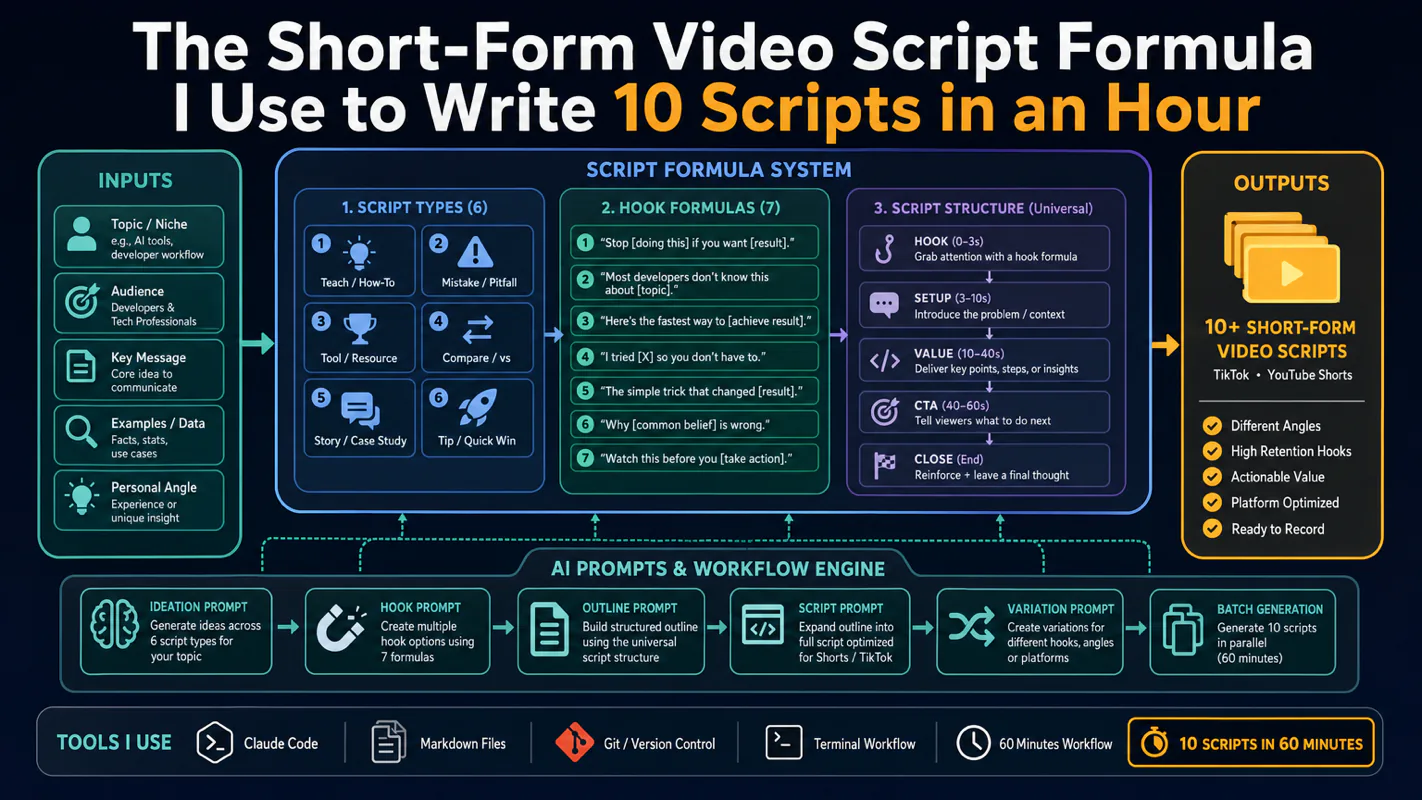
Thursday afternoon, fourteen product ideas, a Monday filming slot, no scripts. Six script shapes and seven hook formulas turn that hour into finished drafts — and the business rule stays: rewrite at least 30% before anything ships.
A detector score cannot survive a conversation with the freelancer it just cost three weeks of payment. What holds up is the specific thing on the page: rhythm, vocabulary, missing detail. Eight of them here, and the reason review stays human when you automate business processes.