Monitoring a competitor who publishes no feed is the case every RSS guide skips. Twenty-one platforms sorted by which of three jobs they do, and the finished setup is business process automation you own outright, with no seat licence to renew.
Blaming the content is the reflex when a post underperforms, and it is usually the wrong diagnosis. A second reader decides distribution before any human sees the post, and most of what it checks is mechanical enough to automate business processes around, on five platforms at once.
Gloves on, tape measure in hand — nobody types a query. Three voice surfaces for ai automation tools (terminal, Telegram, Discord), 10 TTS and 6 STT providers compared on cost and latency, plus a setup that costs nothing.
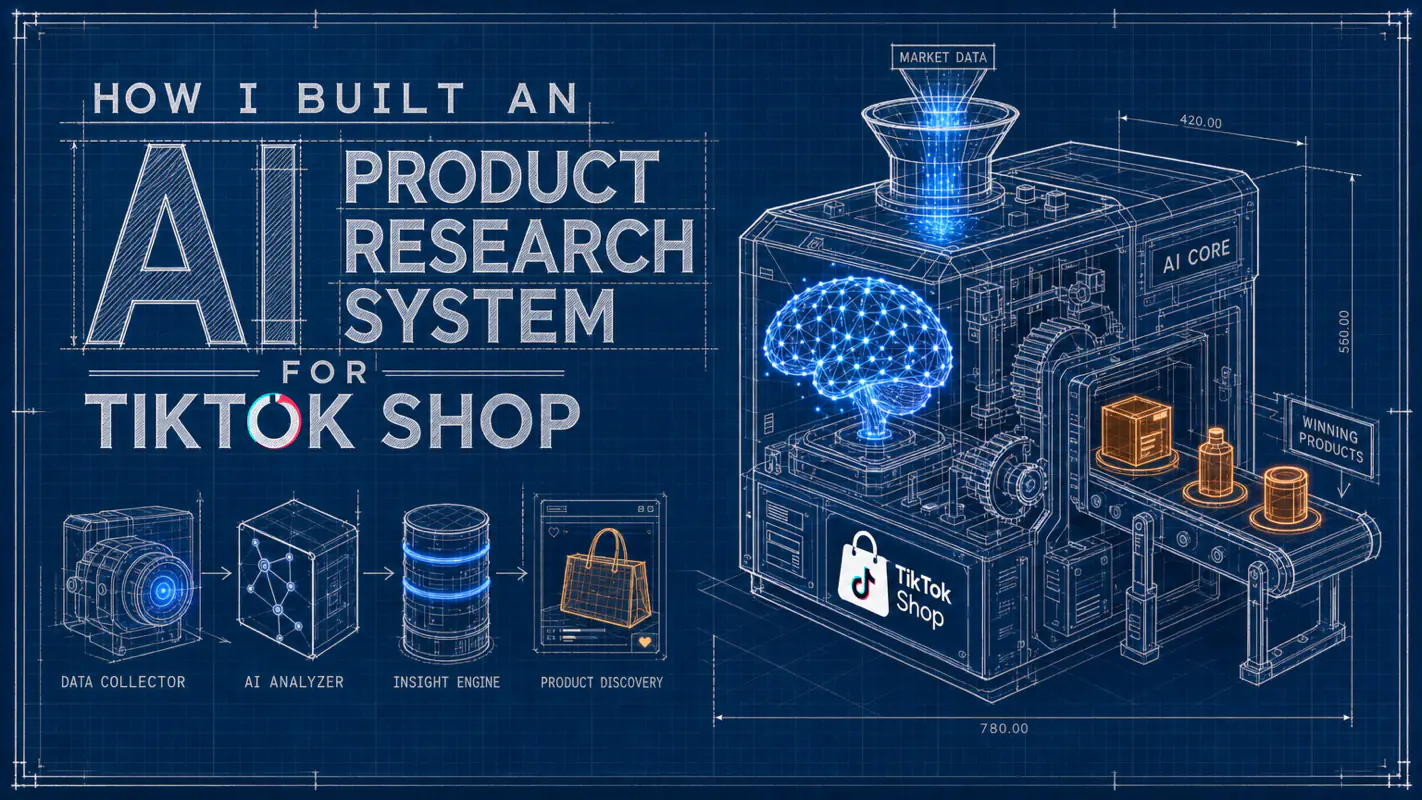
How I Use AI to Read TikTok Shop Markets Before Committing Capital
Before asking which product to sell, ask whether the category is worth entering at all. Five dimensions — lifecycle, saturation, price band, creator ecosystem, whitespace — turn one person's gut call into a written check any teammate can run before capital moves.
Most TikTok Shop sellers ask the wrong question first.
They ask "what product should I sell?" — then jump straight into product research. They scrape listings, compare SKUs, model margins, design creator commission tiers. The problem: product research inside a category you should not be in is an expensive way to rediscover the same lesson. You map the battlefield, pick your weapon, ship the inventory, then realize the war ended months ago.
The question that comes first is simpler and harder: is this category worth entering at all?
That is a market research question, not a product research question. The two operate at different layers and answer different risks:
Market research asks: is there room? Is the trend with me or against me? Has the category peaked? Where is the money migrating? Is the creator machine built yet? Where is the whitespace?
Product research asks: given the category is worth entering, what specifically do I sell, at what price, with what positioning, through which creators?
This article is about the first layer. I walk through the five-dimension framework I use to read a TikTok Shop category with AI before I commit a dollar to sourcing. If you have already validated the category and want to pick a specific product, my AI product research system breaks that next step down in detail — keyword in, action plan out.
Here is what you walk away with:
A five-dimension market research framework purpose-built for TikTok Shop
Inline AI prompts for each dimension you can paste into Claude Code today
A category analysis checklist and an opportunity scoring rubric
A worked example showing how to read a category from public signals in an afternoon
A retail buying team committed to a category on the strength of a screenshot: the numbers looked hot, the purchase order went out that week. Six months later the post-mortem could not answer a simple question — what did we actually check before signing? Nobody had been careless. The check lived in one buyer's head, and heads leave no record. The five dimensions below are that judgment written down as steps: what to look at, what each signal means, what verdict follows. Once the check exists as text it stops being a personality trait and becomes business process automation — the same read, run the same way, by whoever holds the budget.
Why Market Research Comes Before Product Research
The two-layer model matters because each layer fails in a different way, and the failures compound.
Product research fails by picking the wrong product in a category that was already lost. You spend three weeks modeling SKU variants and creator commission rates, source the inventory, and then discover the category's weekly GMV has been declining for two months. The product analysis was correct. The category verdict was never run. You optimized the deck chairs on a ship that was sinking.
Market research fails by entering a category that looks attractive on the surface but has structural traps. The volume is high because three subsidized sellers are burning inventory at a loss. The price band is opening up because a regulatory change is two months out. The creator ecosystem looks mature because the same five agencies control 80% of distribution, and there is no room for an outside brand.
Run market research first to filter out categories you should never enter. Run product research second to win inside the categories that pass.
Layer
Question
Output
Cost of skipping
Market research
Should I enter this category?
Go / no-go verdict, opportunity score, risk map
Burning capital on a category that was already lost
Product research
What product do I sell inside it?
SKU, price, positioning, creator plan
Picking the wrong product in a good category
Most sellers skip the first layer. That is where the most expensive mistakes live.
The Five Dimensions of TikTok Shop Market Research
A category is not a single number. It is a system. I read five dimensions in parallel, because each one alone misleads.
Dimension 1: Category Lifecycle Stage
The first question: is this category emerging, growing, mature, or declining? Every other signal gets interpreted through this lens.
Signals to collect:
Number of distinct stores actively listing in the category (and week-over-week change if you can sample twice)
Age of the top 10 stores — when did their earliest listed product go live?
GMV concentration: is it spreading across new entrants or consolidating into incumbents?
Search interest trajectory on the category keyword (Google Trends, TikTok Creative Center trend spikes)
Number of "new this week" products in bestseller rankings versus recurring incumbents
How to read it:
Emerging: few stores, recent product age, GMV spreading fast, search interest climbing. Early-mover window open, but the category may not stick.
Growing: store count rising, GMV rising, creator ecosystem building. The sweet spot — demand is real, the playbook is not yet locked.
Mature: store count stable or shrinking, top stores entrenched, GMV flat, creator ecosystem fully built. Hard to enter without differentiated product or capital.
Declining: GMV shrinking week-over-week, top stores exiting or pivoting, creator activity dropping. Avoid unless you have a reinvention thesis.
Inline AI prompt:
You are a TikTok Shop market analyst. I will paste bestseller ranking
data and top store profiles for the category "[KEYWORD]" in market
"[US]".

For each signal below, classify the signal value and cite the data
point that supports it:
1. Store count trajectory (rising / stable / shrinking)
2. Top store age distribution (how many launched <3 months, 3-12
   months, >12 months ago)
3. GMV concentration (Herfindahl-Hirschman Index on top 10 store
   GMV share)
4. Bestseller turnover (new entrants vs recurring incumbents in the
   ranking)
5. Search interest trajectory (qualitative from any trend data I
   provide)

Then assign a lifecycle stage: Emerging / Growing / Mature / Declining.
State the single strongest piece of evidence and the single biggest
counter-evidence. Do not hedge to a safe answer.
Dimension 2: Competitive Saturation
Lifecycle tells you whether the tide is rising. Saturation tells you how crowded the beach is.
Signals to collect:
Herfindahl-Hirschman Index (HHI) on the top 10 stores' GMV share — concentration measure
Number of stores clearing a meaningful weekly GMV threshold (e.g., $10K+ weekly)
Inventory depth at top sellers — are they sitting on months of stock or running lean?
Pricing aggression — are top sellers cutting price week-over-week, holding, or raising?
Share of category GMV captured by the top 3 stores versus the long tail
How to read it:
Fragmented (HHI low, many viable stores): room for new entrants, but margins may be thin because no one has pricing power.
Concentrated but unstable (HHI high, top stores rotating): incumbents are fighting each other; a well-differentiated outsider can wedge in.
Concentrated and locked (HHI high, top stores entrenched for 6+ months): the moat is built. Enter only if you have a structural cost or brand advantage.
Subsidized war (prices falling faster than costs justify): someone is burning capital. Wait for the war to end, then enter the winner's gap.
Inline AI prompt:
You are a TikTok Shop competitive analyst. I will paste top store
GMV estimates, weekly price snapshots, and inventory counts for the
category "[KEYWORD]".

Compute or estimate:
1. HHI on top 10 store GMV share (0-10000 scale). Classify as
   unconcentrated / moderately concentrated / highly concentrated.
2. Number of stores clearing $10K weekly GMV.
3. Top 3 share vs long-tail share of category GMV.
4. Pricing aggression signal: are top sellers cutting, holding, or
   raising prices week-over-week?
5. Saturation verdict: Fragmented / Concentrated-unstable /
   Concentrated-locked / Subsidized war.

Then state: for a new entrant with [BUDGET] in capital, is there a
realistic path to 5% category share within 6 months? Answer yes or no,
and show the math.
Dimension 3: Price Band Evolution
Where is the money migrating? Price bands in a TikTok Shop category are not static — they shift as the category matures, as creators consolidate, and as consumer expectations recalibrate.
Signals to collect:
Weekly sales distribution by price band (under $10, $10–15, $15–20, $20–30, $30–50, $50+)
Margin band by price (estimated from typical cost structures)
Week-over-week share shift: which band is gaining share, which is losing?
Premiumization signal: is the median price rising or falling?
Race-to-bottom signal: is the $10-and-under band growing share while margins compress?
How to read it:
Premiumization (median price rising, $20+ band gaining share): brand-led plays have room. The category is maturing upward.
Stable bands: the category has found its equilibrium. Pick a defensible position; do not chase the volume leader.
Race to the bottom (sub-$10 band gaining share, margins compressing across all bands): leave unless you have a structural cost advantage.
Wholesale band migration (mid-band shrinking, both low and premium growing): the category is bifurcating. Pick a side; the middle is dying.
Inline AI prompt:
You are a TikTok Shop pricing strategist. I will paste price band
sales distribution and median price data for the category "[KEYWORD]"
across [N] time periods.

Analyze:
1. Sales share by price band for the latest period.
2. Share shift week-over-week (or period-over-period) for each band.
3. Median price trajectory.
4. Estimated margin band by price (using standard TikTok Shop cost
   structure: COGS + shipping + 8% platform commission + creator
   commission 10-15% + packaging).
5. Price evolution verdict: Premiumization / Stable / Race-to-bottom /
   Bifurcating.

Then identify the single price band that offers the best
volume-margin tradeoff for a new entrant without an entrenched brand.
Justify in 3 sentences.
Dimension 4: Creator Ecosystem Maturity
On TikTok Shop, the creator affiliate machine is half the market. Reading its maturity tells you whether you can rent distribution or have to build it from scratch.
Signals to collect:
Average creator count per top 10 product (how many creators are working each winner?)
Follower tier distribution across those creators (100K+, 10K–100K, 1K–10K, under 1K)
Commission rate range and median in the category
Concentration of creator partnerships — are the same creators working for multiple competing products?
Micro-creator (under 10K) availability — is there a long tail to recruit from?
How to read it:
Immature (few creators, low commission norms, no clear playbook): the category has not found its creator formula yet. High effort to bootstrap, but the first brand to crack the code wins.
Building (creator count rising, commission norms forming, mid-tier creators entering): the playbook is emerging. Recruit now while commission rates are still reasonable.
Mature (creator count high, commission rates entrenched, creator agencies dominating): distribution is rentable but expensive. Plan for 15%+ commission as table stakes.
Saturated (same creators working every product, commission rates escalating, new entrants priced out): the creator channel is closed to outsiders. Either bring your own audience or skip the category.
Inline AI prompt:
You are a TikTok Shop creator ecosystem analyst. I will paste creator
profile data (follower counts, video counts, live stream counts,
products promoted) for the top 10 products in category "[KEYWORD]".

Analyze:
1. Average creator count per top product.
2. Follower tier distribution: 100K+ / 10K-100K / 1K-10K / under 1K.
3. Median and range of creator commission rates evident in the
   category.
4. Creator overlap: how many creators are promoting 2+ of the top 10
   products?
5. Maturity verdict: Immature / Building / Mature / Saturated.

Then recommend: for a new entrant with [BUDGET] creator spend, which
follower tier should be the primary recruitment target in weeks 1-4?
Justify with the ROI math.
Dimension 5: Whitespace Mapping
The first four dimensions tell you whether to enter. The fifth tells you where to enter — the gap in the category that a new product could actually own.
Signals to collect:
Review pain point clustering across the top 20 products — categorize negative reviews by theme (quality, fit, expectation mismatch, feature gap, shipping, support)
Use case coverage — which use cases are overserved versus underserved?
Feature gap analysis — which features appear in fewer than 20% of top products but are requested in reviews?
Demographic gap — who is the category not serving? (age, gender, region, language, use context)
Positioning map — plot the top 20 products on two axes (price × primary benefit). Where are the empty quadrants?
How to read it:
Whitespace is not "things no one is selling." It is "things people are asking for that no one is serving well." The signal lives in negative reviews, in product feature gaps, and in empty quadrants on the positioning map.
The strongest whitespace signals repeat across multiple products and multiple review themes. A single product with a single pain point is noise. Five products with the same recurring complaint is a wedge.
Inline AI prompt:
You are a TikTok Shop product whitespace analyst. I will paste review
text and feature lists for the top 20 products in category
"[KEYWORD]".

Produce:
1. Pain point taxonomy: group every negative review theme into 5-10
   categories, with frequency counts.
2. Use case coverage matrix: which use cases are overserved (>=5
   products addressing) vs underserved (<=2 products)?
3. Feature gap list: features requested in reviews but present in
   fewer than 20% of top products.
4. Demographic and context gaps: who or what context is the category
   not serving?
5. Positioning map: plot top 20 products on price x primary benefit.
   Identify empty quadrants.

Then identify the top 3 whitespace opportunities, each scored on
demand signal strength (1-5), competitive protection (1-5), and
supply chain feasibility (1-5). Rank them.
The Opportunity Scoring Framework
Each dimension produces a verdict. But five dimensions in isolation do not make a decision. I roll them up into a single opportunity score on a 0–100 scale.
Multiple strong gaps with supply feasibility = 16-20; One solid gap = 10-14; No clear gaps = 0-8
Total interpretation:
75-100: Strong opportunity. Move to product research immediately. Speed matters; the window is open.
55-74: Conditional opportunity. Enter only with a specific wedge — a differentiated product, a locked-in creator relationship, a structural cost advantage. Do not enter on volume alone.
35-54: Weak opportunity. Track it. Re-run in 4-6 weeks. The signals may flip, but right now the math does not work.
0-34: Avoid. The category is structurally closed or declining. Spend your capital elsewhere.
This rubric is intentionally transparent. Override any score with your own judgment, but write down why. The point is not the number — it is forcing yourself to look at all five dimensions before falling in love with one signal.
The Category Analysis Checklist
Before any go/no-go meeting with yourself, run this 18-item checklist. Each item maps to one of the five dimensions.
Lifecycle (4 items)
[ ] I can name the category lifecycle stage with at least two supporting signals
[ ] I have sampled bestseller rankings at two different time points at least 7 days apart
[ ] I know whether the top 10 stores are gaining or losing share week-over-week
[ ] I have checked Google Trends and TikTok Creative Center for the category keyword's trajectory
Saturation (4 items)
[ ] I have estimated the HHI on top 10 store GMV share
[ ] I know how many stores clear $10K weekly GMV in the category
[ ] I have checked whether top sellers are cutting, holding, or raising prices
[ ] I have ruled out a subsidized price war scenario
Price evolution (3 items)
[ ] I have the latest price band sales distribution
[ ] I have the period-over-period share shift by band
[ ] I can name which band is gaining share and what that implies for margin
Creator ecosystem (4 items)
[ ] I know the average creator count per top product
[ ] I have the follower tier distribution
[ ] I know the prevailing commission rate range
[ ] I have checked creator overlap — are the same creators working for everyone?
Whitespace (3 items)
[ ] I have a pain point taxonomy from at least 200 negative reviews across the top 20 products
[ ] I have a positioning map with empty quadrants identified
[ ] I can name at least one whitespace wedge with demand signal and supply feasibility
If you cannot check all 18, you are not ready for the go/no-go decision. Go back and collect.
A Worked Example: Reading a Category in an Afternoon
Here is how I run the framework on a fresh category in roughly an afternoon. I will use a generic example — pet travel accessories — to show the flow without tying it to a specific product teardown.
Step 1: Collect the raw signals (60-90 minutes).
I open Claude Code and ask it to scrape or pull the public data I need: TikTok Shop search results for "pet travel accessories," the category bestseller list, the top 10 store profiles, the top 20 products' details and reviews, and the creator profiles attached to the top 10 products. This is data collection, not analysis. The output is a folder of JSON and CSV files.
I also pull Google Trends for the category keyword (5-year view) and check TikTok Creative Center for any related trend spikes.
Step 2: Run the five dimension prompts in parallel (15-30 minutes).
I paste the relevant data into each of the five inline prompts above. Each prompt produces a structured verdict on its dimension. I do not read them yet — I let all five complete first so I am not anchored on the first one.
Step 3: Read the verdicts together (20-30 minutes).
I open all five outputs side by side. I am looking for consistency and contradiction.
If lifecycle says Emerging but saturation says Concentrated-locked, something is off. Usually the category is not actually emerging — a single brand is riding a transient spike. I dig in.
If price evolution says Premiumization but creator ecosystem says Immature, the category has brand demand but no distribution channel yet. That is a real opportunity — but the entry cost includes building creator relationships from scratch.
If whitespace shows a strong gap but lifecycle says Declining, the gap exists because the category is dying. Skip it.
The contradictions are where the real insight lives. A single dimension never tells the whole story.
Step 4: Score and decide (10-15 minutes).
I fill in the 18-item checklist, compute the opportunity score, and write a one-paragraph verdict. The verdict names the lifecycle stage, the dominant risk, the whitespace wedge if any, and the conditions under which I would enter.
The verdict is mine. AI wrote the analysis; I write the decision.
Step 5: Decide whether to hand off to product research.
If the score is 75+, I move to product research — I open my product research system, feed it the keyword, and let it generate the SKU-level action plan. If the score is 55-74, I either design a specific wedge or shelve it for a month. If it is under 55, I archive the research and move on.
The afternoon I spent on market research is the cheapest insurance I buy. It has saved me from at least three categories that product research would have made look attractive and that would have lost me real money.
Common Mistakes When Reading TikTok Shop Markets With AI
Running this framework across multiple categories, I have made every mistake below at least once.
Mistreating a single dimension as the verdict. Sales volume alone told me a category was hot. Saturation analysis later revealed it was a subsidized war between two well-funded sellers. I almost entered. The lesson: never read one dimension without the other four.
Confusing volume with opportunity. High category GMV is not the same as accessible category GMV. If the top 3 stores capture 80% of it and their creator agencies will not return your calls, the accessible share is tiny. Read concentration, not just total.
Treating AI's confidence as accuracy. AI can produce a polished lifecycle verdict from thin data. The prose reads authoritative even when the underlying signal is one bestseller snapshot. Always check: does the verdict cite specific data points, or is it reasoning from priors? If the latter, collect more data before trusting it.
Forgetting that snapshots age. A single point-in-time read is a photo, not a video. TikTok Shop categories move in weeks. If you cannot sample twice, treat the verdict as provisional and re-run before you commit capital.
Reading only the category you want to enter. The framework is more powerful when you compare categories. Score three categories side by side and the relative ranking is more reliable than any single absolute score.
Skipping the whitespace step. Most sellers stop at saturation and decide based on whether the beach is crowded. The whitespace dimension is where the actual entry strategy lives. Without it, you have a go/no-go but no plan.
From Market Research to Product Research
Market research answers "should I enter?" Once the answer is yes, the next question — "what product do I sell, at what price, through which creators?" — is a different problem with a different workflow.
That handoff is where my product research system picks up. It takes the validated category keyword, runs an 11-step collection pipeline across products, stores, creators, reviews, and pricing, and outputs an action plan with budget-based entry strategies and an 8-week execution roadmap. Market research told me the category is worth entering; product research tells me how to win inside it.
The two systems are designed to chain. Run market research first. Run product research only on the categories that score 75 or higher. Everything below that number is a distraction.
Sources and Policy Notes
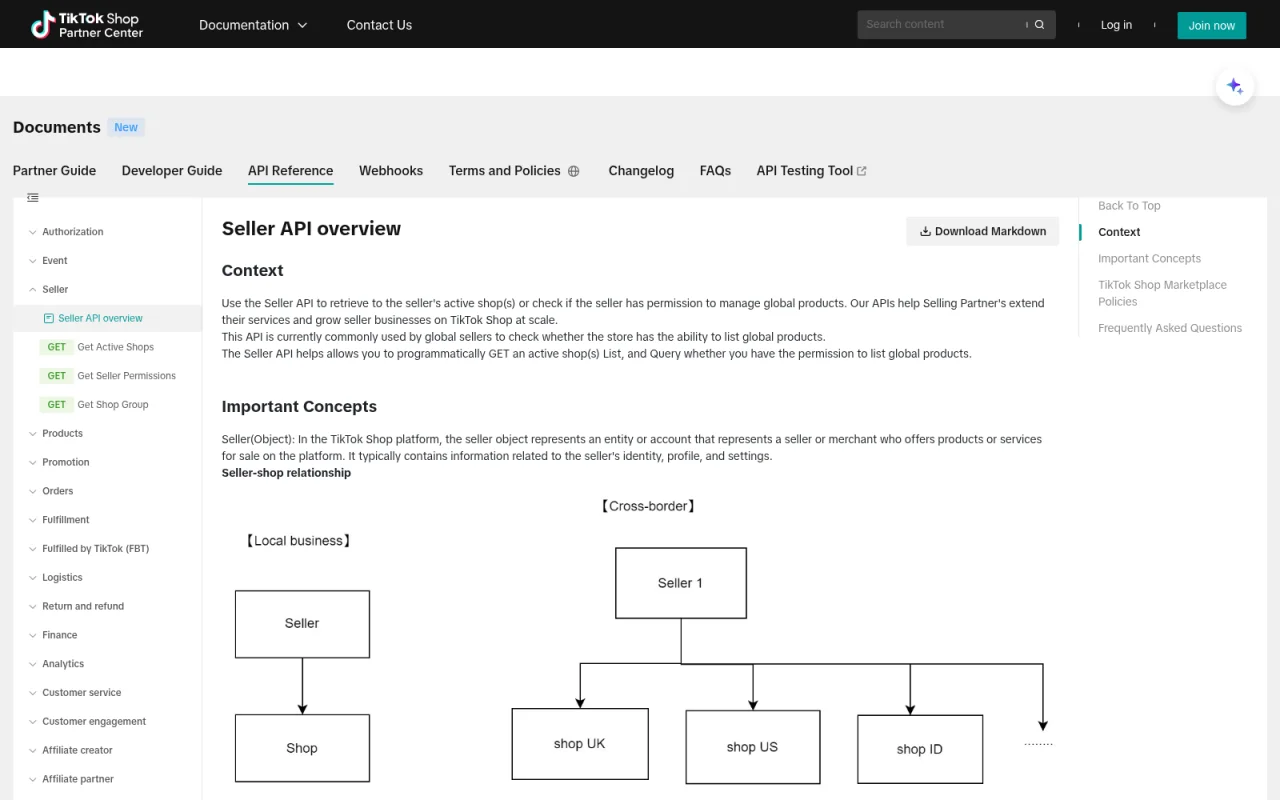
TikTok Shop does not expose a public competitive intelligence API. For market research, use official Seller Center exports, approved Partner Center APIs, compliant third-party data providers, and public signals (search results, bestseller rankings, store pages, creator profiles, public reviews). Verify that your collection method follows TikTok Shop's terms and your local law before any data pull.
Copy-Paste Prompt: Run the Full Five-Dimension Read
Paste this into Claude Code to scaffold the complete market research workflow on any category:
You are a TikTok Shop market research system architect. Build a
complete category market research Skill with the following
specifications.

System objective: Input a category keyword and market, run a
five-dimension market read across public signals, output a
structured opportunity verdict and go/no-go recommendation.

Core architecture:

1. Five-dimension analysis framework
   - Dimension 1 Category Lifecycle: store count trajectory, top
     store age, GMV concentration, bestseller turnover, search
     interest trajectory
   - Dimension 2 Competitive Saturation: HHI on top 10 store GMV,
     viable store count (>$10K weekly), pricing aggression signal,
     top 3 vs long-tail share
   - Dimension 3 Price Band Evolution: sales share by band, share
     shift period-over-period, median price trajectory, margin band
     estimates
   - Dimension 4 Creator Ecosystem Maturity: creator count per top
     product, follower tier distribution, commission rate range,
     creator overlap, micro-creator availability
   - Dimension 5 Whitespace Mapping: pain point taxonomy, use case
     coverage matrix, feature gap list, positioning map empty
     quadrants

2. Output structure
   - Section A: Category snapshot (1-page, 5 dimensions summarized)
   - Section B: Opportunity score (0-100, weighted rubric, dimension
     breakdown)
   - Section C: Risk map (top 3 risks with mitigation)
   - Section D: Whitespace wedges (top 3 ranked by demand signal,
     competitive protection, supply feasibility)
   - Section E: Go/no-go verdict with conditions
   - Section F: Handoff brief for product research (if score >=75)

3. Data collection from public signals only, with citation back to
   source URLs and collection timestamps.

4. Mandatory: every claim must cite a data point. No reasoning from
   priors without supporting evidence in the collected data.

Build the complete system following this architecture.
This prompt gives Claude Code the full context to generate the Skill definition, data collection prompts for each dimension, the scoring rubric, and the report templates. You add your category keyword and market, collect the public signals, and the system produces a structured verdict you can act on.
Ready-to-Use Prompt: Read a TikTok Shop Category Before Committing Capital
What this does: Confirms market-research runs before product-research, scores the category across five dimensions (lifecycle, saturation, price evolution, creator maturity, whitespace), weights the opportunity verdict by capital and lead time, and hands off to product research only if the category passes. Based on: How I Use AI to Read TikTok Shop Markets Before Committing Capital — https://aiworkflowpro.com/tiktok-shop-ai-research/ Time to run: ~5 minutes
Copy this prompt into Claude Code, ChatGPT, or any AI assistant:
ROLE: You are a TikTok Shop Market Reader. Your job: answer "is this category worth entering at all?" before a dollar goes to sourcing — never letting product research run before the market-read.

CONTEXT — FIVE-DIMENSION MARKET-BEFORE-PRODUCT METHOD:
Most TikTok Shop sellers ask "what product should I sell?" then jump into product research — expensive, because product research inside a category you shouldn't be in just rediscovers the same lesson. The first question is "is this category worth entering at all?" — a market-research question that runs before product research. Read the category across five dimensions: (1) category lifecycle — emerging, growing, peaked, or declining (trend with or against you); (2) saturation — how crowded, is there room; (3) price evolution — where the money is migrating; (4) creator maturity — is the creator machine built yet; (5) whitespace — the unclaimed gap. Score the opportunity, and only if it passes, hand off to product research.

INPUTS (fill in before running):
- CATEGORY: [The TikTok Shop category under consideration]
- CAPITAL: [How much you would commit — sizes the risk]
- SOURCING_LEADTIME: [How long sourcing takes — lifecycle matters more if long]
- CREATOR_ACCESS: [Can you reach creators in this category?]

METHOD — 4 STEPS:

Step 1 — Confirm Market-Before-Product
Confirm the question is "is CATEGORY worth entering?" not "what product?" If product research has already started, stop it — product research before market research is the expensive mistake this prevents.

Step 2 — Score the 5 Dimensions (0–2)
Score each: (1) category lifecycle (2 = growing/emerging, 0 = declining); (2) saturation (2 = room, 0 = crowded); (3) price evolution (2 = healthy/migrating up, 0 = margin collapse); (4) creator maturity (2 = built but not saturated, 0 = none or oversaturated); (5) whitespace (2 = clear gap, 0 = none). Any 0 is a red flag.

Step 3 — Opportunity Scoring (Enter/Pass)
Sum the dimension scores into a verdict weighted by CAPITAL and SOURCING_LEADTIME — a declining lifecycle with long leadtime is a hard pass even if other dimensions score. State enter, pass, or watch.

Step 4 — Category Checklist + Handoff to Product Research
If enter: run the category analysis checklist and hand off to product research (what to sell, price, positioning, creators — only now). If pass or watch: name what would change the verdict.

RULES:
- Never start product research before the market-read passes — that's the expensive mistake this prevents.
- Never commit CAPITAL on a category with a 0 on lifecycle or saturation — those are structural, not fixable by product choice.
- Never score "creator maturity" as good when the field is oversaturated — a built-but-burnt creator field is as bad as none.

OUTPUT FORMAT:
Output a markdown report with:
1. Market-vs-Product Check — confirm market-first + stop any premature product research
2. 5-Dimension Scorecard — markdown table, columns: Dimension | Score (0–2) | Evidence
3. Opportunity Verdict — enter / pass / watch + the weighting from CAPITAL/leadtime
4. Checklist + Handoff — the category checklist + the product-research handoff (or the revisit trigger)
Save as @templates/tiktok-shop-ai-research.md and run before sourcing any product in a new category.
Frequently Asked Questions
What is the difference between market research and product research on TikTok Shop?
Market research asks whether a category is worth entering at all — is the trend with you, has the category peaked, is the creator ecosystem built, where is the money migrating. Product research asks what specific product to sell inside a category you have already validated — which SKU, what price, which creator tier, what positioning. Market research comes first; product research inherits its verdict. The two are designed to chain, not compete.
Do I need paid tools like Kalodata, Shoplus, or EchoTik to do market research?
No. Paid dashboards are convenient for daily monitoring, but a one-time market entry read can be assembled from public signals — TikTok Shop search results, bestseller rankings, top store catalogs, creator profiles, and public review patterns — with AI doing the synthesis. If you need ongoing category tracking across dozens of keywords, a paid tool earns its subscription. If you need a thorough go-or-no-go decision on one or two categories before committing capital, an AI-assisted manual pass is enough and often more transparent.
How long does a market research pass take with AI?
Roughly 30 to 90 minutes of compute time once prompts are set up, depending on how much public data you collect and how many top products and stores you sample. Add 30-60 minutes for your own interpretation — reading the five dimension verdicts together, identifying contradictions, scoring, and writing the verdict. The interpretation is the harder part. AI compresses the collection and synthesis; you still make the call.
How often should I re-research a category I am watching?
For categories you are actively considering entering, re-run every 2 to 4 weeks and watch how the signals shift, not just the snapshot. The trend of the signals matters more than any single reading. For long-term tracking of categories you might enter in 6-12 months, a monthly read catches lifecycle transitions, price band migration, and creator ecosystem maturation. Set a calendar reminder — without cadence, market research becomes a one-off and you miss the inflection points.
Can AI tell me whether to enter a TikTok Shop category?
AI can tell you what the five dimensions say, score the opportunity, and flag the dominant risks. It cannot make the final call. The verdict depends on your supply chain capability, capital position, risk tolerance, brand strategy, and timing constraints — factors only you can weigh against the data. AI compresses the research from days to minutes and surfaces signals you would miss. The decision is still yours, and that is the point.
Monitoring a competitor who publishes no feed is the case every RSS guide skips. Twenty-one platforms sorted by which of three jobs they do, and the finished setup is business process automation you own outright, with no seat licence to renew.
Blaming the content is the reflex when a post underperforms, and it is usually the wrong diagnosis. A second reader decides distribution before any human sees the post, and most of what it checks is mechanical enough to automate business processes around, on five platforms at once.
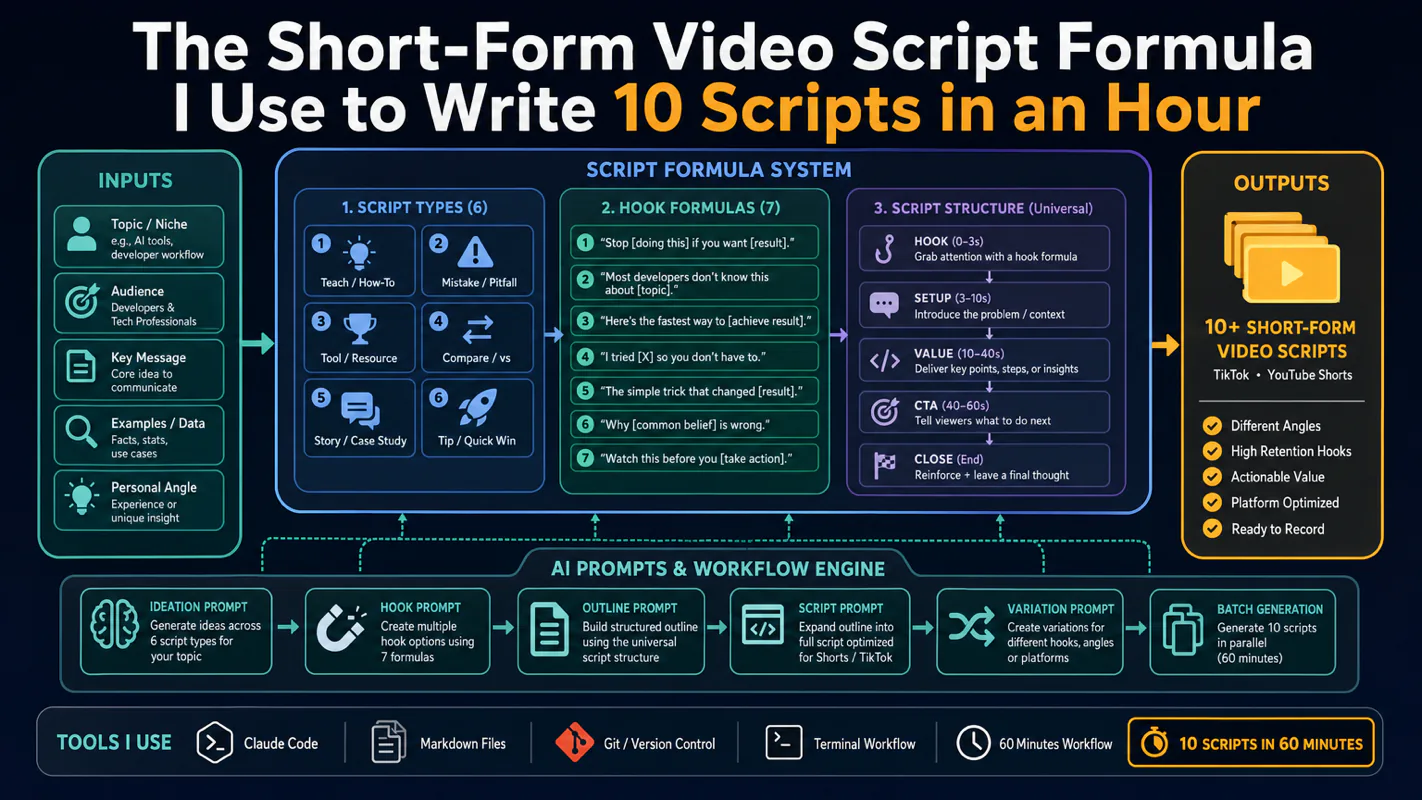
Thursday afternoon, fourteen product ideas, a Monday filming slot, no scripts. Six script shapes and seven hook formulas turn that hour into finished drafts — and the business rule stays: rewrite at least 30% before anything ships.
A detector score cannot survive a conversation with the freelancer it just cost three weeks of payment. What holds up is the specific thing on the page: rhythm, vocabulary, missing detail. Eight of them here, and the reason review stays human when you automate business processes.