A 30-minute video is too long for one conversation. This guide walks the 8-step Skill that locks the narration and one look, then gives each 3-minute segment to a fresh sub-agent, five at a time, and polishes the cut in an empty-context session.
The folder structure behind my AI agent team, the Herdr setup where Grok Build, Claude Code and Kimi Code work side by side, and the two live tasks from the video: an article published by voice and a three-model front-end test.
Eight folders of plain Markdown, a CLAUDE.md index in each, and seven prompts that make your agent interview you. Every prompt, template and command from the video, in order.
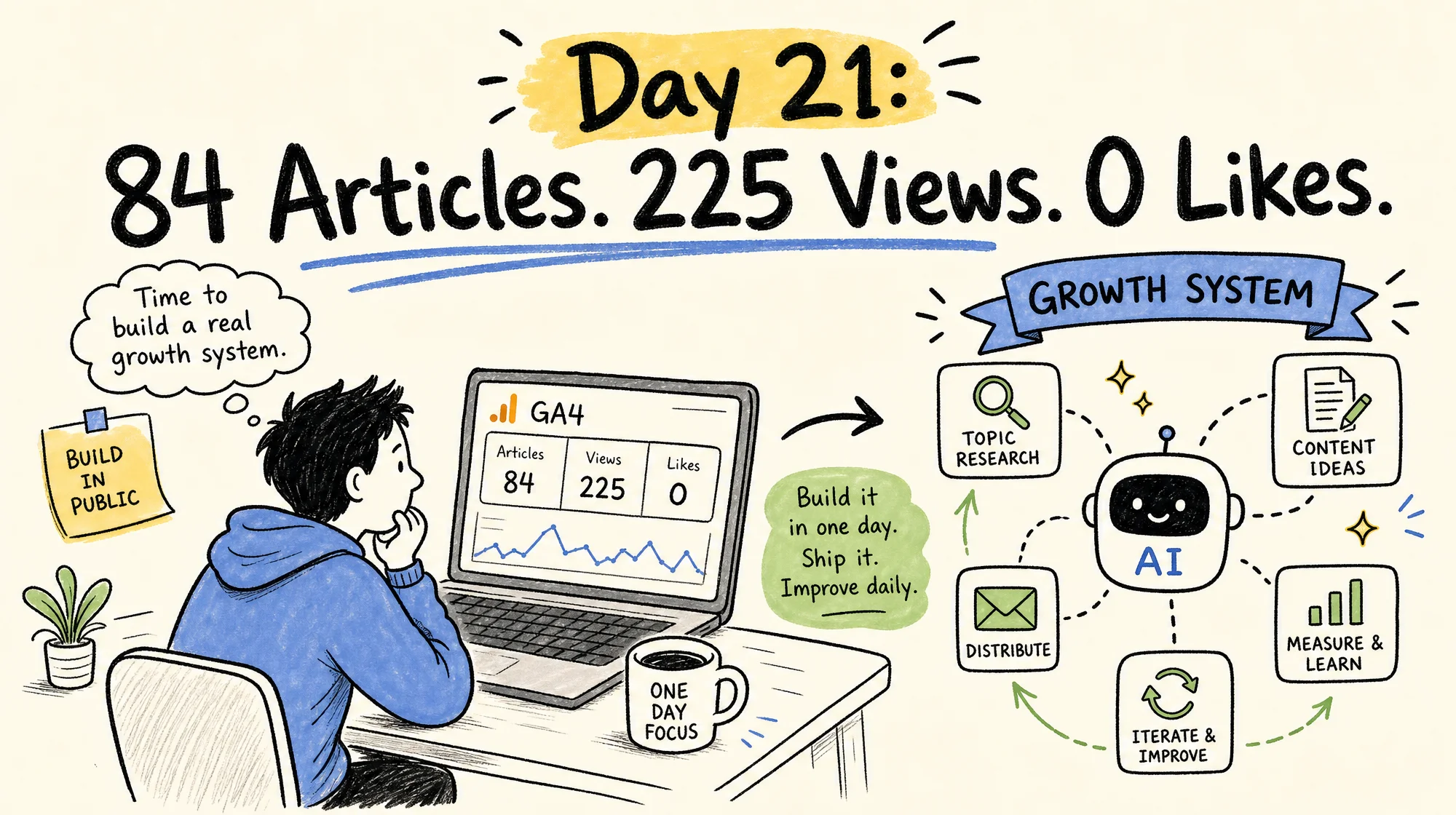
Day 21: 84 Articles. 225 Views. 0 Likes. So I Had AI Build Me a Growth System.
84 articles, 225 views, 0 likes. A day spent building the distribution layer that publishing alone never provides: four reusable systems for repurposing, internal linking, and resurfacing old work, plus the prompts behind each one.
I had 84 published articles and 225 monthly views. I spent a day using AI to build a growth system from scratch. Here's what I found, what I built, and the frameworks you can steal.
A store owner who uploads listings for three weeks and sells nothing rarely has a listing problem. The catalogue is full, the work got done, and nothing downstream of publishing was ever built: no route from a finished page to anyone who might want it. Work nobody sees is a distribution failure wearing the costume of a content failure, and the two get fixed in completely different places. What gets built below is the missing half, the machinery that carries something already written to somebody who might read it. A worked example of where an ai assistant for business growth earns its keep: downstream of the writing, not inside it.
What Is This and Who Am I?
I'm Leo. I'm building AI Workflow Pro — a one-person AI product studio. I make tools and templates for people who use AI in their daily work: indie builders, solopreneurs, and small teams who want to ship faster without hiring a dev team.
The studio runs on five platforms: a blog for long-form articles and tutorials, X for build-in-public updates, Substack for a weekly newsletter, GitHub for open-source projects (including a 1,017-role AI persona library), and eventually YouTube for tool demos.
I'm building all of this in public. Every number you see in this post is real. Every failure is documented. The idea behind this Growth Log series is simple: I record what I try, what works, and what doesn't — so you can learn from my experiments without running them yourself.
This is Growth Log #1. Day 21.
What Does 21 Days of Data Actually Look Like?
I opened GA4 on Day 21 expecting at least something after 84 published articles. The number: 225. Total views. For the month. I stared at it, did the math, and landed on 2.7 views per article per month. That's when I stopped tweaking headlines and started building a system.
If your numbers look anything like this — lots of content, almost no traction — this post is for you.
The problem isn't the content. I know because my best article has a 649-second average dwell time. People who find it read the whole thing. The problem is nobody finds it.
I decided to fix this by doing something I should have done on Day 1: I opened Claude Code, fed it every number I had, and spent a day building an actual growth system. Not "post and hope." A system with written SOPs, experiment templates, and a weekly review process.
Below are the prompts I used, the thinking behind each one, and what came out. You can copy these, feed them your own data, and have your own growth playbook by tonight.
Why Is 225 Views on 84 Articles Not a Content Problem?
Before I show you the system, here's how I diagnosed the problem. You can run the same checks on your own project right now.
Check 1: Is it a content problem or a distribution problem?
Look at your dwell time. If people who find your articles stay and read (my best: 649 seconds, that's 11 minutes), your content is fine. The bottleneck is discovery.
Check 2: Do your articles link to each other?
I had 84 articles with zero internal links between them. Each article was a dead end — one visit, one pageview, gone. A reader finishes your CLAUDE.md guide and there's nowhere to go next. That's 84 dead ends.
Check 3: Are you talking to anyone, or just broadcasting?
I had 13 tweets, all original posts, zero replies to other accounts. The 70/30 rule says 70% of your X time should be replying. I was at 100/0 — all broadcast, zero conversation.
Check 4: Do your tweets show what happened, or just what you think?
Every tweet I wrote said "I built X" but none said "and here's what happened after." The result is the hook, not the thing.
If any of these sound familiar, what follows will help.
Platform by Platform: Where the Numbers Break Down
Blog (aiworkflowpro.com): 84 articles, 225 views
My blog has 84 published articles and 15 more scheduled through September. The content isn't the problem — my best piece holds readers for 649 seconds, nearly 11 minutes. The problem is zero internal links between articles. Every article is a dead end: a reader finishes one and has nowhere to go next. No topic clusters, no related posts, no network connecting them. Fix: add 3-5 internal links per article, group articles into topic clusters, and refresh the top 20 — content updated within 30 days gets cited by AI systems at 3.2x the rate of stale content.
X: 13 tweets, 0 likes, 3 followers
A 21-day-old account with Premium enabled. Two problems: I posted 13 original tweets and replied to nobody — a 100/0 broadcast ratio when the data says 70% of your X time should be spent replying to others. And every tweet led with an opinion ("Five search APIs don't own the index...") instead of a result number. Fix: 15-20 quality replies per day to accounts with 2-10x my follower count, and switch to the result-first tweet formula (details below).
Substack: 3 posts, 0 Notes
Three posts published, 50 more in the queue. The biggest gap: zero Notes. In 2026, Notes has overtaken cross-promotions as Substack's #1 discovery engine — it's what surfaces your content to strangers who haven't subscribed yet. I haven't posted a single one. Fix: 2-3 Notes per day in micro-story format (a specific moment → what I noticed → what I learned) to tap into the platform's built-in network effect.
GitHub: 7 repos, 0 stars
Seven public repositories, including a 1,017-role Agent Occupational OS built on the US O*NET classification system. Zero stars because the READMEs read like internal documentation, not landing pages. Fix: treat every README as a landing page — hero GIF showing the tool in action, a 3-step Quick Start you can copy-paste, status badges, and a clear opening line that says what the project does for you.
Revenue: $0
My first paid product (AI Directory Template, $89 as of 2026-07) is live with automated checkout. Zero sales so far. Target: 10 paying users by December 2026. The right move at this stage isn't optimizing the product — it's building the distribution infrastructure so people can actually find it.
What Did I Actually Build in One Day?
Here's where the day went. I'll walk through each step, including the prompts I used, because the thinking behind the prompts matters more than the prompts themselves.
Step 1: I Asked AI What I Was Missing
I started by asking a simple question: if I'm managing growth for a product studio across five platforms, what kind of knowledge do I actually need?
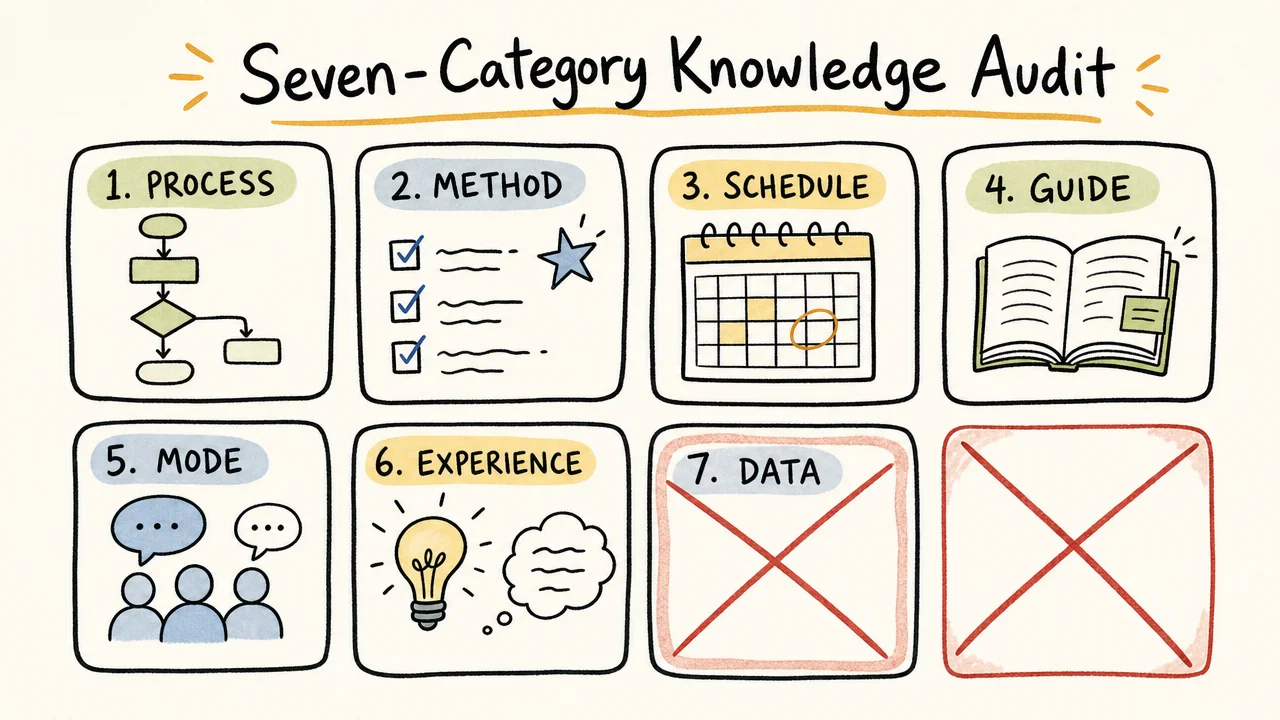
I gave AI my current situation — the platforms, the numbers, the content — and asked it to audit my growth knowledge against a seven-category framework:
Role: You're a growth manager for an indie AI product studio.
Platforms: Blog (84 articles), X (21 days, 13 tweets), Substack (3 posts),
           GitHub (7 repos), YouTube (not started).
Task: Audit my growth knowledge across 7 categories:
      Process, Method, Schedule, Guide, Mode, Experience, Data.
Question: Which categories are empty? What capability does each gap represent?
Two entire categories came back empty:
Process: zero SOPs (standard operating procedures). I had no written procedure for weekly data review, no experiment cycle, no competitive analysis routine. Every week I was reinventing how to look at my own data.
Method: 47 lines of framework names with zero depth. I could name "Growth Loops" and "North Star Metric" but had never written down how to actually use them for my specific situation.
Meanwhile, my Guide category was stacked — deep platform research on X, Substack, and blog SEO algorithms. I had the knowledge. I just had no system for using it.
This is the pattern I think most indie builders fall into: you research how platforms work (guides), but never build the operating system that turns that knowledge into weekly action (process + method).
Step 2: Seven Parallel Research Agents
Once I knew what was missing, I ran seven research agents in parallel — each one searching for the latest practices in one dimension:
Seven directions (each agent ran independently):
1. Growth thinking frameworks (Growth Loops, Bullseye, ICE — 2026 practices)
2. GitHub as a growth channel (how indie builders actually get followers)
3. SEO/GEO (Generative Engine Optimization) 2026 changes (AI Overviews impact on traffic)
4. Indie builder distribution strategies (which channels actually work)
5. Growth experiment design (how to test with low traffic)
6. Cross-platform syndication (content across 5 platforms without repetition)
7. Data review and competitive analysis methods (one-person operation)
All seven came back in about 11 minutes with 103 data points, case studies, and tactical recommendations from sources like Reforge, Amplitude, Buffer's 18.8-million-post analysis, SparkToro, and indie builder case studies. Eleven minutes. A human researcher would need a week.
How Does One Person Run Five Platforms?
The seven parallel agents aren't a one-off trick. They're one example of a larger system.
I run my operation out of a structured knowledge base — markdown files organized by function. Growth knowledge, brand rules, platform research, publishing procedures, past mistakes. All written down in files that AI can read. I built 19 specialized AI personas — a growth manager, a content writer, a code builder — each with its own playbook of instructions and accumulated experience.
Here's a concrete example. The growth manager persona that built today's system didn't start with a blank page. It read 14 existing files — deep notes on how X, Substack, and blog SEO algorithms work — saw that I had strong guides but zero process documents, and focused the audit on that specific gap. If I'd opened a fresh AI chat and typed "help me grow my product studio," I'd have gotten generic advice. The persona got targeted advice because it had context.
The same system handles daily content publishing, scanning X timelines, pulling analytics, and converting articles across formats. One person, five platforms — not by working harder, but by building infrastructure that lets AI handle the repetitive work while the judgment calls stay with me.
The core principle anyone can use: move your operating knowledge from your head into files that AI can read. Even a single markdown file that describes your publishing process, platform rules, and past mistakes gives AI enough context to help you execute instead of starting from zero every session.
Step 3: From 103 Findings to 20 Operational Files
103 findings is a pile, not a system. I didn't use all of them — about a third were duplicates or too vague to act on. What I kept, I turned into operational documents I'll actually use every week:
3 new platform guides (GitHub growth, attribution tracking, directory submission)
2 data files (2026 industry benchmarks, public timeline)
1 experience file (pre-loaded with common failures so I don't repeat them)
From 14 files to 34 files. From "I know stuff about X and Substack" to "I have a written SOP for what to do every Friday afternoon."
Step 4: I Discovered My Tweet Formula Was Wrong
While researching, I compared my tweets to accounts that actually get engagement. The pattern was obvious once I saw it.
Their tweets followed this structure: result number → method → principle → action for reader.
"Zapier ranks for 1.3 million keywords using this exact system. Full playbook inside."
My tweets: opinion → explanation.
"Five search APIs don't own the index they rent you." (24 views, 0 likes)
The difference: they lead with what happened. I lead with what I think. Results stop thumbs. Opinions don't.
I rewrote one of my tweets using the new formula. The before/after is in the frameworks section below — it's one of the four systems you can steal.
Why You Need a Growth System (Not Just "More Content")
Before I share the four systems, let me explain why I built them in the first place — because "just post more" is the advice most indie builders follow, and it's why most indie builders stay invisible.
Most of us — myself included until yesterday — run growth like this: write something, post it, hope people find it. That's not a strategy. That's a lottery ticket. A growth system is different. It's a set of written procedures that answer four questions every week: What data am I looking at? How do I know if something is a trend or noise? Which experiment do I run next? And what did I learn from the last one?
When these procedures live in your head, two things happen. First, you reinvent them every week — you sit down on Friday and think "what should I check?" instead of running a checklist. Second, AI can't help you — because AI doesn't know what's in your head. But if you write your procedures into files, AI can read them, follow them, and do the repetitive parts while you focus on the decisions that actually require judgment.
That's what I built today: not "more content," but the operating system underneath the content. Here are the four pieces.
Four Systems You Can Steal
Here's the part you can steal. Four systems — pick whichever fits. Each one is independently useful.
System 1: The Seven-Category Knowledge Audit
If you do only one thing from this post, do this. It takes 30 minutes and it will show you exactly where your growth knowledge has gaps.
The idea is simple: every piece of growth knowledge you have fits into one of seven categories. Each category answers a different question. When a category is empty, you have a blind spot — and that blind spot is costing you something specific.
Category
Question it answers
What goes in it
What happens when it's empty
Process
How do I execute, step by step?
SOPs, checklists, launch sequences
You reinvent your weekly routine every week — no repeatable rhythm
Method
How do I decide?
Frameworks, scoring systems, mental models
You make decisions on gut — sometimes right, often expensive
You post when you remember, go silent when you forget — algorithms punish inconsistency
Guide
What do I need to know about each platform?
Algorithm research, best practices, API limits
You learn platform rules by stepping on mines — every mistake costs reach
Mode
Which context am I in right now?
Platform-specific configs, audience segments
You use the same approach on every platform — what works on a blog fails on X
Experience
What went wrong before?
Lessons anchored to outcomes, not feelings
You repeat the same mistakes — the same experiment that failed last month gets tried again
Data
Where am I right now?
Baselines, benchmarks, tracking tables
You don't know where you stand — you can't tell if something is working or just feels like it
Try this now: open wherever you keep your growth notes — Notion, markdown files, a Google Doc, whatever. Sort everything you have into these seven categories. Which categories are empty?
Here's what surprised me: I expected Method to be my weak spot — I assumed I lacked frameworks. It wasn't Method. It was Process — completely blank. Zero SOPs. No written procedure for reviewing my own data weekly. No experiment cycle. No "after publishing, do these five things" checklist. Method at least had 47 lines of framework names (Growth Loops, North Star Metric, Bullseye), even if they had zero depth. Process had literally nothing.
That's why 84 articles produced 225 views. I had deep platform knowledge (my Guide category was stacked — 400+ lines of X algorithm research, Substack growth tactics, blog SEO best practices). I just had no system for turning that knowledge into weekly action. Guides without Process is like having a recipe book but no kitchen schedule — you know how to cook, but you never actually cook on Tuesday.
System 2: The Result-First Tweet Formula
This one came from comparing my tweets to accounts that actually get engagement. Here's the exact process I used, so you can do it too.
Step 1: Find the number in what you did. Look at your recent work — did you spend money? Save time? Test something? Compare options? There's always a number hiding in there.
Step 2: Put that number in the first sentence. Not in the middle. Not at the end. First sentence.
Step 3: Explain what you did in the middle.
Step 4: End with something the reader can act on.
Here's the full rewriting process from my own account:
Original thought: "I think most search APIs are overpriced."
Find the number: I tested 6 APIs. I was paying $180/month total.
Find the result: After consolidation, $23/month.
Final tweet: "I spent $180/month on 6 search APIs. After consolidation: $23. Here's what I cut and why."
The before/after:
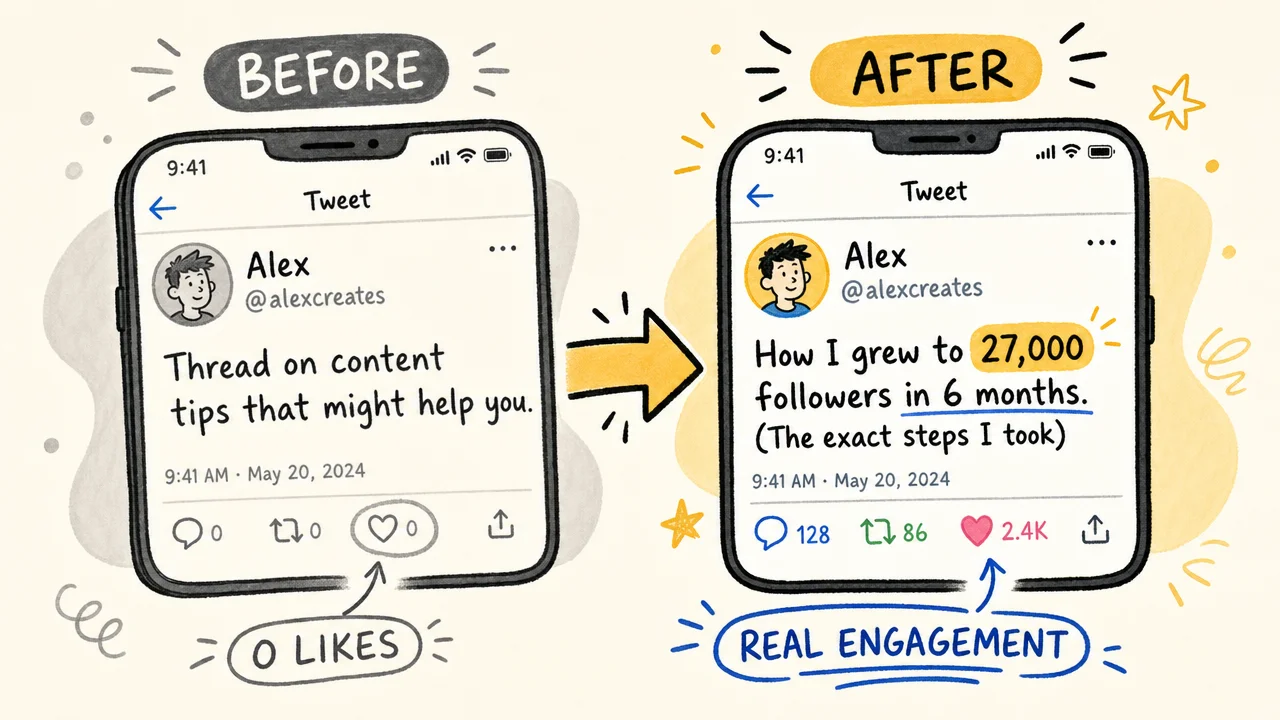
Before: "Five search APIs don't own the index they rent you." → 24 views, 0 likes.
After (rewritten): "I spent $180/month on 6 search APIs. After consolidation: $23. Here's what I cut and why."
Same content. Completely different structure. The before version leads with an opinion — it tells you what I think. The after version leads with a result — it tells you what happened. Results stop thumbs. Opinions don't.
Five templates you can copy right now:
1. "{Metric} was {bad number}. I changed {one thing}. Now it's {good number}."
2. "I tested {N} {things}. {M} were {verdict}. Here's the one that {result}."
3. "{Brand/tool} does {impressive result} using {method}. Here's how it works:"
4. "Everyone recommends {common advice}. I tried it for {time}. The data: {surprise}."
5. "${cost} spent, {outcome} saved. The math behind {decision}."
System 3: The 30-Minute Weekly Review
If you run multiple platforms, you need a weekly check-in that's short enough to actually do every week. Here's mine — five platforms, 30 minutes, one decision at the end.
Step 1 — Collect (15 minutes). Open each platform and pull exactly one core number:
Substack/newsletter: subscriber count (net of unsubscribes)
GitHub: new stars this week
Revenue: dollars in
Write them in a single row on a spreadsheet next to last week's numbers.
Step 2 — Record (5 minutes). Compare this week's numbers to last week's. Calculate the percentage change. This takes seconds but it's the step most people skip — and without it, you're comparing feelings, not data.
Step 3 — Judge (5 minutes). Apply three rules:
Two weeks same direction = trend. If pageviews dropped two weeks in a row, that's real. Investigate.
Single-week swing > 50% = anomaly. Something unusual happened — an algorithm change, a viral post, a technical glitch. Investigate.
Everything else = noise. Ignore it. Don't react. One week of data tells you almost nothing.
Step 4 — Decide (5 minutes). Write exactly one action for next week. Not five actions. One. "Reply to 15 tweets per day." Or "Add internal links to the top 10 articles." Or "Stop posting on Substack until Notes is set up." One thing you'll actually do, not a wish list.
Red flags that mean stop everything and investigate:
Traffic cliff: >30% week-over-week drop on any platform
Engagement death: 3 consecutive posts with zero interaction
Bounce rate spike: weekly average above 90%
Index loss: search console shows fewer indexed pages
Subscriber churn: net new subscribers below zero
System 4: ICE Scoring for Low-Traffic Experiments
When you have fewer than 1,000 weekly visitors, traditional A/B testing doesn't work — you don't have enough traffic for the math to be meaningful. ICE scoring is the replacement. Here's exactly how to do it.
What ICE stands for:
Impact (1-10): If this experiment works, how much will it move your most important metric? A complete content strategy overhaul is a 9. Changing your bio link is a 3.
Confidence (1-10): How sure are you it will work? If there's published data from someone who tried it (like Buffer's 18.8-million-post analysis on reply rates), score it high. If it's just a hunch, score it low.
Ease (1-10): How quickly can you run this experiment? If you can do it today with no setup, that's a 9. If it requires building a new tool first, that's a 2.
Multiply all three. The highest score wins.
Why multiplication matters: A zero on any dimension kills the total. An experiment with Impact 10 but Confidence 1 and Ease 1 scores only 10. An experiment with Impact 5, Confidence 6, Ease 7 scores 210. The "boring" experiment wins by 21x. This is the whole point — ICE overrides the excitement bias that makes us chase high-impact moonshots instead of high-probability quick wins.
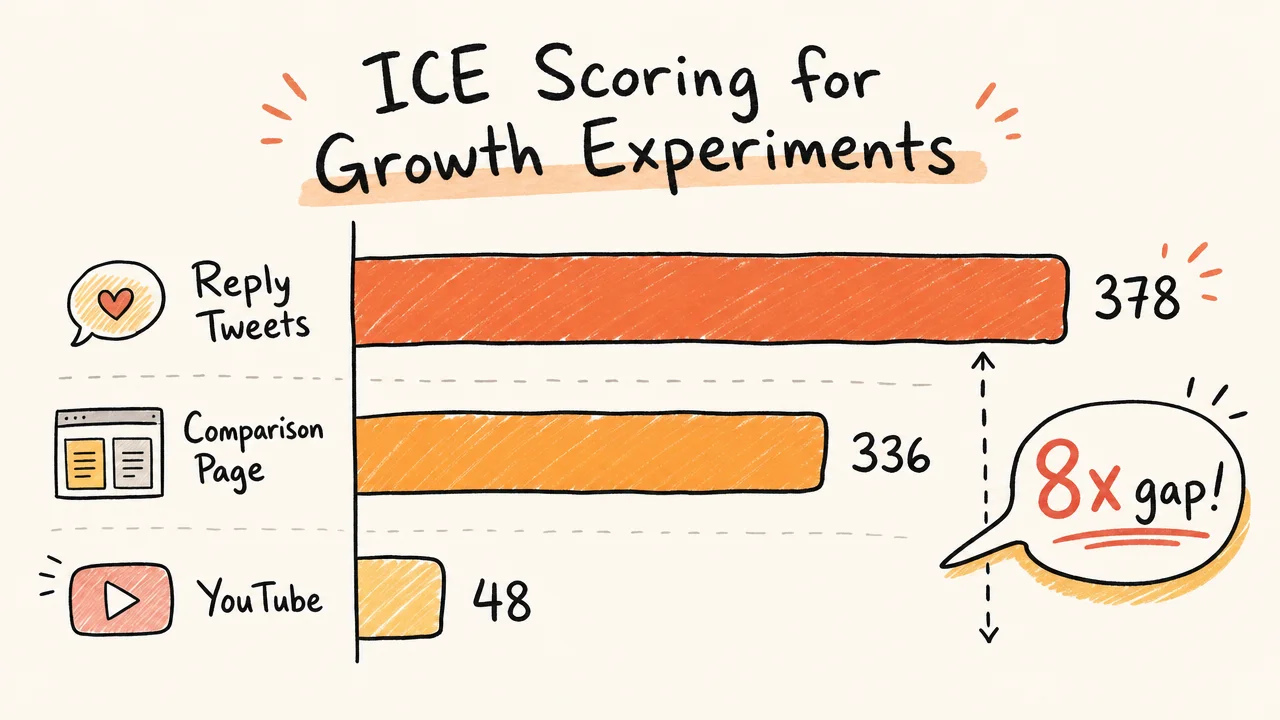
Here's the scoring that made my priority obvious:
Experiment
Impact
Confidence
Ease
ICE Score
Write "AWP vs X" comparison page
7
6
8
336
Launch YouTube channel
8
3
2
48
Start replying to 15 tweets/day
6
7
9
378 ← winner
I was sure YouTube should be number one — it feels like the high-impact move. ICE said tweet replies at 378 vs. YouTube at 48. An 8x gap. The reply experiment won because Confidence is high (the 70/30 rule is well-documented by multiple studies) and Ease is high (no production cost, just my time). YouTube scored lowest on both: I have no data on what works for my niche (low Confidence) and video production from scratch is slow (low Ease). I haven't published a single YouTube video — and now I know that's the right call for this stage.
The weekly cycle once you pick your experiment:
Monday (30 min): Score your experiment backlog. Pick the highest ICE score. Write down your hypothesis: "If I do X, I expect Y to change by Z%."
Tuesday–Thursday: Execute. Change exactly one variable. Don't change two things at once — you won't know which one worked.
Friday (30 min): Compare seven days before vs. seven days after. Three outcomes: Continue if ≥15% improvement. Pivot (adjust the variable) if flat. Kill if it made things worse. Record what you learned in your Experience category.
What Went Wrong — and What AI Still Cannot Fix
Here's the part nobody talks about in "I used AI to do X" posts: AI helped write those 84 articles. The quality wasn't the problem — my best article holds readers for 649 seconds, and several others have dwell times above 100 seconds. The problem is that I gave AI a complete workflow for writing articles (13 steps from topic selection to publishing), but I never gave it a workflow for distributing them. So AI did exactly what I asked: it wrote articles and stopped. Eighty-four articles with zero internal links, zero cross-platform syndication, zero distribution strategy. AI perfectly executed an incomplete system.
The lesson is uncomfortable: AI output quality depends on the system you give it, not on AI's own capability. My article-writing process was thorough — topic research, outline, draft, three rounds of review, SEO optimization, publishing. Thirteen steps, all documented. My distribution process? It literally didn't exist. No file. No checklist. No "after publishing, do these five things." AI can't fix a gap it doesn't know about. It executed my system faithfully. My system just stopped at "publish."
Today I discovered my tweet formula was wrong — opinions first instead of results first. AI didn't catch that. I caught it by looking at a competitor's tweet and noticing the structural difference. AI will tell you "effective tweets need hooks." It won't show you the specific gap between your tweets and the ones that actually work, because it doesn't know what your competition looks like until you ask.
AI handles the research, first drafts, data pulls, format conversions, and cross-platform reformatting. In my estimate, that's roughly 80% of the weekly work. But the judgment calls stay with me. Which experiment to run next. Whether a tweet formula works. When to stop optimizing content and start fixing distribution.
Here's a specific example: AI generated all seven parallel research reports today. Every report was well-structured and sourced. But AI didn't know to compare my actual tweets to competitors' tweets side by side. I did that manually, scrolling through accounts that get real engagement, and noticed the structural pattern — results first, opinions second. That observation became the tweet formula fix. AI gave me the research fuel. The pattern recognition was mine.
These are decisions that require looking at your own situation and comparing it to reality — and that comparison is something you have to initiate.
The clearer you think — and the more of that thinking you write down in structured files — the more AI amplifies your output. If you don't think, AI helps you spin your wheels faster.
What Can You Do in the Next 30 Seconds?
Open your growth notes and count how many of the seven categories have actual content. Not bookmarks. Not plans. Written procedures you have used this month. The empty ones are your blind spots.
If Process is blank, you have no system for reviewing your own data. If Method is blank, you're making decisions on gut. If Data is blank, you don't know where you stand. Pick one empty category and write the first document for it today.
Next Steps: Replies, Links, Refreshes
Three layers, from this week to the next few months.
This week: reply tweets. One experiment, one variable. 15–20 quality replies per day to accounts with 2–10x my follower count. Only reply within 15 minutes of their post. Every reply adds information — no "Great thread!" or "100%." I'll report the exact before/after numbers in Growth Log #2.
This month: fix the three biggest distribution gaps.
Turn 84 dead-end articles into a connected network. Every article gets 3–5 internal links to related posts. A reader who finishes the CLAUDE.md guide should land on the syncing guide next, not a blank wall.
Launch Substack Notes. Substack's top discovery engine in 2026, and AWP has zero posts there. That's the biggest gap per effort required.
Refresh the top 20 articles with updated information. Content updated within 30 days is cited by AI systems at 3.2x the rate of stale content. Eighty-four articles sitting untouched for weeks are invisible to AI search.
Down the road: this system itself might be replicable. The knowledge base plus AI personas setup that runs my product studio — if it works for one person managing five platforms, maybe it works for other solo operators too. Not just the seven-category framework, but the whole approach: structured files that AI reads, specialized personas that accumulate experience across sessions, and SOPs that turn platform knowledge into weekly action. I'll keep recording what works and what's a waste of time in these Growth Logs, with real numbers attached. If the system proves itself over the next few months, I'll write up exactly how to build one from scratch.
Follow Along
This is the format I'll post every week on X. One snapshot, real numbers, no spin:
Week 3 of building an AI product studio in public.

This week I discovered my 84 articles had zero internal links between
them. 84 dead ends. Fixed it by building a growth system with AI in
one day.

Blog: 225 views (+0% — system just built, results next week)
X: 3 followers (+0)
Substack: ~5 subscribers (+2)
GitHub: 0 stars (README optimization queued)

Revenue: $0 → target: $10K by Dec 2026
Progress: ⬜⬜⬜⬜⬜ (0%)

Full breakdown in this week's Growth Log.
Follow @aiworkflowprolk if you want to see whether any of this actually works.
FAQ
How long does it take for a new X account to get traction?
Data says 90 days of consistent posting, 3–5 times per week, before you can judge. At 21 days with 13 tweets, it's too early to call anything. The signal to watch is engagement rate per tweet, not follower count.
Is 225 views/month on 84 articles a failure?
It's a distribution failure, not a content failure. The best article's 649-second dwell time shows content can hold readers when they find it. The missing piece is discovery — internal linking, topic clusters, and cross-platform syndication.
Should you build audience before launching products?
Based on publicly shared Gumroad creator data, founders with 500–2,000 engaged followers convert at 8–15% on launch day. Cold traffic converts at 0.5–2%. Audience-first is 4–15x more effective — but "audience" means 500 engaged followers, not 50,000 passive ones.
The folder structure behind my AI agent team, the Herdr setup where Grok Build, Claude Code and Kimi Code work side by side, and the two live tasks from the video: an article published by voice and a three-model front-end test.
Eight folders of plain Markdown, a CLAUDE.md index in each, and seven prompts that make your agent interview you. Every prompt, template and command from the video, in order.
Stop briefing your AI from scratch. One free folder holds your background, your rules and your voice. Eight prompts build it, no code, and any AI can read it.
Monitoring a competitor who publishes no feed is the case every RSS guide skips. Twenty-one platforms sorted by which of three jobs they do, and the finished setup is business process automation you own outright, with no seat licence to renew.