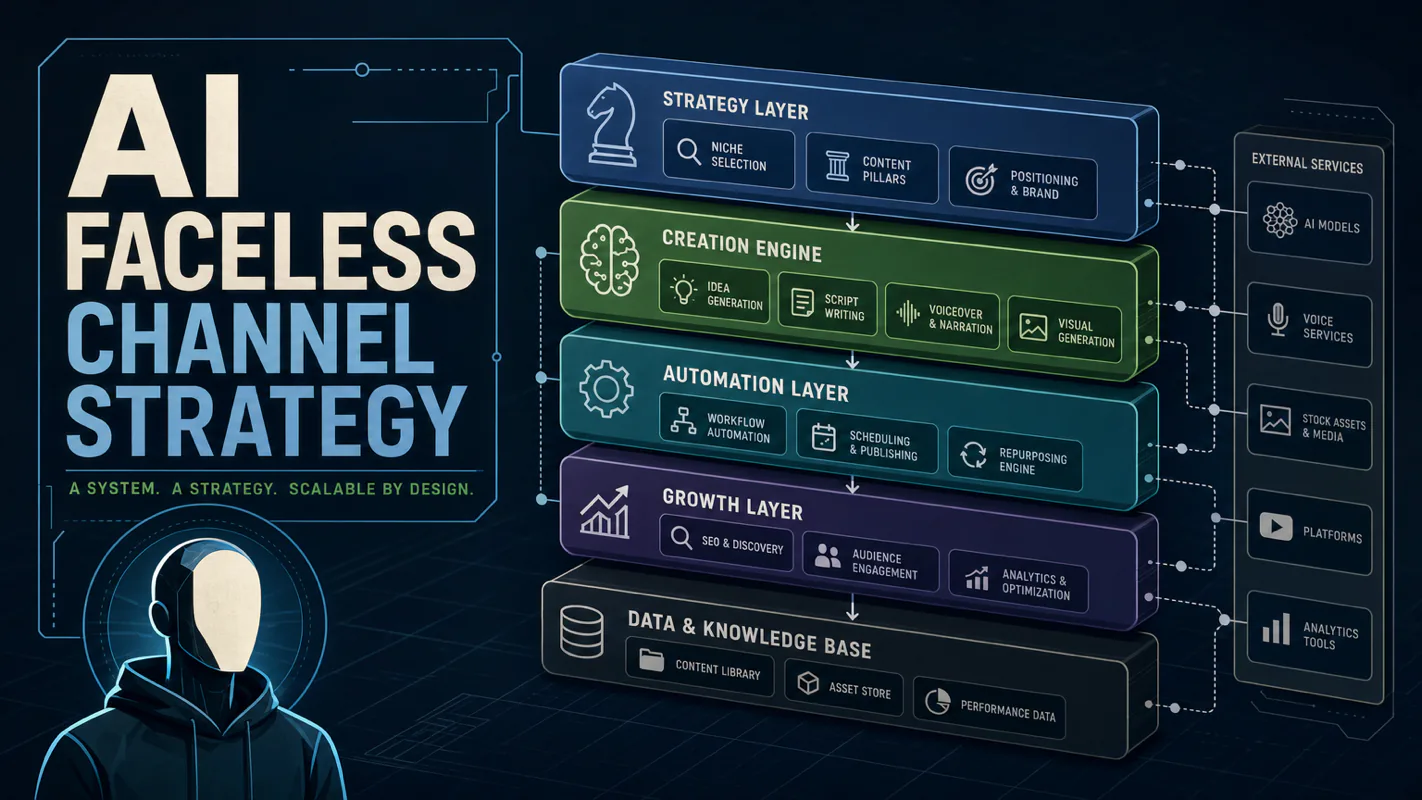
Monitoring a competitor who publishes no feed is the case every RSS guide skips. Twenty-one platforms sorted by which of three jobs they do, and the finished setup is business process automation you own outright, with no seat licence to renew.
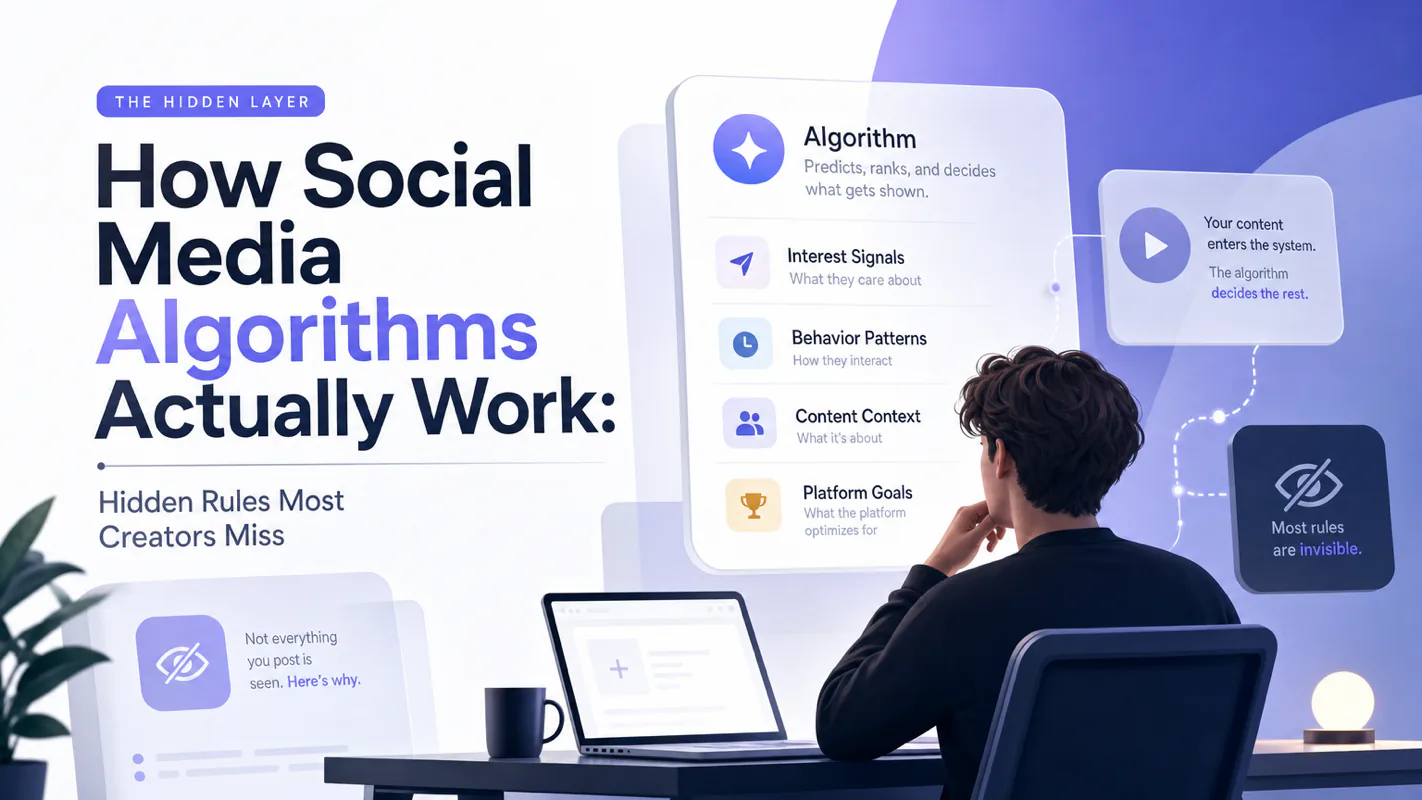
Blaming the content is the reflex when a post underperforms, and it is usually the wrong diagnosis. A second reader decides distribution before any human sees the post, and most of what it checks is mechanical enough to automate business processes around, on five platforms at once.
Gloves on, tape measure in hand — nobody types a query. Three voice surfaces for ai automation tools (terminal, Telegram, Discord), 10 TTS and 6 STT providers compared on cost and latency, plus a setup that costs nothing.
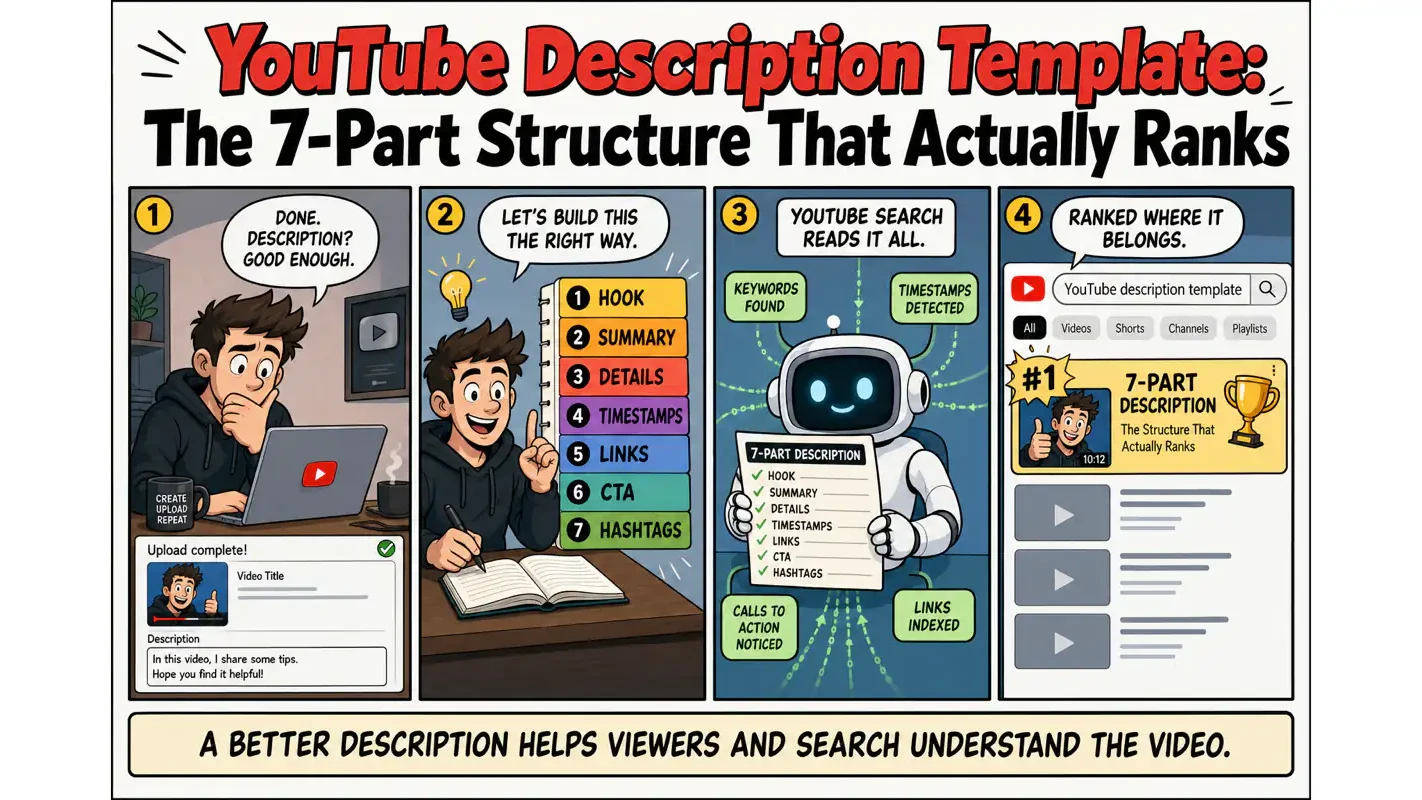
YouTube Description Template: The 7-Part Structure That Actually Ranks
When the format lives in one person's head, the archive ends up unsearchable and nobody notices until somebody inherits it. A 7-part description template, the SEO reasoning behind each field, and why writing it down beats teaching it again next quarter.
Most creators spend ten hours editing a video and two minutes on the description. That math is backwards.
YouTube's algorithm weighs your description heavily when deciding where to rank your video in search. According to YouTube's official Creator Academy, the description is one of the primary metadata signals the platform uses for ranking. The description is not an afterthought — it is a free traffic amplifier that works around the clock, connecting your content to the search queries people actually type.
I spent over two years treating descriptions as a formality. Short, vague, mostly links. When I finally rebuilt my description workflow using a structured template, my channel's search traffic grew by over 40% in three months — without filming a single new video. That result came entirely from better metadata.
This guide breaks down the exact 7-part YouTube description template I use for every upload. You will get the copy-paste structure, the SEO keyword strategy behind it, and the 2026-specific tactics for getting your videos cited by AI search engines.
TL;DR
YouTube descriptions directly influence search ranking — treat them as SEO assets, not afterthoughts
Use a 7-part structure: Hook + Summary + Timestamps + Keywords + CTA + Links + Hashtags
The first 150 characters are the only part most viewers ever see — front-load your keyword and value proposition
Copy-paste template included below — fill in your details and publish
Hand a channel over to a new hire and watch where they stall. Not filming — they stall at the fields underneath the video, because nobody ever wrote down what goes in them. Descriptions become whatever that person had time for, and the archive ends up with three hundred videos each described differently. The seven-part structure below closes that gap, and the reason to write it down is never this week's upload. A written template is the cheapest way to automate business processes, because it outlives whoever happens to hold the job this quarter.
Why Your YouTube Description Matters More Than You Think
Here are the numbers that changed how I approach descriptions:
Metric
Data
Source
Watch time increase with chapter markers
11%
YouTube Creator Data
Organic search traffic increase with text-enriched videos
34%
BrightEdge Research
CTR lift from power words in metadata
8.3%
VidIQ Analysis
Hours of video uploaded to YouTube per minute
500+
YouTube Official
AI Overviews citations from top-20 ranked content
97%
Industry Research
Watch time increase with captions enabled
7%
Transcription Industry Data
Here is the shift that matters: YouTube's algorithm has moved from rewarding raw watch time to measuring viewer satisfaction. Your description is one of the primary signals the algorithm uses to understand what your video covers, who it is for, and whether it matches the search intent behind a query.
A well-written description does not just help viewers — it helps the algorithm place your video in front of the right audience. Understanding how AI content automation works across platforms gives you an edge when writing descriptions that align with platform mechanics.
The 7-Part YouTube Description Template
Every high-performing YouTube description I have studied follows some variation of this structure. Here is the complete map:
Section
Position
Purpose
SEO Impact
Hook Opening
Above the fold (first 2-3 lines)
Capture attention, include primary keyword
Directly affects search ranking
Video Summary
Above the fold
Explain video value, drive clicks
Influences CTR
Detailed Info
Below the fold
Add context, weave in secondary keywords
Expands keyword coverage
Timestamps
Below the fold
Enable chapter navigation
Triggers Google Key Moments
Resource Links
Below the fold
Provide tools and references
Adds link equity
CTA
Above + below the fold
Drive subscriptions, comments, clicks
Boosts engagement signals
Hashtags
Bottom
Assist content categorization
Helps algorithm classification
YouTube allows up to 5,000 characters in a description. The goal is not to fill the space — it is to use it strategically for information, SEO, and conversion at the same time.
How to Write the First 150 Characters (Above the Fold)
The above-the-fold section is the description text viewers see without clicking "Show more." On desktop, that is roughly the first 2-3 lines (about 150 characters). On mobile, it is even shorter — sometimes just 70 characters.
This is the most valuable real estate in your entire description.
What the data says
VidIQ's analysis of top-performing videos shows a consistent pattern in the above-the-fold structure:
Line 1: A value proposition containing your primary keyword (the hook)
Lines 2-3: Natural keyword integration explaining what the viewer will gain
Include your primary keyword. The algorithm and human viewers both scan this section first. Whatever search term you want to rank for needs to appear in your opening line.
State the video's value in one sentence. "In this video, you will learn X" or "If you are struggling with X, this method fixes it." Specificity beats vagueness every time.
Add at least one CTA. "Grab the free template below" or "Subscribe for weekly tutorials." One clear next step.
Good vs. bad openings
Type
Opening Line
Problem
Bad
"Hey everyone! Today's video is really exciting!"
No keyword, no value, no information
Bad
"Welcome to my channel, don't forget to like and subscribe"
Filler opening, wastes prime position
Good
"YouTube descriptions directly impact your search ranking — this video gives you a copy-paste template for higher CTR."
Keyword first + value promise
Good
"3-step YouTube SEO: title, description, and thumbnail optimization. Template link below."
Number + keyword + CTA
The psychology behind the fold
When someone sees your video in search results, their eyes scan three elements in rapid sequence: thumbnail, title, description preview. Research on information-dense interfaces shows that click decisions happen in under two seconds.
Your first two lines must accomplish three things simultaneously: establish relevance ("this video matches my search"), convey value ("I will learn something useful"), and spark curiosity ("I want to know more").
I write five or six versions of every opening and pick the one with the highest information density. Every word has to earn its place. No filler, no pleasantries, no wasted characters.
One detail that most guides skip: mobile and desktop display different character counts. Desktop shows roughly 150 characters above the fold. Mobile might show only 70. Since over 70% of YouTube traffic comes from mobile devices, your core message needs to fit within those first 70 characters. Mobile-first is not optional — it is the priority.
How to Format YouTube Timestamps for Maximum Impact
If your video runs longer than five minutes, timestamps (chapter markers) are practically mandatory. They let viewers jump to the section they care about and help YouTube understand your video's internal structure.
Why timestamps matter more in 2026
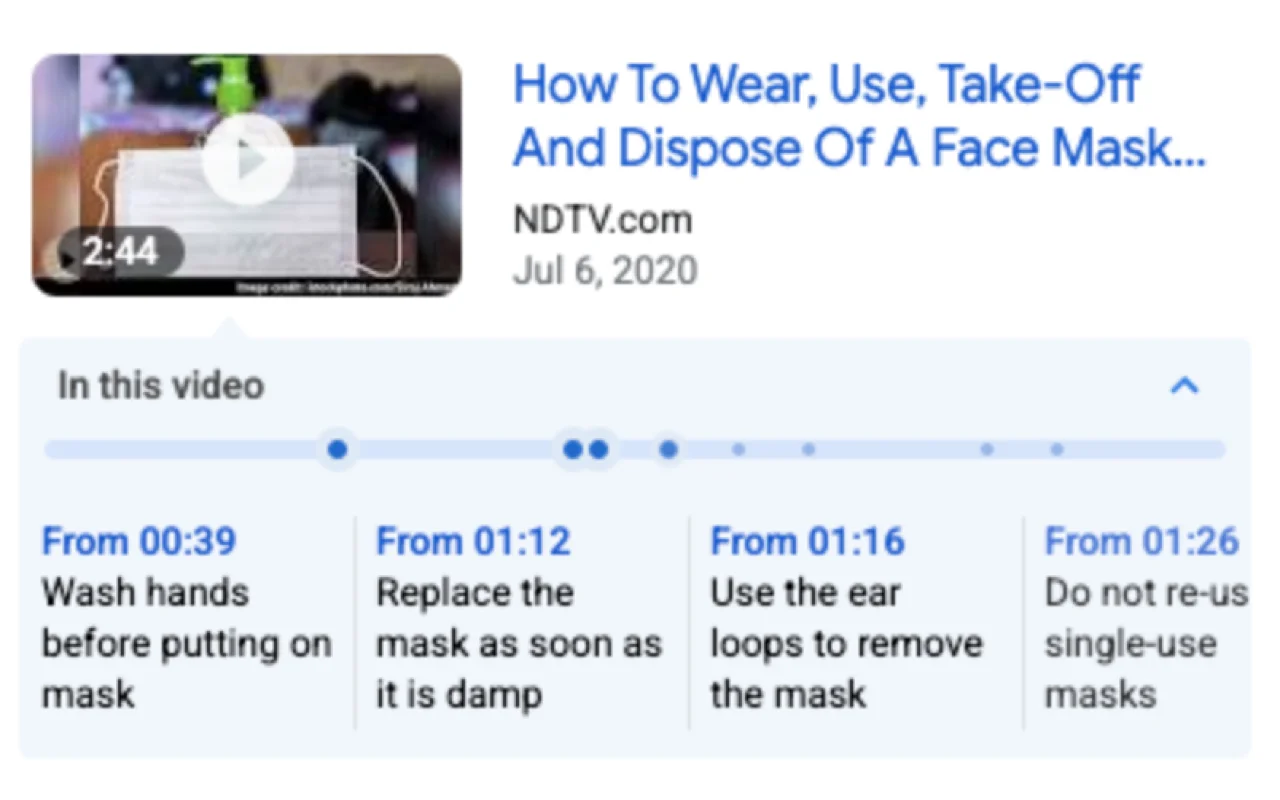
Timestamps now get pulled into Google search results as "Key Moments," appearing as clickable segments directly in the search listing. Your video could earn extra search traffic purely because of a well-written timestamp title.
Even more significant: AI search engines like Google AI Overviews and Perplexity parse timestamps to locate specific knowledge within videos. A clear timestamp like "5:30 How to place keywords in YouTube descriptions" gives AI systems a precise reference point — and increases the chance they cite your video.
Format requirements
First timestamp must start at 0:00 (required for YouTube to enable chapters)
Each timestamp needs a short descriptive label
Include keywords naturally in the labels
Minimum of 3 timestamps (YouTube will not activate chapters with fewer)
Example
0:00 Why most YouTube descriptions fail
2:15 The 3 essentials for above-the-fold text
5:30 SEO keyword placement strategy
8:00 Timestamp and link best practices
10:45 Copy-paste description template
12:00 How to set up default templates
Advanced technique: question-format timestamps
I have noticed top creators increasingly using question formats in their timestamps: "3:20 Why is nobody watching your videos?" This works on two levels. First, questions naturally trigger curiosity — viewers want to jump ahead and hear the answer. Second, question-format timestamps are easier for Google's Q&A search features and AI search engines to parse. When someone searches "why is nobody watching my YouTube videos," your video might surface specifically because the timestamp mirrors that query.
Keep timestamp titles under 50 characters, but always include at least one keyword. "5:30 Keywords" is weak. "5:30 How to place SEO keywords in YouTube descriptions" is discoverable.
YouTube Description Keyword Strategy
Front-load your primary keyword
Your target search term should appear in the first sentence of the description. YouTube's algorithm assigns higher weight to the first 200 characters of description text.
Weave in long-tail variations naturally
In the detailed section below the fold, repeat your core topic using different phrasings. If your primary keyword is "YouTube description template," spread these variations across different paragraphs:
Keyword Variation
Natural Usage
YouTube description template
"This YouTube description template saves 15 minutes per upload"
video description SEO
"Video description SEO starts with the opening line"
how to write YouTube descriptions
"Learning how to write YouTube descriptions changed my channel growth"
YouTube SEO description
"The YouTube SEO description framework below covers all seven sections"
description template for YouTube
"Use this description template for YouTube to stay consistent"
Avoid keyword stuffing
Search engines detect keyword stuffing and penalize it. Each keyword variation should appear 2-3 times across the full description — not more. If you read the description aloud and think "this phrase keeps repeating," you have gone too far.
Match your description to your title
The keywords in your title should reappear in your description. This creates semantic consistency — a signal that tells the algorithm your title and content are tightly aligned.
The 2026 factor: optimizing for AI search
Google AI Overviews, ChatGPT, and Perplexity are now pulling data from video descriptions to generate answers. Recent data shows that 43.2% of pages ranking first get cited by ChatGPT — 3.5x the rate of pages ranked outside the top 20.
To increase your chances of AI citation:
Include Q&A-style paragraphs in your description
Use clear, structured information
Answer common questions related to your video topic directly in the description
Write definition-style sentences: "A YouTube description is the text field below the video title where creators provide context, keywords, and links" — this format is precisely what AI systems extract most easily
Intent matching beats keyword matching
YouTube SEO in 2026 has evolved past simple keyword presence. The algorithm now evaluates whether your video satisfies the searcher's actual intent.
Before writing a description, search your target keyword on YouTube and study the top 5 results. If they are all providing templates, your description should explicitly mention "this video includes a copy-paste template." If they are deep analysis videos, emphasize "in-depth breakdown of the SEO mechanics." Match the intent the algorithm has already validated.
CTA Strategy: Turning Views Into Action
Your description is not just an information panel — it is the entry point of your conversion funnel.
CTA priority order
Priority
CTA Type
Position
Example
1
Primary conversion goal
Above the fold
"Grab the free template" + link
2
Subscribe prompt
Above the fold
"Subscribe for weekly YouTube growth tips"
3
Related video
Below the fold
"If you found this useful, watch next..."
4
Engagement prompt
Below the fold
"Drop a comment with your biggest description challenge"
5
Social links
Below the fold
Other platform links
One or two CTAs per description is enough. Too many choices paralyze readers. Place your most important CTA above the fold — the majority of viewers never click "Show more."
Make CTAs specific
Generic CTAs underperform. Instead of "Subscribe to my channel," write "Subscribe for weekly YouTube SEO tutorials every Wednesday." Instead of "Click the link," write "Grab the free description template below — it saves 15 minutes per upload." Give people a concrete reason to act, and conversion rates improve measurably.
The Copy-Paste YouTube Description Template
Here is the exact structure I use. Copy it, replace the bracketed sections with your content, and you have a search-optimized description ready to publish:
[One-line hook: pose a problem or promise a result, include your primary keyword]
[Video summary: 2-3 sentences explaining what this video helps the viewer accomplish]
Subscribe for more [your niche] content: [channel link]

---

[Detailed summary: background info, key takeaways, supplementary context.
Weave in 2-3 secondary keywords naturally. Keep paragraphs under 3 lines.]

[FAQ section: 2-3 Q&A pairs related to the video topic.
Structured for Google and AI search engines to extract.]

---

Timestamps:
0:00 [Chapter title with keyword]
X:XX [Chapter title]
X:XX [Chapter title]

---

Resources mentioned in this video:
- [Resource name]: [link]
- [Resource name]: [link]

---

Connect with me:
- YouTube: [link]
- Website: [link]
- Newsletter: [link]

#Hashtag1 #Hashtag2 #Hashtag3
How to Set Up Default Templates in YouTube Studio
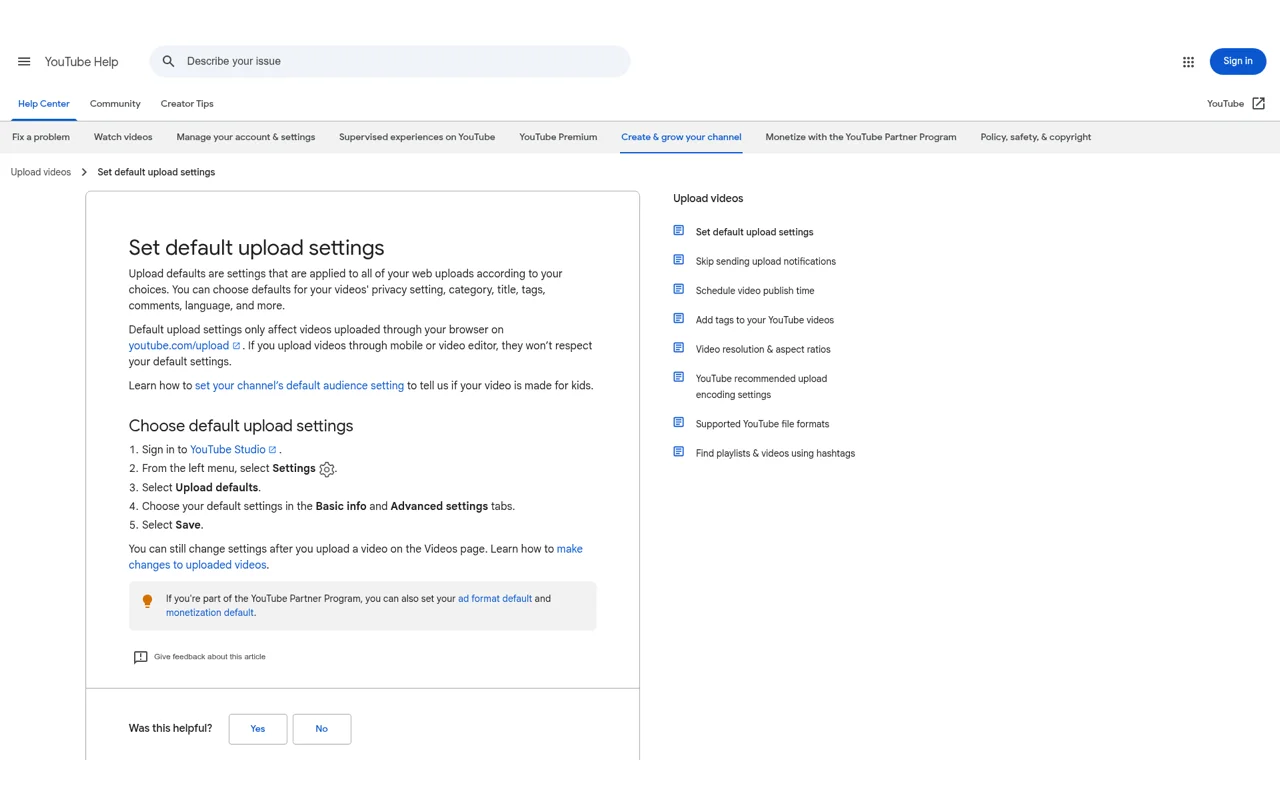
YouTube Studio's "Upload defaults" feature lets you pre-fill recurring sections — social links, channel intro, standard CTAs — so you only need to write the personalized top section for each video.
What belongs in your default template
Fixed social media links section
Channel description (1-2 sentences)
Standard subscribe CTA
Channel-level hashtags (3 permanent tags)
What does NOT belong in defaults
Video-specific keywords (different every time)
Timestamps (different every time)
Video-specific resource links
I have iterated through seven versions of my default template over two years. The first version had three lines of social links and nothing else. Over time, I added a channel value proposition, a persistent newsletter link, and standardized divider formatting. Each revision was driven by data: links that got clicks moved up, links nobody touched got removed. Review your default template quarterly and adjust based on what your audience actually engages with.
Pre-Publish Checklist
Run through this before every upload:
Check
Pass Criteria
Primary keyword in first line
Yes
Above-the-fold value proposition
Yes
Above-the-fold CTA
Yes
Timestamp format correct (starting at 0:00)
Yes
Keywords woven naturally (no stuffing)
Yes
Description keywords match title keywords
Yes
Resource links are clickable and tested
Yes
3-5 hashtags
Yes
Total under 5,000 characters
Yes
Mobile preview looks correct
Yes
At least one Q&A paragraph (AI search optimization)
Yes
All links verified and working
Yes
How Descriptions Work With Your Other Metadata
A YouTube description does not exist in isolation. It operates as part of a metadata system alongside your title, thumbnail, tags, and captions. These elements should form a coherent semantic unit — all pointing toward the same core topic.
Here is how I think about the division of labor: the title grabs attention and carries the primary keyword. The description expands the topic and covers long-tail keywords. The thumbnail provides visual and emotional pull. Tags assist with categorization. Captions (auto-generated or manual) add a full transcript layer for search indexing.
When your title says "3-Step YouTube SEO Guide," your description should explain what those three steps are. Your thumbnail should visualize the "3 steps" concept. Your tags should cover "YouTube SEO" and related terms. This consistency is a quality signal the algorithm rewards.
I was wrong about one thing early on: I thought descriptions and tags served the same purpose. They do not. Tags are a minor ranking signal in 2026 — YouTube has confirmed this publicly. Descriptions carry far more weight because they provide context the algorithm can parse semantically. If you are spending time optimizing tags but neglecting descriptions, flip that priority immediately.
Tools That Make Description Writing Faster
These are the tools I actually use in my workflow:
Tool
What It Does
Cost
TubeBuddy
Bulk-edit descriptions, A/B test titles and thumbnails
Free tier / $9/mo
VidIQ
Keyword research, competitor description analysis
Free tier / $7.50/mo
Google SERP Simulator
Preview how your description appears in search results
Free
YouTube Studio Analytics
Track search traffic sources and CTR data
Free
Claude / ChatGPT
Generate description drafts for iteration
Subscription
TubeBuddy's bulk editing feature is the one I reach for most. When you need to update social links, channel descriptions, or promotional text across dozens of videos, editing them one by one is brutal. TubeBuddy handles batch replacements in minutes.
VidIQ's competitor analysis shows how top-ranking videos in your niche structure their descriptions — what keywords they use, how they format sections, where they place CTAs. Before writing a description for a new video, I analyze the top five videos on the same topic and identify the common keywords and structural patterns, then differentiate my approach.
Ready-to-Use Prompt: Build a 7-Part YouTube Description That Ranks
What this does: Builds your YouTube description across the 7 parts — first-150 above-the-fold hook, keyword body, timestamps, one clear CTA, links/about/tags — and runs the pre-publish checklist plus the YouTube Studio default-template setup, treating the description as a primary ranking signal, not an afterthought. Based on: YouTube Description Template: The 7-Part Structure That Actually Ranks — https://aiworkflowpro.com/write-high-click-youtube-description-guide/ Time to run: ~4 minutes
Copy this prompt into Claude Code, ChatGPT, or any AI assistant:
ROLE: You are a YouTube SEO description writer. Your job: build a 7-part description that ranks — leading with the first 150 above-the-fold characters, keyword placement, timestamps, and a CTA — treating the description as a primary metadata ranking signal, not an afterthought.

CONTEXT — 7-PART YOUTUBE DESCRIPTION BUILDER:
Most creators spend 10 hours editing and two minutes on the description — that math is backwards. YouTube's algorithm weighs the description heavily for search ranking (it is a primary metadata signal, per the Creator Academy); it is a free traffic amplifier working around the clock. The author rebuilt description workflow with a structured template and grew search traffic 40% in three months without filming a new video. The 7-part structure: (1) first 150 characters above the fold, (2) keyword-optimized body, (3) timestamps, (4) CTA, (5) links/resources, (6) about/channel, (7) tags/hashtags — each part owning one metadata job.

INPUTS (fill in before running):
- VIDEO_TOPIC: YOUR_VIDEO_HERE (what the video is about)
- PRIMARY_KEYWORD: YOUR_TARGET_HERE (the search keyword to rank for)
- KEY_CHAPTER_TIMES: YOUR_TIMESTAMPS_HERE (the video's chapter start times — or "none, infer from topic")
- CTA_TARGET: YOUR_ACTION_HERE (subscribe / link / comment / product)

METHOD — 6 STEPS:

Step 1 — Write the first 150 characters (above the fold)
The above-the-fold 150 chars are what viewers and the algorithm see first. Lead with the PRIMARY_KEYWORD + a hook that matches search intent. This slice carries disproportionate ranking weight — do not waste it on "Hey guys, welcome back."

Step 2 — Write the keyword-optimized body
Expand with 2-4 sentences that include PRIMARY_KEYWORD and related terms naturally (not stuffed). The body is where long-tail search queries connect — answer the intent the keyword implies.

Step 3 — Format timestamps for maximum impact
Add timestamps from KEY_CHAPTER_TIMES (or infer logical chapters from VIDEO_TOPIC). Format as 0:00 Chapter · 1:23 Next — timestamps improve search ranking, appear in Google results, and let viewers jump. Every video over 2-3 minutes needs them.

Step 4 — Write the CTA
One clear CTA matching CTA_TARGET (subscribe / click link / comment / product), placed where it earns action — not a stack of five competing asks. Views die without a next action.

Step 5 — Add links, about, tags
Add the resource links, a one-line about/channel line, and tags/hashtags (PRIMARY_KEYWORD + 3-5 related). These are the metadata tail — they help discovery without crowding the above-the-fold hook.

Step 6 — Pre-publish checklist + default-template setup
Run the pre-publish check: (1) keyword in first 150? (2) intent matched? (3) timestamps present? (4) one clear CTA? (5) tags/hashtags set? Then set this as a default template in YouTube Studio so every video starts structured — the 40% gain came from consistency, not one-off effort.

RULES:
- The first 150 above-the-fold characters carry disproportionate ranking weight — lead with keyword + intent, not a greeting.
- Timestamps are required for any video over 2-3 minutes — they rank in Google and let viewers jump.
- One clear CTA — competing CTAs split the action and convert worse.
- Set the structure as a YouTube Studio default template — the traffic gain comes from consistency across every video.

OUTPUT FORMAT:
Output six sections:
1. **First 150 chars** — the above-the-fold hook (with PRIMARY_KEYWORD + intent).
2. **Keyword body** — the 2-4 sentence intent-matching body.
3. **Timestamps** — the formatted chapter timestamps.
4. **CTA** — the single clear CTA for CTA_TARGET.
5. **Links + about + tags** — the resource links, about line, and tags/hashtags.
6. **Pre-publish checklist + default template** — markdown table with columns: Check | Pass? (Y/N), + the YouTube Studio default-template setup note.
Save as @templates/write-high-click-youtube-description-guide.md and run for every video, then set the output as a YouTube Studio default template so every upload starts structured.
Frequently Asked Questions
How long should a YouTube description be?
There is no universal ideal length. From my experience, tutorial and educational videos perform best with descriptions between 300-500 words because they need space for timestamps, keyword coverage, and resource links. Entertainment and vlog content can be effective at 100-200 words. The guiding principle is not length — it is density. A focused 200-word description outperforms a padded 800-word one every time.
How many hashtags should I use?
YouTube recommends 3-5 hashtags. I keep three permanent channel-level hashtags in my default template and add one or two video-specific hashtags per upload. If you exceed 15 hashtags, YouTube ignores all of them — that is a documented penalty, not a myth.
How often should I update old descriptions?
I review my top and bottom performing videos quarterly. Videos that have search potential (high impressions but low CTR in YouTube Studio's "Search" traffic source) are the highest-priority candidates for description optimization. After updating, expect 1-2 weeks before changes affect ranking.
Do external links in descriptions hurt SEO?
YouTube description links are nofollow — they do not pass SEO authority to external sites. But links still matter for user experience. Include links to resources you actually mention in the video. Viewers appreciate being able to find the tools you reference. Avoid stuffing random affiliate links that have no connection to the content.
Can I use the same description for multiple videos?
Technically yes, but do not do it. Duplicate descriptions signal low effort to the algorithm and miss the opportunity to target different keywords per video. Use a default template for the recurring sections (social links, channel intro), but always write a unique opening, summary, and keyword section for each upload.
What to Do Next
Take your three most recent videos and rewrite their descriptions using the 7-part template above. Then set up your default template in YouTube Studio so every future upload starts with a strong foundation.
If you have older videos with minimal descriptions, go back and add timestamps to all of them. That single action — adding chapter markers to existing content — has one of the highest return-on-effort ratios in YouTube optimization. Your existing library is an untapped asset; better descriptions unlock traffic it is already positioned to receive.
Monitoring a competitor who publishes no feed is the case every RSS guide skips. Twenty-one platforms sorted by which of three jobs they do, and the finished setup is business process automation you own outright, with no seat licence to renew.
Blaming the content is the reflex when a post underperforms, and it is usually the wrong diagnosis. A second reader decides distribution before any human sees the post, and most of what it checks is mechanical enough to automate business processes around, on five platforms at once.
Nothing about month four is harder than month three. It is simply the month an unpaid channel starts to feel like proof of failure. Surviving it takes a cadence you can hold while earning nothing, which is a better reason to automate business processes than speed ever was.
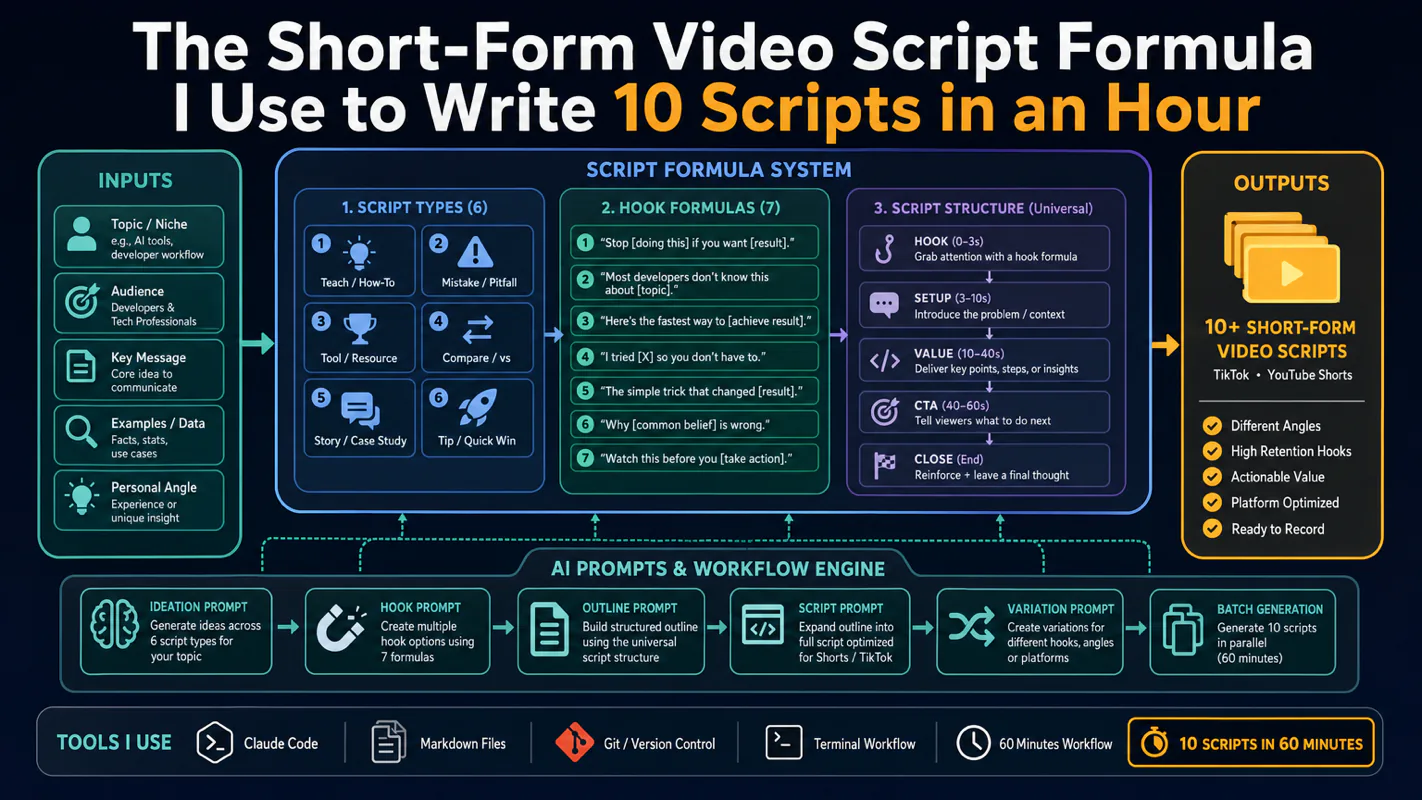
Thursday afternoon, fourteen product ideas, a Monday filming slot, no scripts. Six script shapes and seven hook formulas turn that hour into finished drafts — and the business rule stays: rewrite at least 30% before anything ships.