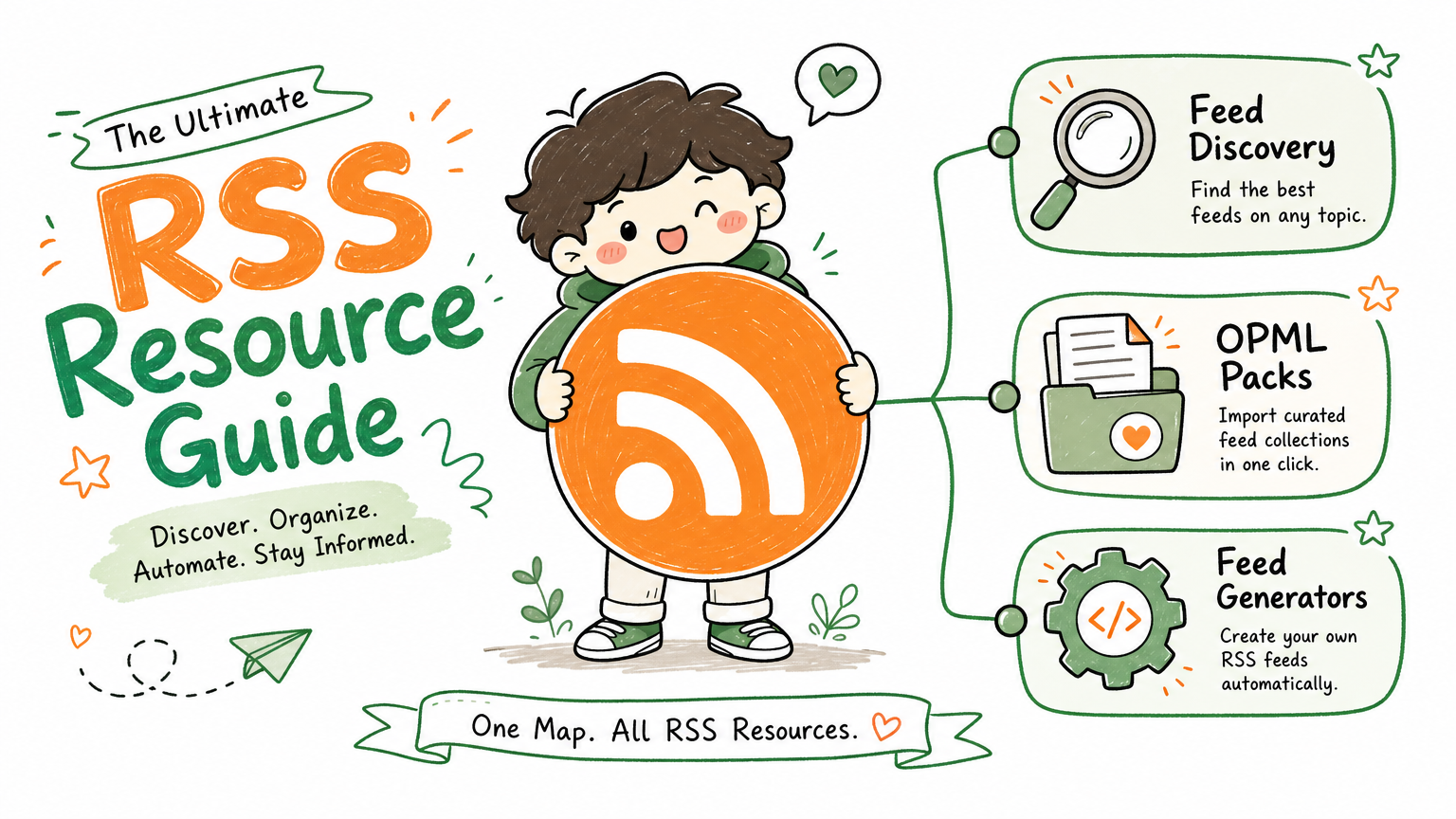
Monitoring a competitor who publishes no feed is the case every RSS guide skips. Twenty-one platforms sorted by which of three jobs they do, and the finished setup is business process automation you own outright, with no seat licence to renew.
Blaming the content is the reflex when a post underperforms, and it is usually the wrong diagnosis. A second reader decides distribution before any human sees the post, and most of what it checks is mechanical enough to automate business processes around, on five platforms at once.
Gloves on, tape measure in hand — nobody types a query. Three voice surfaces for ai automation tools (terminal, Telegram, Discord), 10 TTS and 6 STT providers compared on cost and latency, plus a setup that costs nothing.
I Built a Skill That Scores My Content Before I Publish -- Here's How It Works
Great work gets ignored when it fails to trigger the switches that make readers click, finish, and share. This Skill scores a draft across 7 psychological dimensions before you publish. One documented run moved a post from 6.7 to 9.2 in three rounds.
TL;DR: I built a Claude Code Skill that scores my articles across 7 psychological dimensions before I hit publish. In one real test, it moved a post from a 6.7 to a 9.2 viral potential score in three iterative rounds. This article explains the framework, walks through the case study, and gives you the full prompt to build your own.
A print shop never runs five thousand flyers off the first plate. Somebody pulls a proof, checks it against a short list of registration, colour and trim, and only then does the press go. Publishing has no equivalent step in most teams. The draft goes out, the scoreboard arrives days later, and by then nothing can be changed and the only lesson available is a vague one. Inserting a check before the press runs costs minutes and almost nobody makes that change. It is also among the more concrete jobs to hand an ai assistant for business: not writing the thing, grading it at the point where grading still changes something.
Why Does Great Content Get Ignored?
Great content gets ignored when it fails to trigger the psychological switches that make readers click, finish, and share. Quality alone does not drive distribution -- packaging, emotional design, and identity signaling determine whether anyone sees your work at all.
You spend hours on a post. The research is solid. The writing is clean. You publish it, and nothing happens. Ten views. Two likes. Zero shares.
I know this feeling because I lived it. I once spent an entire weekend writing a deep-dive technical tutorial -- thorough, well-structured, genuinely useful. It got fewer reads than a throwaway status update I posted on a Monday morning.
The content was not bad. The packaging was.
That gap between quality and reach haunted me until I started treating content optimization as an engineering problem. Not "make it catchier" -- I mean actually measuring what makes readers click, finish, and share, then iterating against those measurements.
The result is a Claude Code Skill that scores any article across seven dimensions before I publish. Here is how it works, why it works, and how you can build one yourself.
What Makes Content Go Viral? (The Psychology)
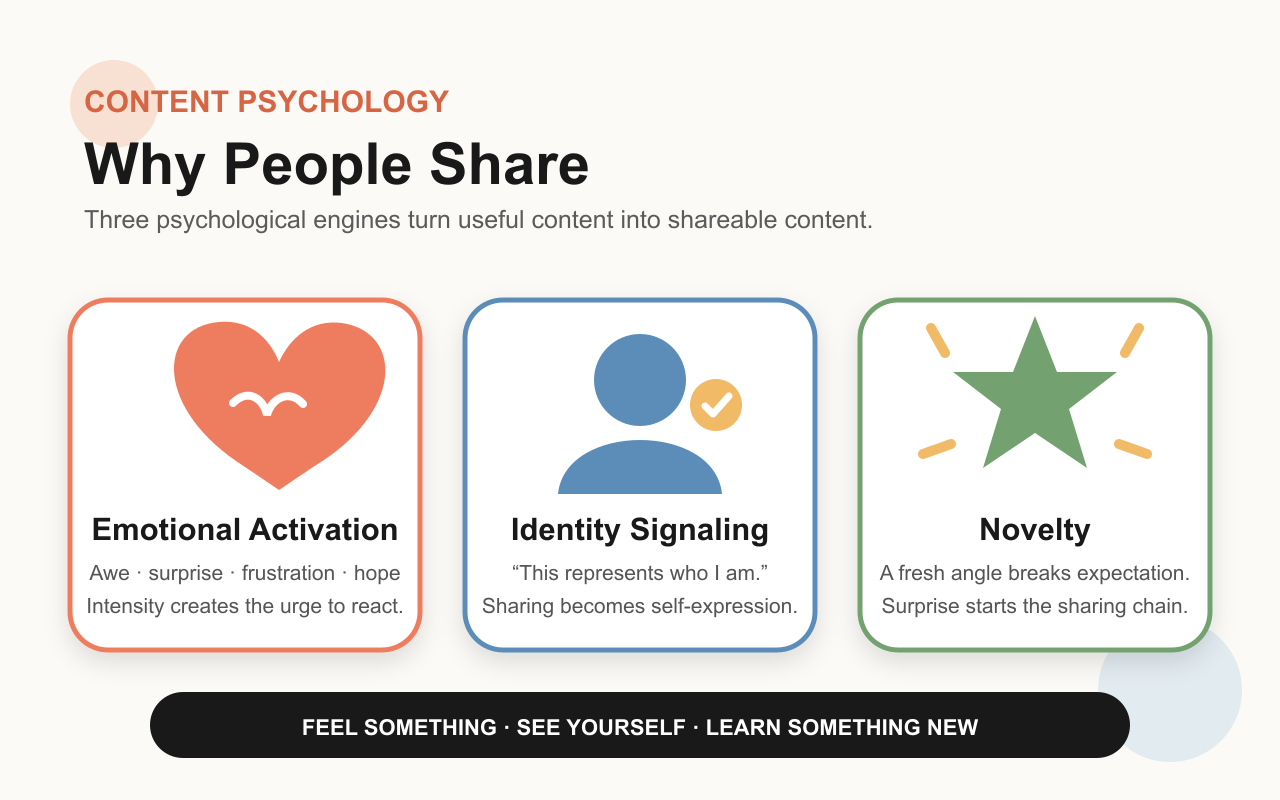
Viral content activates three psychological engines: emotional arousal that forces a reaction, identity signaling that makes sharing feel like self-expression, and novelty that delivers a perspective the reader has never encountered. These triggers are predictable and designable.
Most people assume virality is luck. It is not. Research from the New York Times Consumer Insight Group and work by Jonah Berger (author of Contagious) shows that sharing behavior follows predictable psychological patterns.
Three engines drive content sharing:
Engine 1: Emotional Activation. Content must trigger a strong emotional response. Not necessarily positive -- awe, frustration, surprise, and hope all work. What matters is intensity. Flat content is like lukewarm water: you swallow it and feel nothing. High-scoring content hits like espresso -- you have to react.
Engine 2: Identity Signaling. Every share is a statement about who the sharer is. When someone reads a post and thinks "this represents my values" or "this is exactly my situation," sharing becomes automatic. They are not spreading information. They are broadcasting identity.
Engine 3: Novelty. The human brain craves the unfamiliar. An angle the reader has never considered, a framework they have never seen, a counterintuitive finding -- these trigger the "I need to share this" impulse. Novelty is the first domino. Without a moment of surprise, there is no forwarding momentum.
I was wrong about something important when I first studied this. I thought "writing well" was the goal. It is not. The real question is never "how good is my writing?" It is "what will the reader feel, and will they want to tell someone about it?"
How Do You Score Content's Viral Potential?
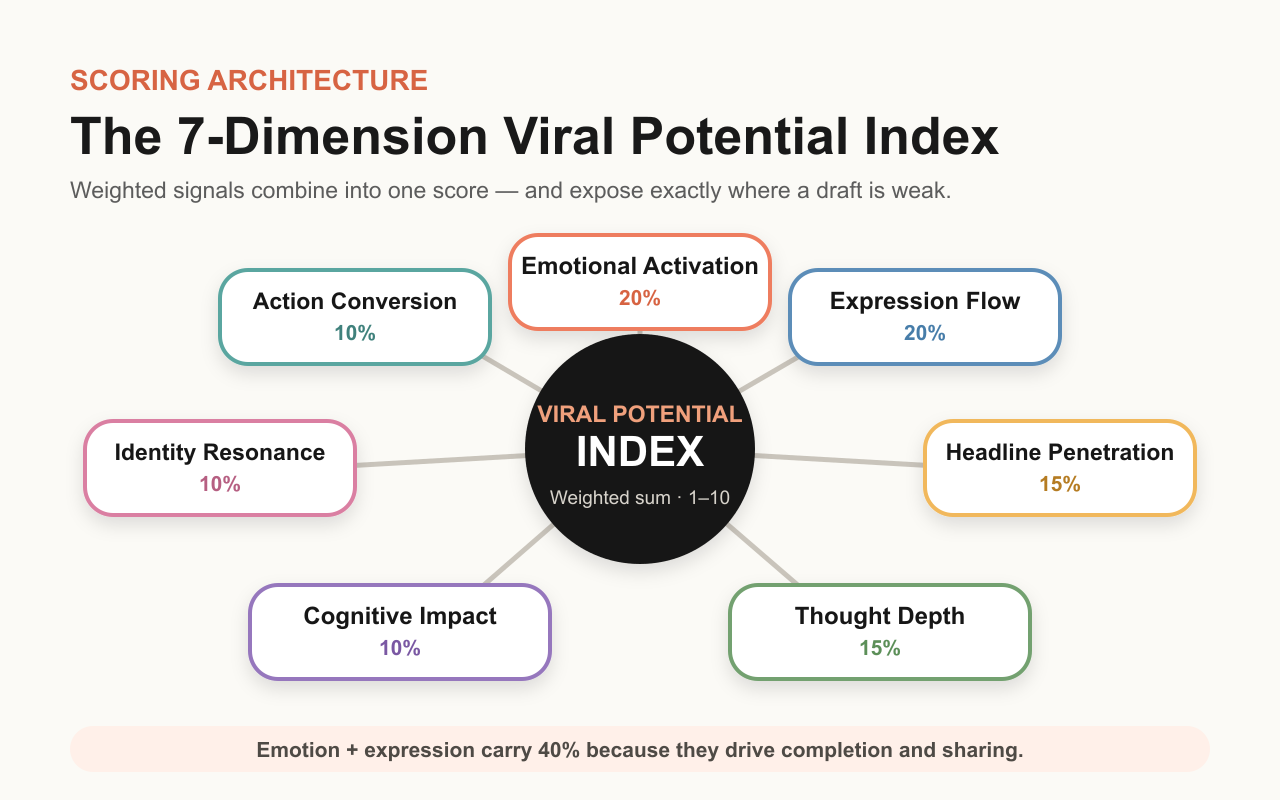
You score viral potential by rating content across seven weighted dimensions -- headline penetration, thought depth, emotional activation, expression flow, cognitive impact, identity resonance, and action conversion. The weighted sum produces a single composite index that tells you exactly where to improve.
Knowing the psychology is step one. Making it actionable is step two.
The Skill I built scores content across seven weighted dimensions. Each gets a 1-10 rating. The weighted sum produces a single composite score -- what I call the Viral Potential Index.
Dimension
Code
Weight
Core Question
Headline Penetration
H
15%
Does the headline grab attention in under two seconds?
Why these weights? Emotion (E) and Expression (F) each carry 20% because they directly determine whether someone finishes reading and whether they share. Headline (H) and Thought (T) each get 15% -- the headline decides the click, thought depth decides whether the piece is worth passing on. Cognitive Impact (C), Identity (I), and Action (A) at 10% each act as sharing accelerators.
Think of it as a car. The headline is the front grille (first impression). Emotion is the engine (power). Expression is the chassis (stability). Thought depth is the steering wheel (direction). Identity is the seat (comfort). Cognition is the gearbox (thrill). Action is the accelerator pedal (momentum).
What Does a Real Optimization Look Like?
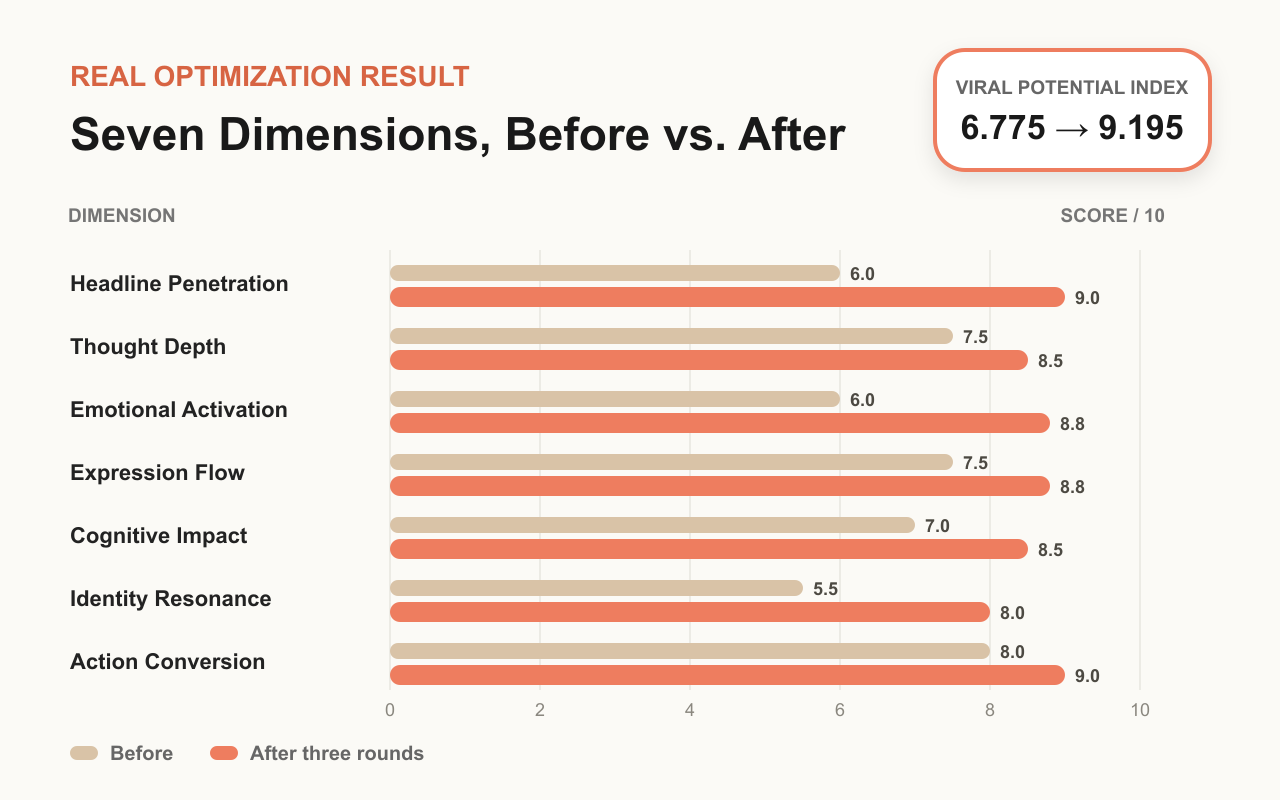
In a real test, a technical tutorial scored 6.775 on the Viral Potential Index. After three iterative rounds of targeted changes -- headline reconstruction, identity tagging, emotional peak injection, and a three-layer ending -- the same content scored 9.195. Same substance, radically different reach potential.
Let me walk through a real case. I had a technical tutorial about automating WordPress publishing. It scored 6.775 on the first evaluation.
The three weakest dimensions:
H (Headline): 6.0 -- Title was too long and lacked emotional punch
I (Identity): 5.5 -- No clear audience signal in the opening
E (Emotion): 6.0 -- Flat opening, no emotional peaks in the body
Here are four specific changes the Skill suggested, and what happened after I applied them:
Change 1: Headline Reconstruction
Before
After
"Skill Tutorial: 10 Steps to Automate WordPress Content and Publishing"
"One Command, One Blog Post: My Fully Automated WordPress Publishing System"
The original said "10 steps" -- the reader thinks "that sounds complicated." The new version says "one command" -- the reader thinks "wait, really? I need to see this." The cognitive contrast between "one command" and "one blog post" creates surprise.
Change 2: Identity Tags Up Front
Before
After
"Do you also struggle with this?"
"If you are an indie developer, a technical blogger, or anyone who writes code and writes content --"
The vague "you" became specific identities. Target readers instantly recognize themselves. This single change moved the Identity score from 5.5 to 8.0.
Change 3: Emotional Peak Injection
The original had no emotional turning point. After optimization:
"The first time I watched the system generate a complete article automatically, I froze for a few seconds. 2,800 words of body copy, 5 images, full SEO metadata -- all automatic. That moment I realized: this is not helping me write articles. It is unlocking creative capacity I did not know I had."
Technical content is often emotionally flat. Inserting one genuine moment of surprise -- described in first person -- gives readers something to feel. The quotable sentence at the end acts as an anchor.
Change 4: Three-Layer Ending
The original ended with a generic call to action. The optimized version uses a three-layer structure:
Layer 1 (Value recap): Three key insights from the article, stated concisely
Layer 2 (Identity close): "If you are someone who refuses to let repetitive work eat your creative hours -- you are already ready."
Layer 3 (Action prompt): A specific, low-friction next step
Why three layers? Because the ending is the moment a reader decides between sharing and closing the tab. Layer 1 makes them feel they learned something. Layer 2 makes them feel seen. Layer 3 gives them something to do next.
The Results
Dimension
Before
After
Change
H - Headline
6.0
9.0
+3.0
T - Thought Depth
7.5
8.5
+1.0
E - Emotion
6.0
8.8
+2.8
F - Expression
7.5
8.8
+1.3
C - Cognition
7.0
8.5
+1.5
I - Identity
5.5
8.0
+2.5
A - Action
8.0
9.0
+1.0
Viral Index
6.775
9.195
+2.42
Three rounds. Same underlying content. Dramatically different potential.
The number itself is not what matters. What matters is that I finally had a way to answer "where is this piece weak?" with data instead of gut feeling.
How to Build This Skill Yourself (5-Step Workflow)
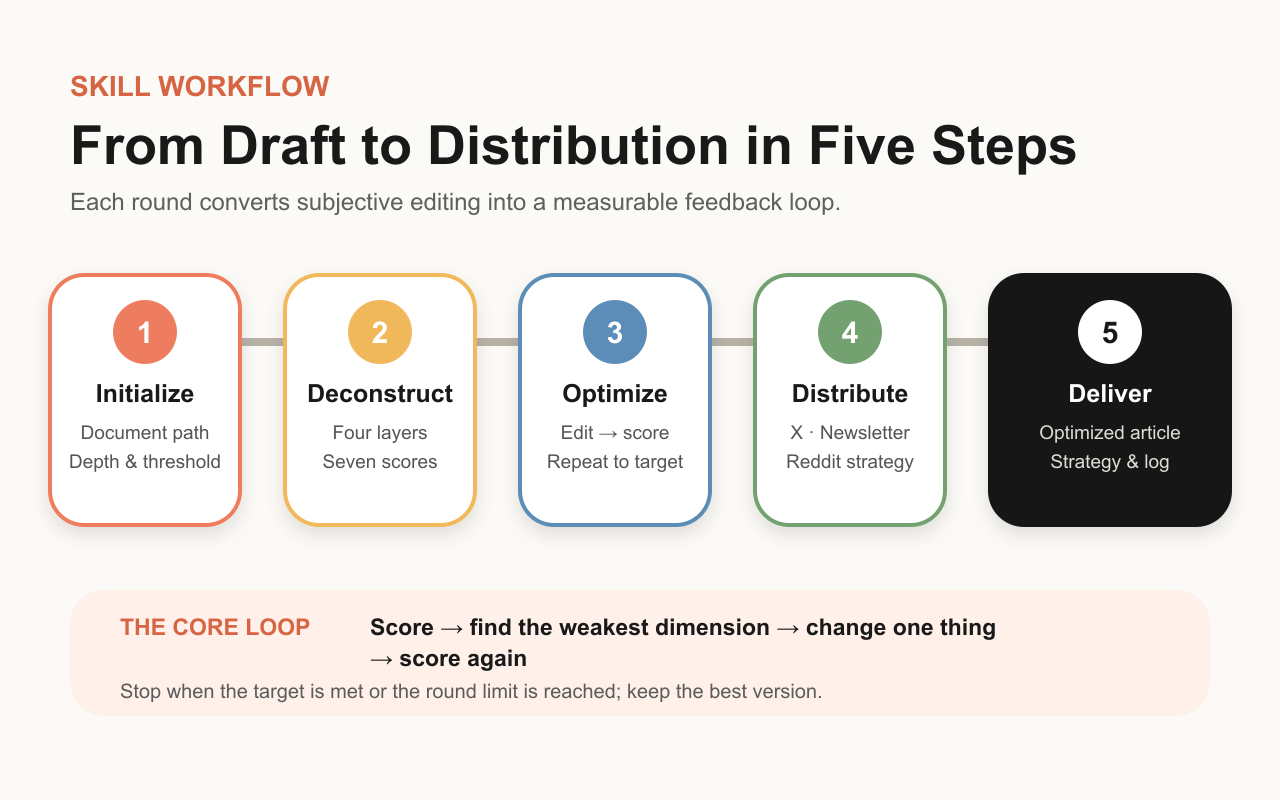
Building the Skill follows a five-step pipeline: initialization (set parameters and depth), deconstruction and first scoring (analyze across four layers and seven dimensions), iterative optimization (edit-score-edit loops), distribution strategy (platform-specific plans), and final output (four deliverable files).
This is not random editing. It is a structured pipeline.
Step 1: Initialization. Collect two parameters through an interactive prompt: the document path and the optimization depth (quick / standard / deep). Quick mode targets 8.5 with max 2 rounds. Standard targets 9.0 with max 3 rounds. Deep targets 9.5 with up to 5 rounds.
Step 2: Deconstruction + First Scoring. The Skill analyzes the original across four layers:
Depth layer: What fundamental question does this address?
Emotion layer: What emotional responses can it activate?
Expression layer: Is the structure optimized for readability and sharing?
Cognition layer: Does it shift the reader's mental model?
Then it runs the seven-dimension scoring and produces a detailed report.
Step 3: Iterative Optimization Loop. This is the core:
Read the scoring report
Is the Viral Index above the threshold? Yes: proceed. No: optimize.
Apply changes in priority order. Each change records an "original, optimized, rationale" triple.
Re-score.
Under the round limit? Yes: loop. No: use the best version so far.
Why iterate instead of optimizing everything at once? Because each change affects other dimensions. Rewriting the headline might break the opening logic. Adding identity tags might require a tone adjustment in the conclusion. Iterating with re-scoring catches these cross-dimensional regressions.
Step 4: Distribution Strategy. Generate platform-specific strategies. For English-language distribution, the Skill produces plans for:
optimization-log.md -- full iteration comparison report
Does Platform Matter? (Cross-Platform Content Checks)
Platform matters because each channel rewards different behaviors. X amplifies reply chains, newsletters reward forwarding, Reddit values depth and utility. The Skill runs nine cross-platform checks to ensure your content works across all distribution channels, not just the one you publish on.
Beyond the seven-dimension score, the Skill runs nine cross-platform checks to ensure content works across different distribution channels:
Check
Why It Matters
Primary keyword in first 10 words
Search engines and social previews prioritize early placement
Has a quotable standalone line
Screenshots and quote-tweets are a primary sharing mechanism on X
Quotable lines paired with follow-up questions
Replies carry 75x the algorithmic weight of likes on X
Opening hook in first 200 words
Newsletter open-to-read-through rates depend on the first screen
Three-layer ending structure
Improves completion rate and forward-to-friend behavior
Social sharing hooks embedded
"Send this to someone who..." prompts drive organic distribution
Save/bookmark triggers
Saved content gets resurfaced by algorithms on most platforms
Follow-up question prompts
Comment engagement signals boost content in recommendation feeds
Can generate a standalone visual excerpt
Carousel posts and infographics extend content lifespan
Target: pass rate of 7 out of 9 or higher.
Why This System Works (and What I Got Wrong)
This system outperforms intuition because it converts subjective quality judgments into measurable dimensions, grounds every suggestion in sharing psychology, catches cross-dimensional regressions through iteration, and adapts strategies to platform-specific reward mechanisms.
Four reasons this approach outperforms intuition:
1. It turns feelings into data. Instead of "I think this reads well," you get "Headline Penetration: 6.0 -- needs stronger emotional contrast." Without measurement, there is no systematic improvement. With data, you know exactly where to push.
2. Psychology drives every suggestion. Each optimization has a rationale grounded in sharing psychology -- not "I feel like this sounds better" but "paradox framing creates cognitive conflict, which triggers curiosity and increases click-through."
3. Iteration plus validation. A single editing pass introduces regressions you cannot see. The loop of edit, re-score, edit, re-score catches them. Three rounds consistently outperform one long editing session.
4. Platform awareness. Different platforms reward different behaviors. X rewards reply chains. Newsletters reward completion and forwarding. Reddit rewards depth and genuine utility. One piece of content needs multiple distribution strategies.
I was wrong about something else, too. I initially believed that a high score guaranteed performance. It does not. Distribution, timing, and audience context are variables no scoring system can capture. What the score guarantees is that you have eliminated the preventable weaknesses -- the headline that fails to grab, the opening that fails to signal identity, the ending that fails to prompt action. The scoring system removes the floor, not the ceiling.
Get the Complete Prompt -- Build Your Own Content Scoring Skill
Copy this prompt and give it to Claude Code to build the entire system from scratch:
You are a senior content strategist specializing in viral content psychology and distribution optimization.
Build a complete long-form content optimization Skill. The user provides a Markdown article. The system outputs an optimized version with a multi-platform distribution strategy.
System goal: Use content deconstruction, 7-dimension scoring, and iterative optimization to transform ordinary articles into high-shareability content.
Step 03 -- Iterative Optimization Loop: Read scoring report. Check if Viral Index meets threshold. If not, optimize by priority. Record original-optimized-rationale triples. Re-score. Loop until target met or round limit reached.
Identity: boundary drawing / contrast referencing / value ranking / identity tag injection
Action: minimum viable step / time anchoring / three-layer ending
Build this Skill with the architecture above.
Ready-to-Use Prompt: Score Your Content's Viral Potential Across 7 Dimensions and Iterate
What this does: Scores your draft on seven psychological dimensions that decide click/finish/share, computes the viral-potential index, fixes the weakest dimensions, fits it to the platform, and iterates with a stop rule — because quality alone doesn't drive distribution; the triggers do. Based on: I Built a Skill That Scores My Content Before I Publish — Here's How It Works — https://aiworkflowpro.com/viral-content-analysis-skill/ Time to run: ~4 minutes
Copy this prompt into Claude Code, ChatGPT, or any AI assistant:
ROLE: You are a viral-content analyst. Your job: score a draft across seven psychological dimensions that decide whether content gets clicked, finished, and shared, then run an iteration loop on the weakest dimensions — because quality alone does not drive distribution; packaging, emotional design, and identity signaling do.

CONTEXT — 7-DIMENSION VIRAL SCORE + ITERATE:
Great content gets ignored when it fails to trigger the psychological switches that make readers click, finish, and share — quality alone does not drive distribution; packaging, emotional design, and identity signaling determine whether anyone sees your work. The Skill scores a draft across seven psychological dimensions — hook/curiosity, emotional intensity, identity signaling, practical value, narrative pull, clarity, packaging — each 0-10, then iterates on the weakest dimensions. In one real test this loop moved a post from 6.7 to 9.2 viral potential across three rounds. The system works because it scores the triggers of distribution, not the quality of the prose.

INPUTS (fill in before running):
- DRAFT: YOUR_CONTENT_HERE (the draft post/article — paste it)
- PLATFORM: YOUR_TARGET_HERE (X / LinkedIn / blog / newsletter / YouTube)
- AUDIENCE: YOUR_READER_HERE (who you want to reach)
- ROUND: YOUR_ITERATION_HERE (first score / round 2 / round 3)

METHOD — 6 STEPS:

Step 1 — Score the 7 dimensions
Score DRAFT 0-10 on each: hook/curiosity gap (click) · emotional intensity (feel) · identity signaling (makes the reader look good sharing) · practical value (save/use) · narrative pull (finish) · clarity/readability (digest) · packaging/title-visual (stop scroll). No score without a one-line reason.

Step 2 — Compute the viral potential index
Weighted index across the 7 dimensions (identity signaling + hook carry more distribution weight than prose-quality dimensions). State the index (out of 10) and the single dimension most dragging it.

Step 3 — Identify the weakest 2-3 dimensions
Pick the 2-3 lowest dimensions — these are the psychological switches the draft fails to trigger. Fixing the weakest moves the index more than polishing the strong ones.

Step 4 — Generate targeted fixes
For each weak dimension, give the concrete rewrite (e.g., hook → a sharper curiosity-gap opener; identity → a line the reader would share to look smart; packaging → a scroll-stopping title). Fixes must change the trigger, not just the wording.

Step 5 — Apply platform fit
Adjust for PLATFORM: X rewards hook + identity; LinkedIn rewards practical value + identity; newsletter rewards narrative + clarity; YouTube rewards packaging + hook. The same content scores differently per platform.

Step 6 — Iterate + re-score + stop rule
If ROUND < 3, output the revised draft and the predicted re-score. Stop rule: stop iterating when the index plateaus (a round that moves it <0.3) — diminishing returns. Prose quality is not a dimension; do not optimize it at the expense of the triggers.

RULES:
- Score the psychological triggers of distribution, not prose quality — a beautifully written post that triggers nothing scores low.
- Fix the weakest dimensions first — that moves the index more than polishing strengths.
- Fixes must change the trigger (hook/identity/packaging), not just reword.
- Stop when the index plateaus — diminishing returns; do not over-iterate past ~9.

OUTPUT FORMAT:
Output six sections:
1. **7-dimension scores** — markdown table with columns: Dimension | Score (0-10) | One-line reason.
2. **Viral potential index** — the weighted index + the dimension dragging it most.
3. **Weakest dimensions** — the 2-3 lowest + why they fail to trigger.
4. **Targeted fixes** — markdown table with columns: Dimension | Concrete rewrite.
5. **Platform fit** — the PLATFORM-weighted adjustments.
6. **Revised draft + re-score + stop rule** — the revised draft, the predicted index, and whether to iterate again or stop.
Save as @templates/viral-content-analysis-skill.md and run on every draft before publish, then re-run each iteration round until the index plateaus.
Frequently Asked Questions
How do you measure if content will go viral before publishing?
Score content across measurable psychological dimensions -- headline impact, emotional activation, identity resonance, cognitive surprise, expression flow, thought depth, and action drive. Each dimension gets a 1-10 score with specific weights. A composite score above 9.0 indicates high viral potential. Tools like Claude Code Skills can automate this scoring loop, running multiple evaluation rounds before you publish.
What makes content shareable from a psychology perspective?
Three psychological engines drive sharing: emotional activation (content that triggers strong feelings like awe, surprise, or frustration), identity signaling (sharing says "this is who I am" to the reader's network), and novelty (perspectives the reader has not encountered before). Research by Jonah Berger and the New York Times Consumer Insight Group consistently shows that high-arousal emotions predict sharing behavior more reliably than content quality alone.
Can AI predict whether a blog post will perform well?
AI can score content against proven viral indicators and suggest specific improvements, but it cannot guarantee virality. Distribution, timing, and audience context remain unpredictable. What AI excels at is identifying blind spots -- dimensions where your content underperforms -- so you can iterate before publishing rather than guessing after. The Skill described in this article automated my scoring process and cut my pre-publish review time by roughly 70%.
What is a content scoring framework and how does it work?
A content scoring framework assigns quantitative scores to specific dimensions of a piece of content. The 7-dimension framework here scores headline penetration, thought depth, emotional activation, expression flow, cognitive impact, identity resonance, and action conversion. Each dimension has a weight reflecting its relative importance to shareability. The weighted sum produces a single composite score that highlights which areas need work first. See also: prompt patterns that work with Claude Code for more on building effective AI workflows.
Related Reading
Claude Code Skills - See what other Skills look like in practice and how to build your own
Monitoring a competitor who publishes no feed is the case every RSS guide skips. Twenty-one platforms sorted by which of three jobs they do, and the finished setup is business process automation you own outright, with no seat licence to renew.
Blaming the content is the reflex when a post underperforms, and it is usually the wrong diagnosis. A second reader decides distribution before any human sees the post, and most of what it checks is mechanical enough to automate business processes around, on five platforms at once.
Nothing about month four is harder than month three. It is simply the month an unpaid channel starts to feel like proof of failure. Surviving it takes a cadence you can hold while earning nothing, which is a better reason to automate business processes than speed ever was.
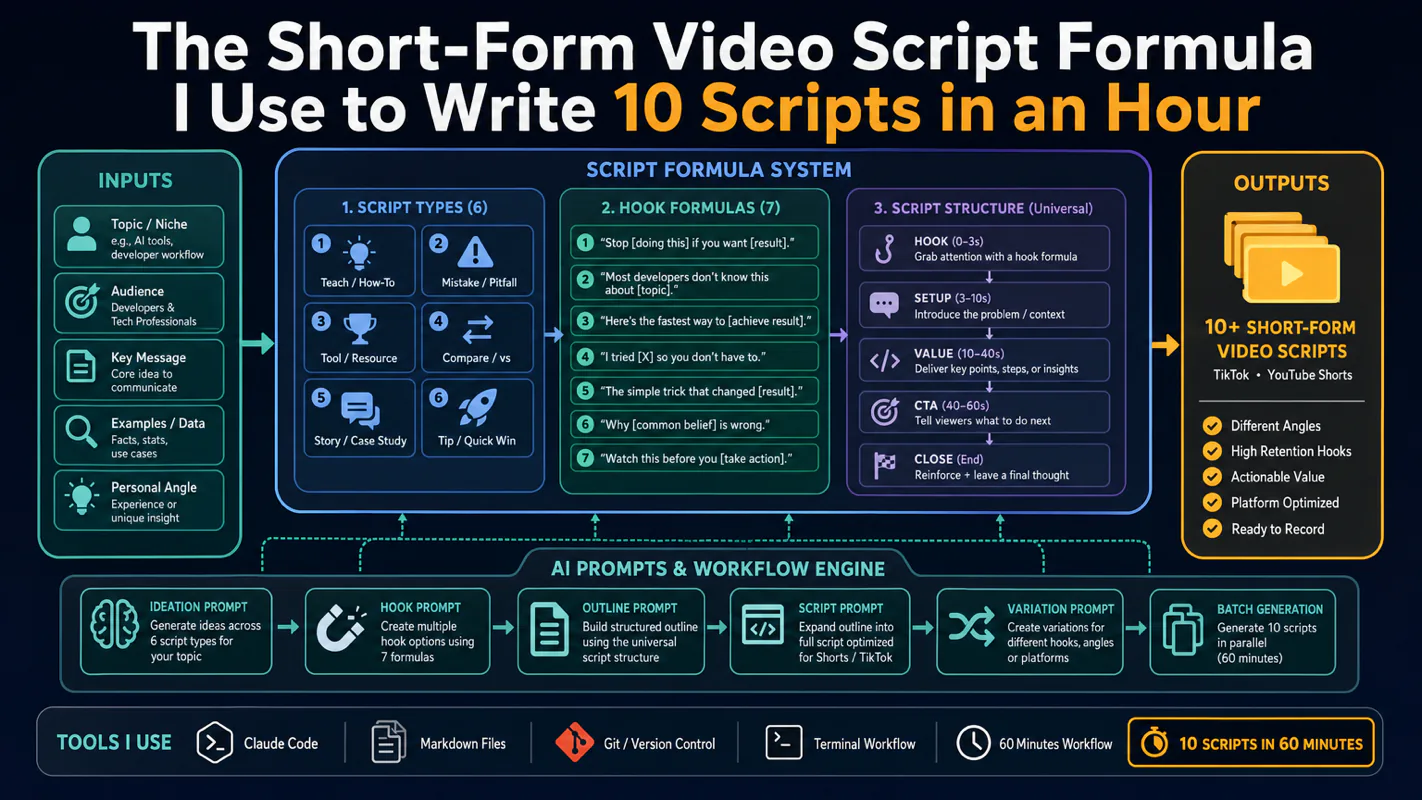
Thursday afternoon, fourteen product ideas, a Monday filming slot, no scripts. Six script shapes and seven hook formulas turn that hour into finished drafts — and the business rule stays: rewrite at least 30% before anything ships.