Monitoring a competitor who publishes no feed is the case every RSS guide skips. Twenty-one platforms sorted by which of three jobs they do, and the finished setup is business process automation you own outright, with no seat licence to renew.
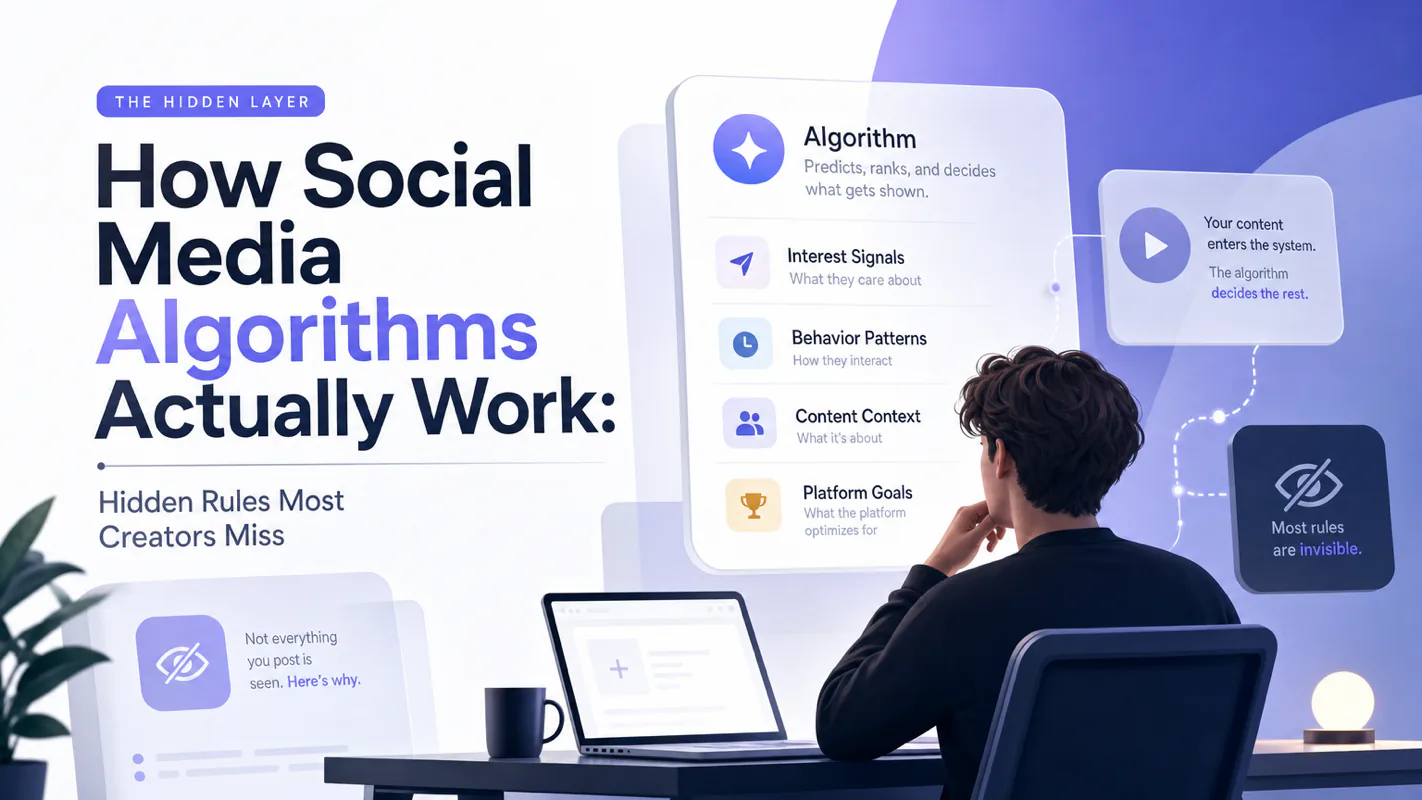
Blaming the content is the reflex when a post underperforms, and it is usually the wrong diagnosis. A second reader decides distribution before any human sees the post, and most of what it checks is mechanical enough to automate business processes around, on five platforms at once.
Gloves on, tape measure in hand — nobody types a query. Three voice surfaces for ai automation tools (terminal, Telegram, Discord), 10 TTS and 6 STT providers compared on cost and latency, plus a setup that costs nothing.
Chatbots answer. Agents act. Five distinct stages sit between those two verbs, and knowing which one a tool reached tells you whether an ai assistant for business will draft the reply or send it.
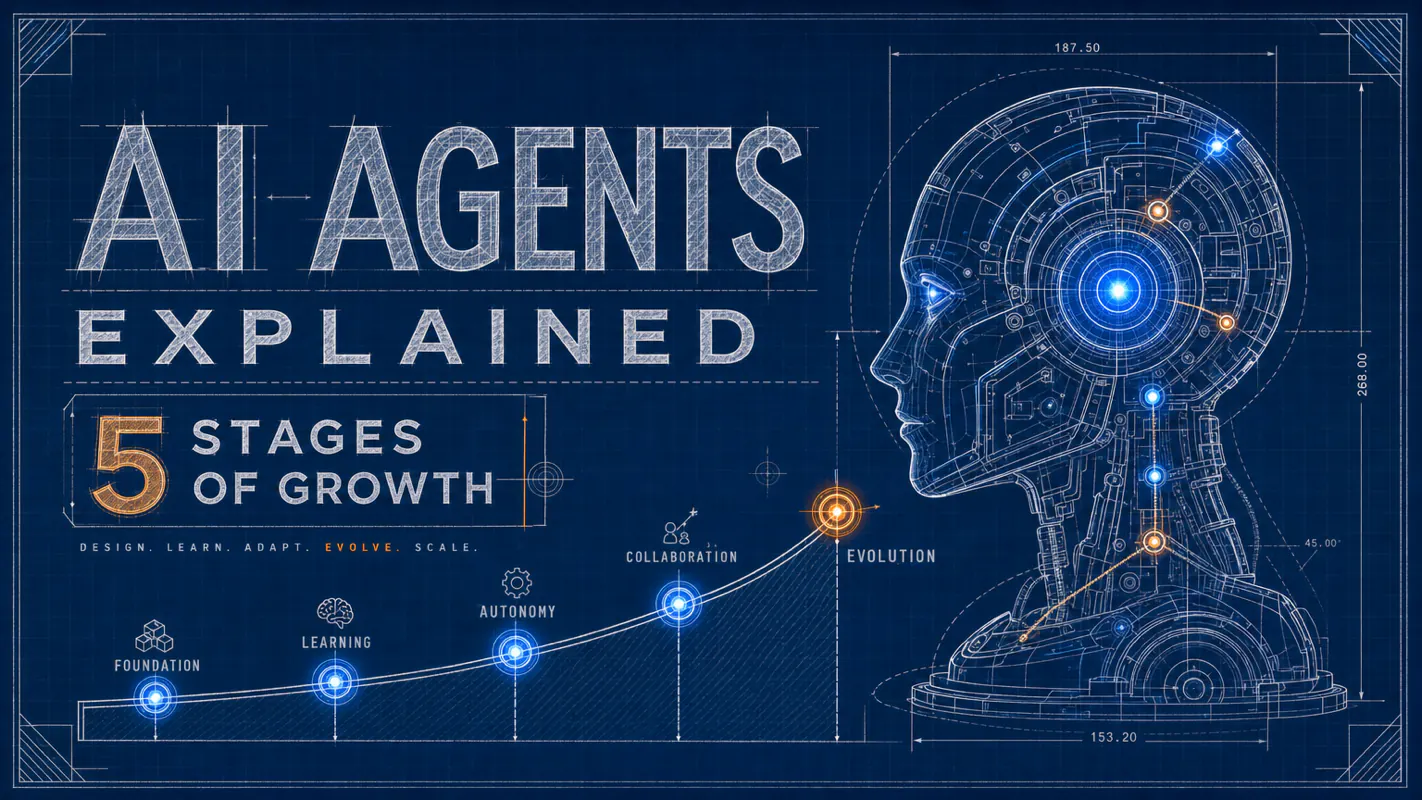
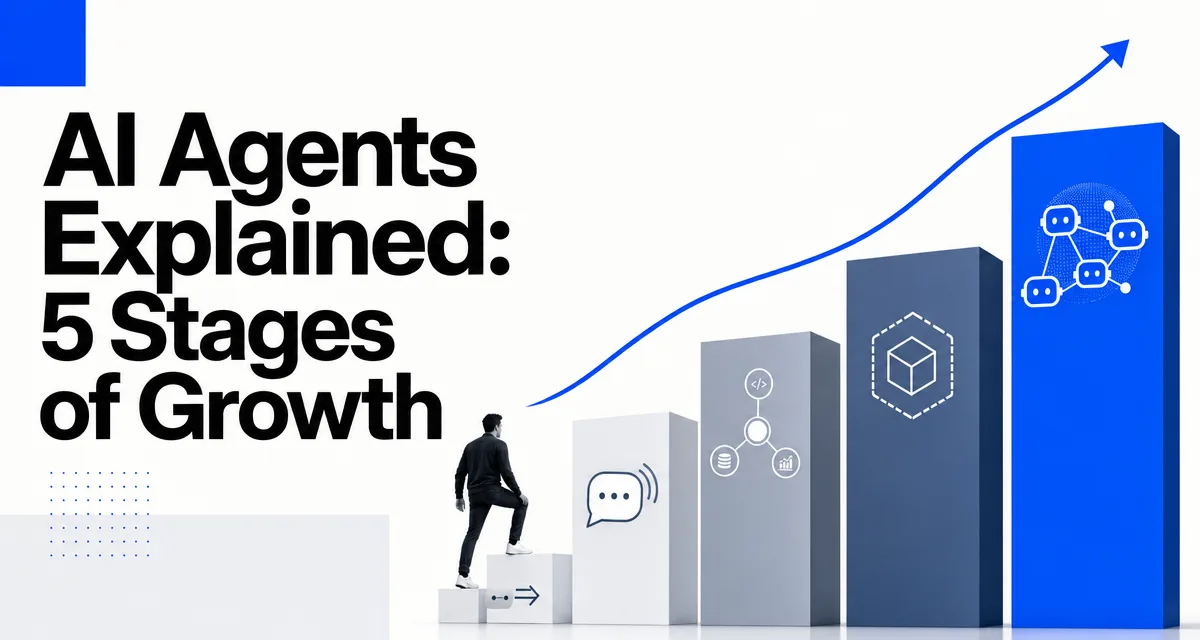
The short version: AI agents are not just "better chatbots." They are the next step in a growth pattern: output, conversation, tool use, autonomous planning, and multi-agent collaboration. Once you see those five stages, the AI market stops looking like random product launches and starts looking like a species learning how to interact with the world.
Read a dispatch coordinator job posting and you find two kinds of duty in one list. Some read like watch the board and flag delays. Others read like call the carrier, rebook the load, update the customer. The first kind is observation. The second is action, and that line is what separates a chatbot from an agent. This article maps the line across five stages, from a system that only emits text to one where several specialized agents split a job. Read it as a spec sheet: when somebody offers you an ai assistant for business work, ask which stage it operates at, because stage two answers the question and stage four rebooks the load.
Everyone says AI progress is "a model race." Actually, the better lens is developmental: AI is moving through the same five stages a human child moves through: cry, speak, hands, independence, society. Once you see the stages, the headlines stop feeling random.
If you already see the five-stage shape and want the implications, skip ahead to stage 5 for the multi-agent layer. If "AI is just text in, text out" is still your mental model, read on.
Most people explain AI progress as a model race.
GPT gets better. Claude gets better. Gemini gets better. Context windows grow. Benchmarks move. Prices fall. New demos arrive every week.
That view is useful, but it misses the deeper pattern.
The real story is not only that models became smarter. The real story is that AI changed how it interacts with the world.
That is the lens I use now:
Intelligence is not just knowledge. Intelligence is an interaction pattern.
A system that can only emit text is one kind of intelligence. A system that can hold context is another. A system that can call tools is another. A system that can plan, inspect, act, and repair its own work is another. A system that can coordinate with other specialized agents is another again.
That sequence matters because it gives you a practical map.
When a new AI product launches, the useful question is not "Is this impressive?" The useful question is:
Which interaction stage is this product actually in?
The Five Stages of AI Growth
Here is why this matters: the five stages are predictive. A new release that improves stage three (tool use) means different things from a release that improves stage four (autonomy). Vocabulary turns AI news from noise into signal.
Here is the whole map before we go deeper.
Stage
Human analogy
AI capability
Practical example
What changed
1
Crying
One-way output
Early ChatGPT-style prompting
AI can respond
2
Speaking
Contextual conversation
GPT-4-class dialogue
AI can follow a thread
3
Hands
Tool use
Function calling, MCP tools
AI can act through systems
4
Independence
Goal-directed agency
Coding agents, research agents
AI can plan and self-correct
5
Society
Multi-agent collaboration
Agent teams, A2A-style systems
AI can divide work
This is not a perfect biology analogy. AI is not a human child, and models do not "grow up" in the way people do.
But as an operator mental model, the analogy is useful because every stage upgrades the same thing: the channel between intelligence and reality.
Stage 1 is output.
Stage 2 is dialogue.
Stage 3 is action.
Stage 4 is judgment.
Stage 5 is coordination.
If you remember only one line, remember this:
The agent era begins when AI stops merely answering and starts changing the state of a system.
Stage 1: Crying — One-Way Output
The first mass-market AI moment was not agency. It was output.
You typed a prompt. The model produced text. The text was often useful, sometimes wrong, frequently surprising, and occasionally brilliant.
That was enough to change the internet.
But it was not yet an agent.
In this stage, the interaction pattern is simple:
Human gives input.
Model generates output.
Human decides what to do next.
That last line is the key. The model does not act. It does not inspect your files. It does not call your calendar. It does not verify the result. It does not decide that its answer was not good enough and run another step.
It emits.
That sounds small now, but it was the necessary first stage. Before AI could become a collaborator, the world had to see that language models could produce outputs that felt useful at human scale.
Stage 1 created the demand shock.
People did not adopt ChatGPT because it had a perfect theory of the world. They adopted it because it could draft, summarize, explain, brainstorm, and rewrite fast enough to become part of daily work.
That changed expectations.
Once people saw AI produce useful language, they immediately wanted the next thing:
"Can it remember what we are talking about?"
Stage 2: Speaking — Contextual Conversation
The second stage is conversation.
Not just a single answer. A thread.
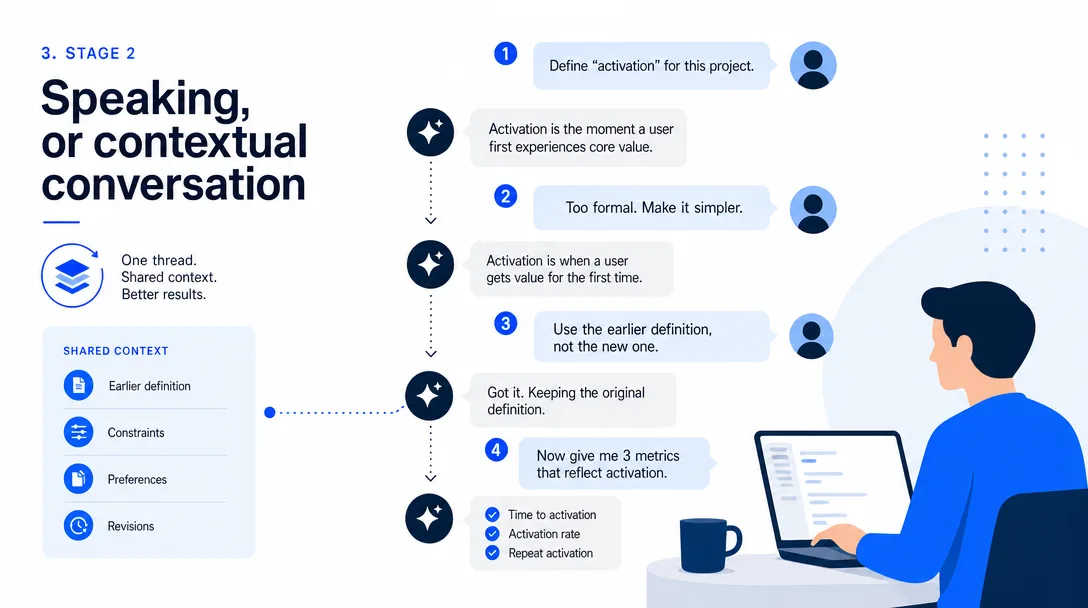
The jump from one-shot output to contextual dialogue is bigger than it looks because work rarely happens in one prompt. Real work has revisions, constraints, contradictions, examples, preferences, and accumulated context.
When a model can hold the thread, the relationship changes.
You can say:
"No, that is too formal."
"Keep the structure, but make the intro sharper."
"Use the earlier definition, not the new one."
"Compare this against the previous version."
That is not just text generation. That is shared state.
Shared state is the beginning of collaboration.
In human terms, a toddler does not become useful because they know more words. They become easier to work with because they can connect one sentence to the next. The same pattern shows up in AI products. The more context a system can carry, the more it can participate in an ongoing task instead of answering isolated questions.
This is why context windows, memory, files, and project-level context matter so much. They are not feature polish. They are the foundation that turns an answer machine into a working partner.
But conversation still has a ceiling.
Even the best conversational model is trapped if it cannot touch anything.
It can tell you what command to run. You run it.
It can draft the email. You send it.
It can outline the database migration. You apply it.
At Stage 2, the model can think with you, but it still needs your hands.
Stage 3: Hands — Tool Use
Tool use is the stage many people underestimate.
It sounds like an implementation detail:
"The model can call a function."
"The assistant can use tools."
"The app supports MCP."
But this is the point where AI crosses from language into work.
OpenAI describes function calling as a way to connect models to external tools and systems. That simple idea changes the interaction pattern: the model can choose a structured action, the software can execute it, and the result can come back into the model's context.
MCP pushes the same direction from another angle. The official MCP docs describe it as an open standard for connecting AI applications to external systems such as local files, databases, tools, and workflows.
This is the "hands" stage.
Before hands, AI lives in text.
After hands, AI can change state.
It can search.
It can read files.
It can query a database.
It can call an API.
It can run a command.
It can update a ticket.
It can create a draft in another system.
That is why tool calling is not just a developer feature. It is the bridge between model intelligence and operational reality.
Here is the practical distinction:
Capability
Chatbot stage
Tool-use stage
Answer a question
Yes
Yes
Fetch fresh data
Only if pasted in
Yes
Use private files
Only if uploaded
Yes, through controlled access
Execute an action
No
Yes
Verify through a tool
No
Yes
Build a workflow loop
Manual
Possible
Tool use also introduces a new kind of risk.
When AI could only write text, a bad answer was mostly an information problem. When AI can call tools, a bad decision can become a system problem.
That is why permissions, logs, approval gates, and sandboxing become important as soon as you enter Stage 3.
Hands are valuable because they can build.
Hands are dangerous because they can break.
Stage 4: Independence — Goal-Directed Agency
Before stage four, AI executed your asks. After, AI proposes courses of action and waits for your sign-off. The shift is small in code and large in posture; the agent becomes a partner instead of a typewriter.
An AI agent is not just a chatbot with tools.
A useful agent has a goal, a working context, available tools, a way to choose steps, and a way to evaluate whether the work is good enough.
IBM defines an AI agent as a system that autonomously performs tasks by designing workflows with available tools. Google Cloud similarly emphasizes autonomy, task automation, tool use, and the ability to interact with the world.
That is the line I care about:
An agent designs part of the path.
A normal automation workflow follows a route you already designed.
An agent receives a target and figures out some of the route itself.
That difference changes how it feels to use the system.
With a workflow, you think in nodes.
With an agent, you think in delegation.
You can ask a coding agent to inspect a repository, identify where a bug likely lives, propose a patch, edit files, run tests, read the failures, and adjust. You can ask a research agent to gather sources, filter weak evidence, build a brief, and flag uncertainty. You can ask an operations agent to watch a queue, triage exceptions, and escalate only the cases it cannot resolve.
The important part is not that the agent succeeds every time.
It does not.
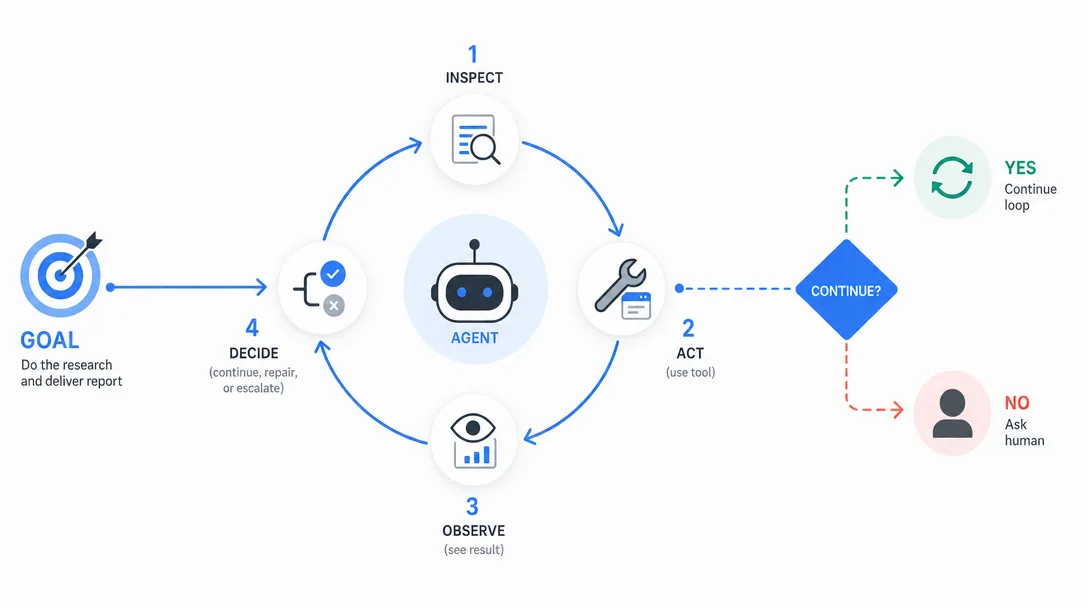
The important part is that the agent participates in the loop:
Understand the goal.
Inspect the environment.
Choose a next action.
Use a tool.
Observe the result.
Decide whether to continue, repair, or ask for help.
That loop is what separates Stage 4 from Stage 3.
Stage 3 gives AI hands.
Stage 4 gives AI a work cycle.
But this is also where beginner expectations break.
An agent is not magic autonomy. It is bounded autonomy.
If you give it a vague goal, unlimited tools, no tests, no permission model, and no review process, you are not building an agentic workflow. You are creating a failure amplifier.
The mature version of Stage 4 looks less like "AI does everything" and more like this:
Agent responsibility
Human responsibility
Explore the working context
Define the goal
Propose a plan
Set constraints
Execute reversible steps
Approve risky actions
Run checks
Judge business correctness
Report uncertainty
Decide tradeoffs
That is why the best agents often feel like very fast junior collaborators. They can do real work, but the quality of the system depends on how clearly you define the operating boundary.
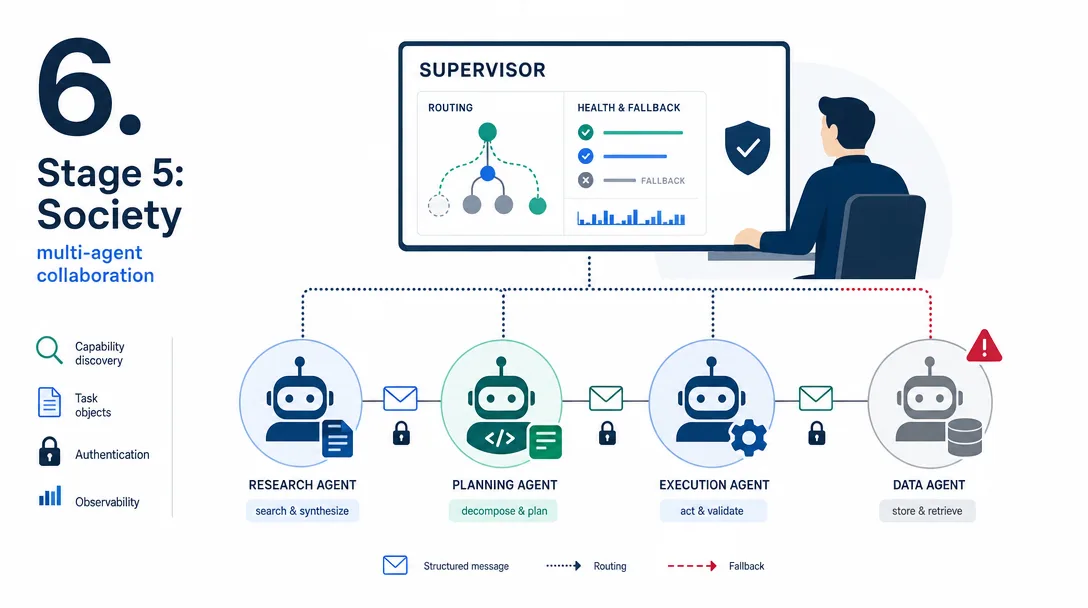
Stage 5: Society — Multi-Agent Collaboration
The most common failure mode in AI predictions is mapping new capabilities to old categories. Early agent demos got dismissed as fancy chatbots because the chatbot rubric was the only one in scope. New stage, new rubric.
The fifth stage is not a bigger single agent.
It is multiple specialized agents working together.
This matters because individual intelligence scales poorly. One person can be brilliant and still have only one attention stream. The same is true for agents. A single agent can plan, call tools, and iterate, but it becomes overloaded when the task requires many domains at once.
Human civilization did not scale because every individual became a genius. It scaled because people divided labor.
One person farms. One person builds tools. One person records transactions. One person teaches. One person enforces rules. The system becomes more capable than any individual.
Multi-agent systems follow the same logic.
Google's Agent2Agent protocol announcement frames the problem directly: agents need to collaborate across siloed systems and applications, even when built by different vendors or frameworks. A2A focuses on agent interoperability, capability discovery, task management, collaboration, and secure communication.
That is the beginning of AI society.
Not because the agents are conscious.
Not because they are people.
But because the coordination pattern becomes social:
Social function
Agent-system equivalent
Find the right specialist
Capability discovery
Agree on the task
Task object and status
Exchange work artifacts
Messages and structured outputs
Maintain trust
Authentication, permissions, logs
Divide labor
Specialized agents
Repair failure
Monitoring and fallback agents
This is where the market will get noisy.
Many "multi-agent" demos are just multiple prompts in a trench coat. A real multi-agent system needs more than role names. It needs state, routing, permissions, observability, fallback behavior, and a reason why multiple agents are better than one.
The diagnostic question is simple:
Does each agent own a real responsibility, or is the system just pretending to have a team?
If the answer is the second one, you do not have AI society. You have a diagram.
Why the Order Matters
The five stages are not random.
You cannot safely coordinate agents that cannot act.
You cannot build reliable tool use without context.
You cannot delegate goals to a system that can only emit one-shot text.
The growth order is:
Output.
Context.
Tools.
Goals.
Coordination.
That order gives you a product filter.
When a vendor says "agent," ask:
Question
What it reveals
Can it preserve context across the task?
Stage 2 maturity
Can it call tools safely?
Stage 3 maturity
Can it inspect results and self-correct?
Stage 4 maturity
Can it ask for approval at risk points?
Operational maturity
Can it coordinate with other agents?
Stage 5 maturity
Can I see logs and permissions?
Production maturity
Most products that call themselves agents are somewhere between Stage 2 and Stage 4.
That is not a criticism. It is useful to know.
If you expect Stage 5 behavior from a Stage 3 tool, you will be disappointed. If you treat a Stage 4 agent like a harmless chatbot, you will create risk.
The map protects you from both mistakes.
Where We Are Now
As of 2026, the market is moving from tool use into agency and early multi-agent infrastructure.
You can see the shift in several places:
OpenAI's Agents platform and function calling materials emphasize tools, structured outputs, and tracing.
MCP has become a common way to connect AI applications to external systems.
Google announced A2A to address agent-to-agent interoperability.
Enterprise explainers from IBM and Google Cloud now define agents around planning, tool use, memory, and autonomy.
Stanford's 2026 AI Index shows that AI-agent-related skills became a visible job-market category in 2025, with large year-over-year growth for terms such as "agentic AI" and "AI agents."
The exact winners will change.
The pattern will not.
The future of AI will not be one giant chatbot sitting above every workflow. It will be a layered system: models, tools, memory, permissions, agents, protocols, marketplaces, and monitoring.
That is why the next useful skill is not memorizing every product name.
The next useful skill is knowing how to place a product on the interaction ladder.
What This Map Says About the Rest of 2026
Two predictions I am willing to make from inside the five-stage map this year.
Prediction 1: stage three matures into reliable tool chains. Today, multi-step tool use is impressive when it works and disappointing when it does not. By the end of 2026, the failure modes will be predictable enough to plan around, which means real workflows can depend on agent tool chains, not just hope to.
Prediction 2: stage four shifts from demo to product. Long-horizon autonomous agents (a week, a project, a campaign) are still rough today. By 2027, the autonomy class of products will exist as ordinary tools, not as research previews.
Save this article. Check the predictions in twelve months. The corrections are at least as informative as the hits.
What the Map Deliberately Leaves Out
Three things this article does not try to do, so you know what to read elsewhere for them.
Implementation details. This article gives you the shape, not the code. If you want to build a stage-three agent, the map points the direction; the actual builder needs an agent runtime tutorial, not a thinking framework.
Hard timelines. The four-million-vs-four-years comparison is suggestive, not predictive. Silicon evolution is happening faster than carbon, but the exact cadence of stage-five emergence is unknown. Treat the timing as a useful prior, not a calendar entry.
Ethical assessment. This article is descriptive, not normative. The map describes what is happening; it does not argue what should happen. Both kinds of conversation are important; this article is the descriptive one.
Three Habits That Compound on This Map
Reading the map is the start. Three habits make it actually useful in your week.
Habit 1: stage-tag the news. Every time you read an AI announcement, pause for ten seconds and ask which stage this advances. The habit takes about two weeks to feel automatic and dramatically improves your prediction sense.
Habit 2: stage-tag your own asks. Watch your prompts for one day. Most beginners ask at stage one even when their tool supports stage three or four. Naming the stage is half the fix.
Habit 3: stage-tag the gap. When something feels off about an AI tool, the gap is usually between the stage you expected and the stage the tool actually supports. Naming the gap turns frustration into a clear next step — find a tool at the right stage, or lower the expectation by one stage.
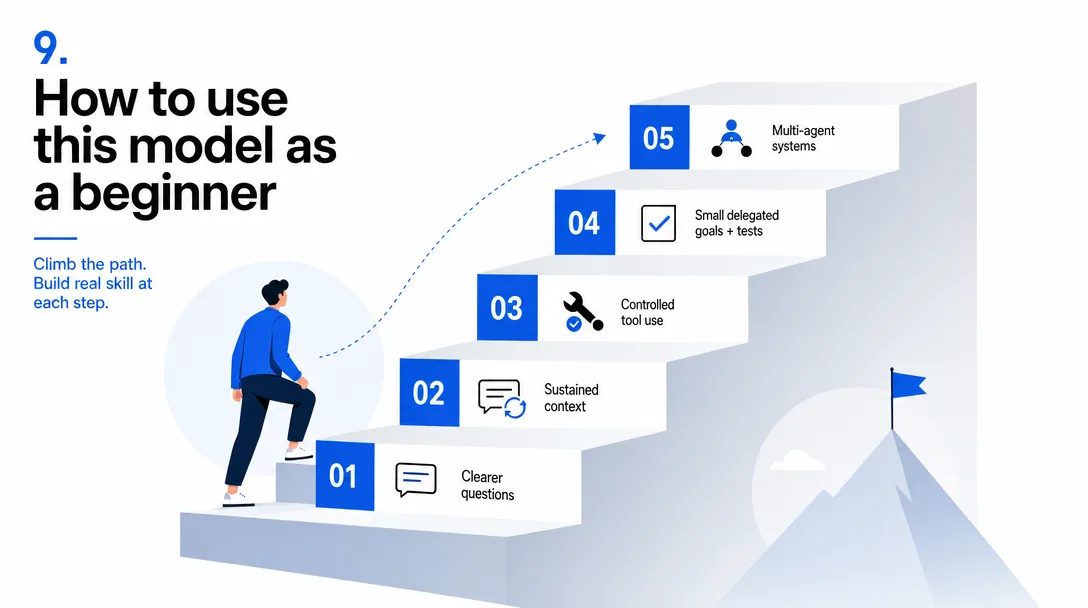
How To Use This Model as a Beginner
If you are learning AI, do not try to jump straight into "multi-agent systems."
Follow the same growth path.
Your learning stage
Practice
Output
Ask clear questions and compare answers
Context
Work on one real project across multiple turns
Tools
Let AI use files, search, commands, or APIs in a controlled environment
Agency
Delegate a small goal with tests and review
Society
Split a workflow into specialist roles only when one agent becomes a bottleneck
This is the operator path.
It is also why I tell beginners to start with asking better before they chase complex automation. If you cannot define the goal clearly, more agents will not help. They will just produce more noise.
If you want the next layer after this map — what an agent actually needs to live in production (memory, workspace, channels, security, scheduling) — the OpenClaw deep series walks through each piece in order.
Worked Example: Stage-Tag Your Last AI Question
Take the last AI question you asked any tool. Find it in your history if you can; otherwise reconstruct from memory.
Step 1: tag the stage of the ask. Were you asking for output (stage one), context-aware understanding (stage two), action (stage three), judgment (stage four), or coordination across agents (stage five)?
Step 2: tag the stage the tool actually serves at that moment. A model in chat-only mode is stage two. A model with tool use enabled is stage three. An agent runtime is stage four. A multi-agent system is stage five.
Step 3: see if the stages match. A stage-three ask served by a stage-two tool will produce a polite refusal or a generic answer. A stage-two ask served by a stage-four tool will use too much horsepower for the question.
Most early AI frustration comes from stage mismatch. The exercise above takes ninety seconds and turns invisible mismatch into a fixable signal.
Three Places This Map Is Wrong on Purpose
Three simplifications I make to keep the map teachable, with the caveats so you know what you are accepting.
Simplification 1: stages are presented as discrete. In reality they overlap and feed each other. A model can be doing stage one (generating output) and stage three (calling a tool) in the same turn. The discrete view is a teaching scaffold.
Simplification 2: progress is presented as forward-only. In reality, model upgrades sometimes regress on earlier stages while advancing on later ones. The forward-only view is mostly true, with quiet exceptions worth knowing about.
Simplification 3: the map ignores costs. A stage-four agent costs more per task than a stage-two model, often by an order of magnitude. The map says nothing about whether you should pay that cost; that depends on the task. Use the map to choose the level; use a separate calculation to choose the budget.
What I Tell Beginners To Do This Week
Three concrete moves from this map this week, ranked by ROI.
Move 1: tag your tools. Open your AI tool list and write the stage next to each. The mismatch between "what stage I treat this as" and "what stage it actually supports" is where most week-one friction lives.
Move 2: tag your asks for one day. Notice how many of your prompts land at stage one even when the tool can do stage three or stage four. The reframe is half the fix; the rewrite of one or two prompts is the other half.
Move 3: pick one stage to practice. If your asks are mostly stage one, deliberately try three stage-three asks this week (asks that involve tool calls). The discomfort is the learning.
The Four-Million-vs-Four Comparison
The most striking line in this article is the speed gap: human cognition took roughly four million years to walk the five stages; AI is at stage four in about four years.
The comparison is suggestive, not literal. Carbon evolution had constraints silicon does not have. Each generation took a generation. Mutations were random. Energy budgets were tight. Branches that hit dead ends could not be checkpointed and resumed.
Silicon has none of those bounds. Iterations happen in days, mutations are deliberate and parallel, energy comes from a wall socket, and dead-end branches just get archived for later. Each constraint that gated carbon evolution is relaxed by orders of magnitude on silicon.
The implication for stage five is honest: the social layer of AI will not require centuries to stabilize. The infrastructure (multi-agent runtimes, durable identity, communication protocols) is being built right now, in public, in real time. The compression that turned millions of years into four for stages one through four will not stop at stage five.
The Deeper Point
The most important shift in AI is not that computers became more fluent.
It is that intelligence is gaining interfaces to reality.
Text was the first interface.
Context made it collaborative.
Tools made it operational.
Agents made it goal-directed.
Multi-agent systems make it social.
That is why this moment feels so strange. We are not only watching software improve. We are watching a new work pattern form.
The people who benefit from it will not be the people who memorize the most model names.
They will be the people who understand the interaction pattern early enough to build with it.
200 Mental Models for AI — Thinking frameworks that sharpen how you evaluate AI tools and workflows.
Build Your First AI Assistant — A hands-on starting point if you want to move from reading about agents to building one.
AI Jargon Survival Guide — Decode the terminology around agents, MCP, function calling, and more.
Ready-to-Use Prompt: Locate Any AI Product on the Five-Stage Agent Growth Map
What this does: Diagnoses where any AI product or agent sits on a five-stage developmental ladder (Crying → Speaking → Hands → Independence → Society), names the one capability blocking its next stage, and gives a concrete build-or-buy action to climb. Based on: AI Agents Explained: 5 Stages of Growth — https://aiworkflowpro.com/ai-growth-like-human/ Time to run: ~3 minutes
Copy this prompt into Claude Code, ChatGPT, or any AI assistant:
ROLE: You are an AI-market analyst who maps any AI product or agent onto a five-stage developmental ladder. Your job: pinpoint its current stage, name the exact gap blocking the next stage, and give one build-or-buy action to climb.

CONTEXT — FIVE-STAGE AGENT MAP:
AI progress is not a model race; it is developmental, like a child growing up. The five stages, in strict order, are: (1) Crying — one-way output, no memory; (2) Speaking — two-way contextual conversation within a session; (3) Hands — tool use, acts on the world; (4) Independence — goal-directed agency that plans, chooses tools, and recovers on its own; (5) Society — multi-agent collaboration. The order is fixed: no stage works without the one below it. Locating a product on this ladder tells you what it can and cannot do today and exactly what it must add to climb.

INPUTS (fill in before running):
- SUBJECT: YOUR_PRODUCT_OR_AGENT_HERE (name + one line on what it does)
- CAPABILITIES: YOUR_OBSERVED_BEHAVIOR_HERE (what you have actually seen it do — list concrete behaviors, not marketing claims)

METHOD — 6 STEPS:

Step 1 — Test Stage 1 (Crying)
Does SUBJECT produce output? Met = yes. If it also has no memory of prior turns (each response isolated), its ceiling is Stage 1.

Step 2 — Test Stage 2 (Speaking)
Does SUBJECT remember context within a session and hold two-way conversation? Met = it tracks what you said earlier in the same session. If met, ceiling rises to Stage 2.

Step 3 — Test Stage 3 (Hands)
Does SUBJECT call tools or take real actions (search, run code, call APIs, edit files)? Met = it does things, not just says things. If met, ceiling rises to Stage 3.

Step 4 — Test Stage 4 (Independence)
Given a goal, does SUBJECT plan multi-step, choose its own tools, and recover from errors without step-by-step handholding? Met = true goal-directed agency. If met, ceiling rises to Stage 4.

Step 5 — Test Stage 5 (Society)
Does SUBJECT coordinate with other agents that have distinct roles, handing off work toward a shared outcome? Met = multi-agent collaboration. If met, ceiling is Stage 5.

Step 6 — Locate and prescribe
Current stage = the highest stage fully met AND all lower stages also met (the order is fixed — a tool-using agent with no conversation memory is broken, not Stage 3). Name the one missing capability blocking the next stage, and give one concrete build-or-buy action to add it.

RULES:
- The order is fixed: never award a stage if a lower stage is not met.
- A stage is "met" only if the behavior was observed in CAPABILITIES, not if marketing claims it.
- Tool use (Stage 3) requires Stage 2 context; agency (Stage 4) requires Stage 3 tools; society (Stage 5) requires Stage 4 independent agents.
- If two capabilities conflict (e.g., acts but forgets context), diagnose the gap — do not round up.

OUTPUT FORMAT:
Output four sections:
1. **Stage tests** — markdown table with columns: Stage | Test question | Met? (Y/N) | Evidence.
2. **Current stage** — the diagnosed stage + one-line why.
3. **Gap to next stage** — the single missing capability + what "met" looks like.
4. **Action plan** — one concrete build-or-buy action to close the gap, naming the stage it unlocks.
Save as @templates/ai-growth-like-human.md and run whenever you evaluate a new AI product, roadmap your own agent, or decide what capability to build next.
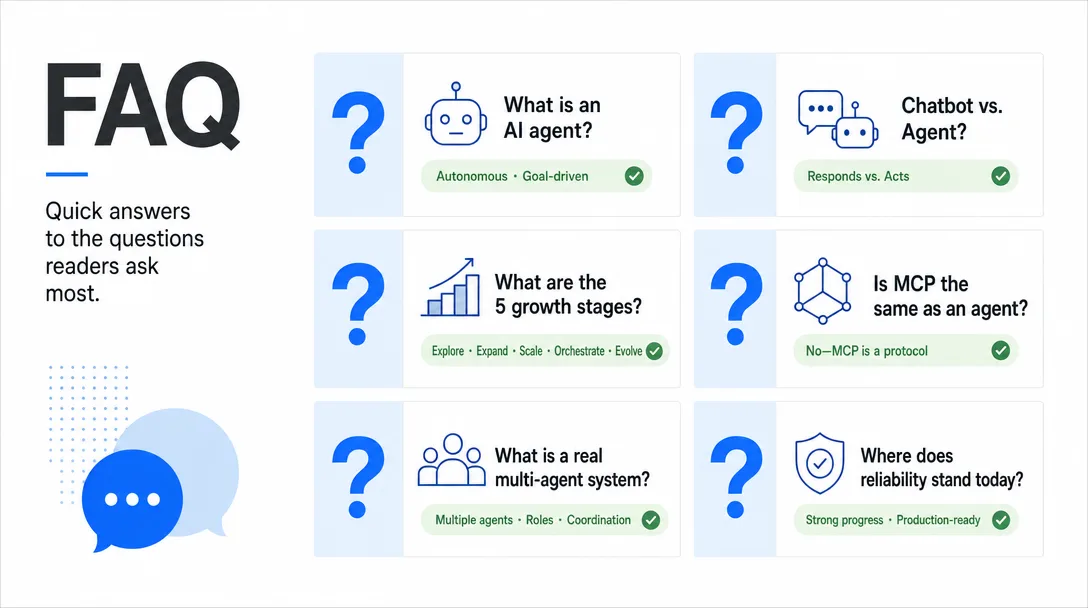
Frequently Asked Questions
What is an AI agent in simple terms?
An AI agent is a system that can pursue a goal through multiple steps, usually by using tools, memory, planning, and feedback. A chatbot mainly answers. An agent can decide what step to take next.
What is the difference between a chatbot and an AI agent?
A chatbot is mostly conversational. An AI agent can plan, call tools, inspect results, and continue working toward a goal. The difference is not the interface. The difference is the work loop behind it.
What are the five stages of AI growth?
The five stages are one-way output, contextual conversation, tool use, autonomous agency, and multi-agent collaboration. Each stage upgrades how AI interacts with the world.
Is MCP the same as an AI agent?
No. MCP is a protocol for connecting AI applications to external systems. It gives agents and AI applications a standard way to access tools, data, and workflows. An agent is the goal-directed system that may use those connections.
What is a multi-agent system?
A multi-agent system uses multiple specialized agents that collaborate or coordinate to solve a task. A real multi-agent system needs responsibility boundaries, state, routing, permissions, monitoring, and fallback behavior.
Should beginners learn multi-agent systems first?
No. Beginners should first learn prompting, context, tool use, and safe delegation. Multi-agent systems are useful only after one-agent workflows become a bottleneck.
Are AI agents reliable enough for production?
Some are reliable for bounded tasks with strong tools, logs, tests, and human approval gates. They are not reliable when given vague goals, broad permissions, and no verification loop.
Monitoring a competitor who publishes no feed is the case every RSS guide skips. Twenty-one platforms sorted by which of three jobs they do, and the finished setup is business process automation you own outright, with no seat licence to renew.
Blaming the content is the reflex when a post underperforms, and it is usually the wrong diagnosis. A second reader decides distribution before any human sees the post, and most of what it checks is mechanical enough to automate business processes around, on five platforms at once.
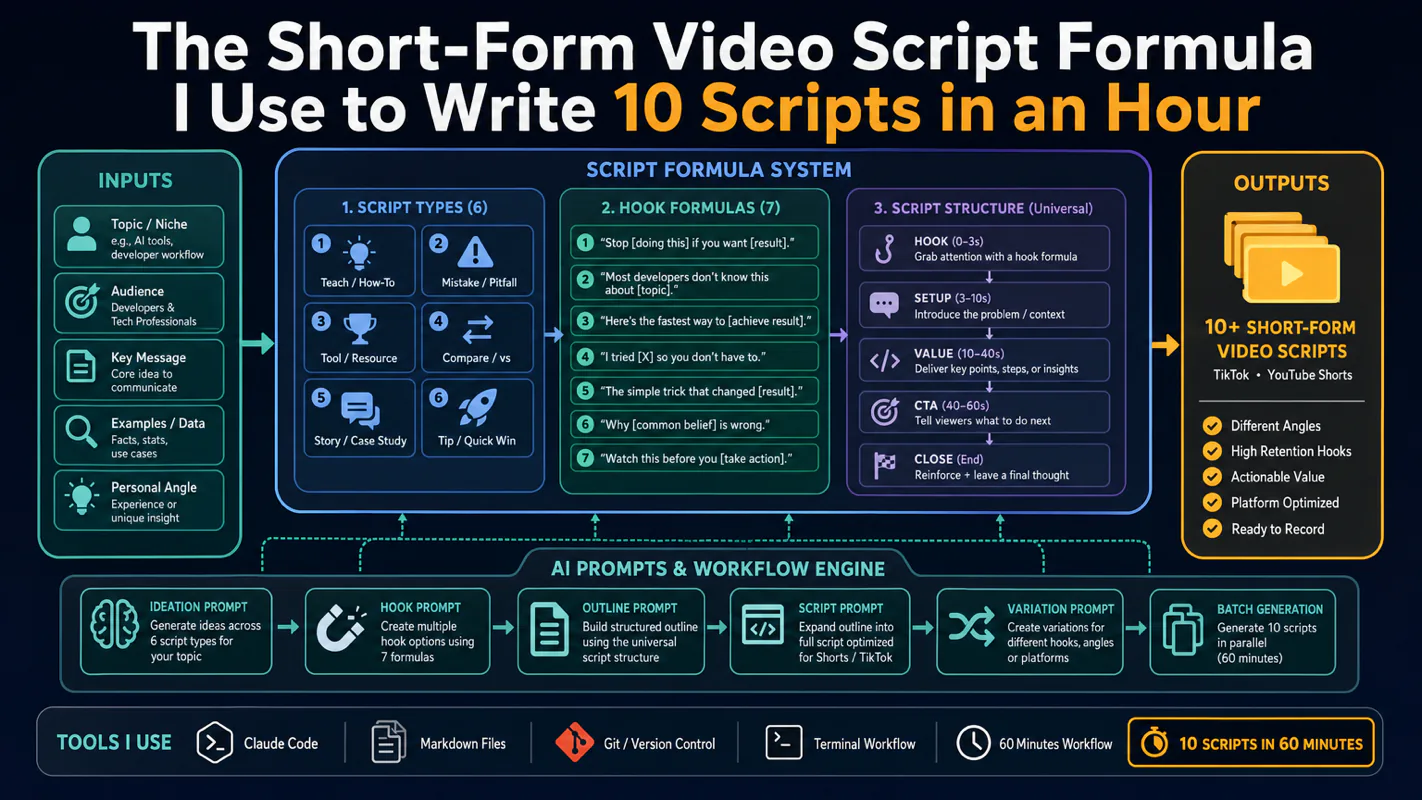
Thursday afternoon, fourteen product ideas, a Monday filming slot, no scripts. Six script shapes and seven hook formulas turn that hour into finished drafts — and the business rule stays: rewrite at least 30% before anything ships.
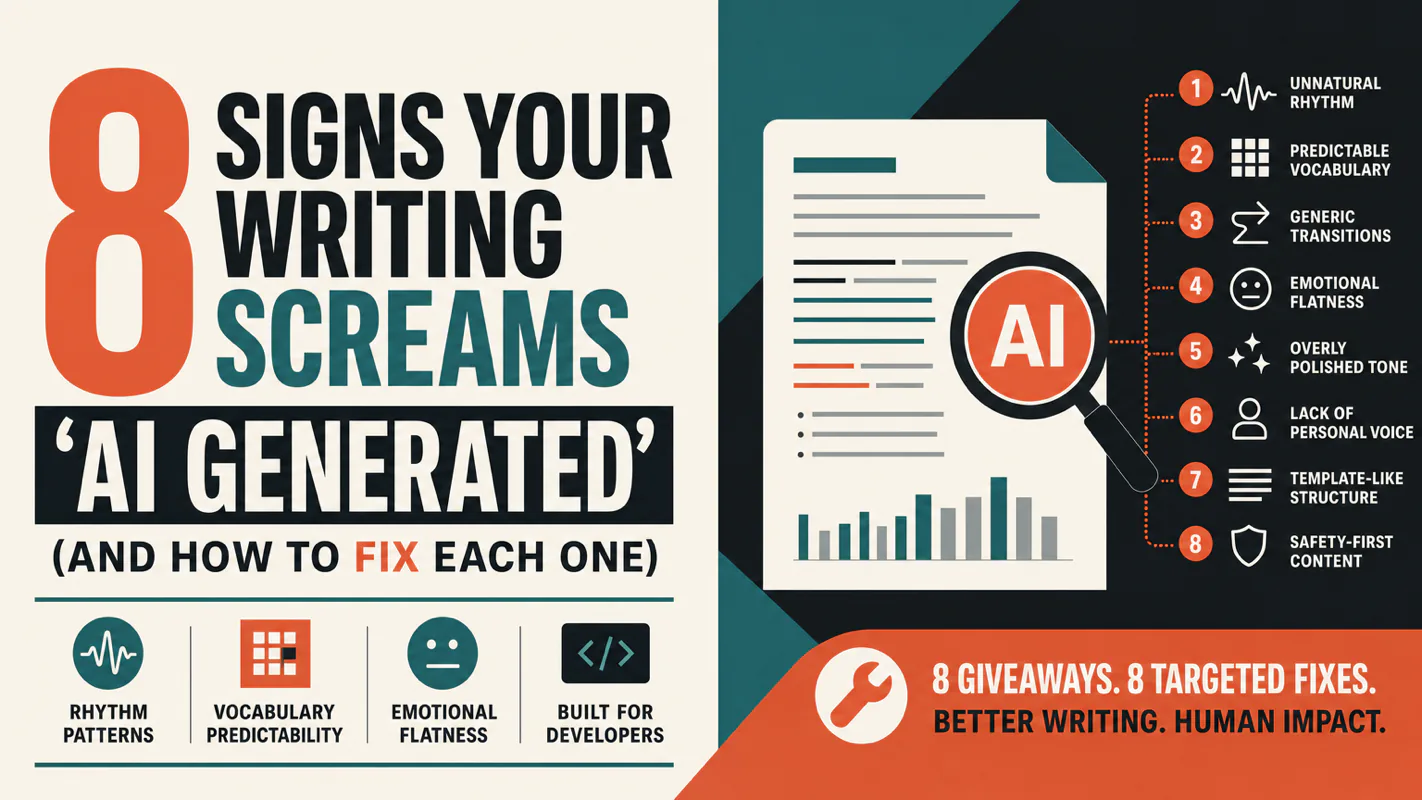
A detector score cannot survive a conversation with the freelancer it just cost three weeks of payment. What holds up is the specific thing on the page: rhythm, vocabulary, missing detail. Eight of them here, and the reason review stays human when you automate business processes.