Monitoring a competitor who publishes no feed is the case every RSS guide skips. Twenty-one platforms sorted by which of three jobs they do, and the finished setup is business process automation you own outright, with no seat licence to renew.
Blaming the content is the reflex when a post underperforms, and it is usually the wrong diagnosis. A second reader decides distribution before any human sees the post, and most of what it checks is mechanical enough to automate business processes around, on five platforms at once.
Gloves on, tape measure in hand — nobody types a query. Three voice surfaces for ai automation tools (terminal, Telegram, Discord), 10 TTS and 6 STT providers compared on cost and latency, plus a setup that costs nothing.
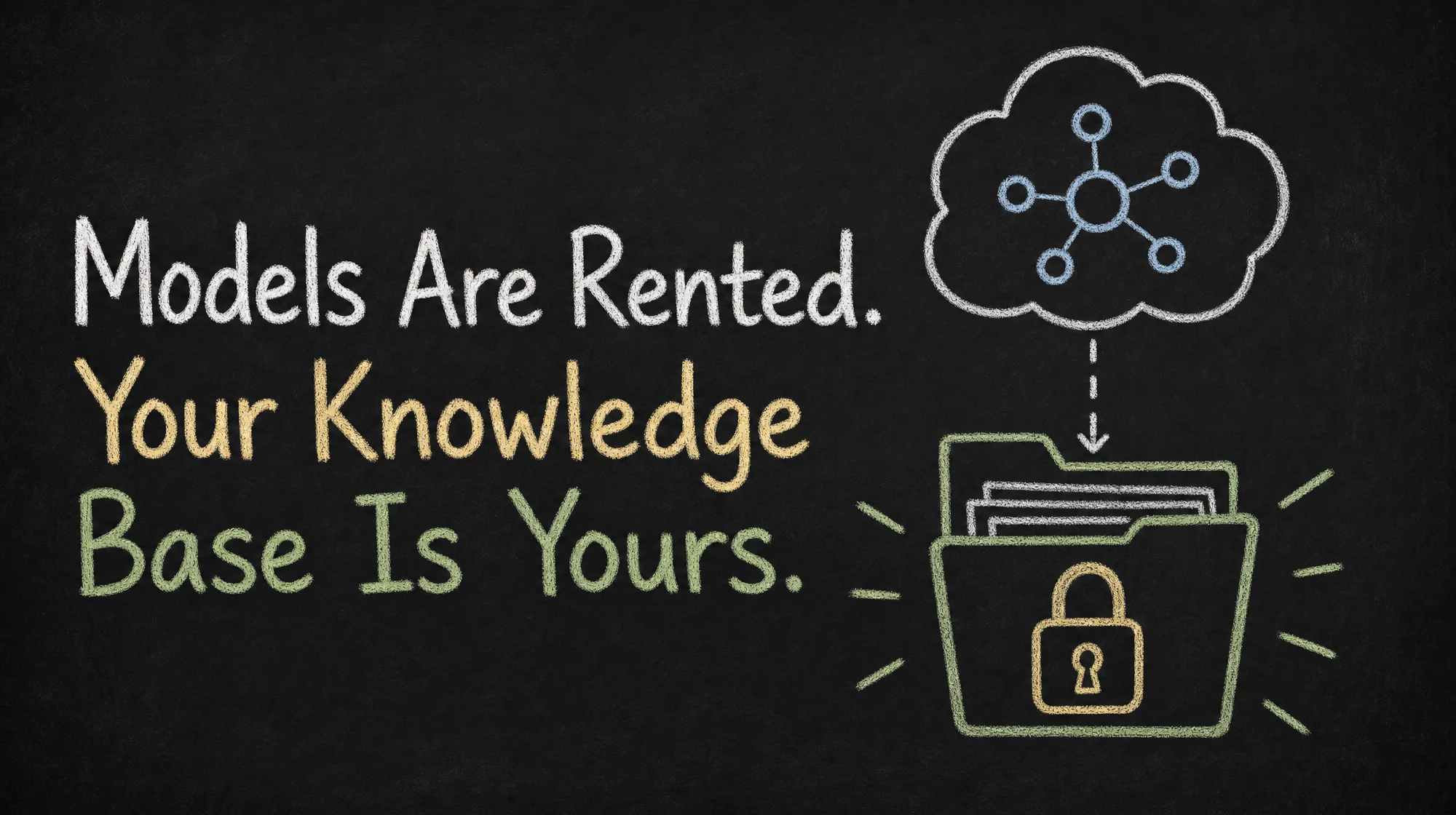
Models, tools, and frameworks are rented. The only AI asset that compounds is the knowledge base you wrote down on disk — and built your agents to read.
Models, tools, and frameworks are rented. The only thing that compounds under your control is the knowledge base you wrote down on disk.
If you re-brief the agent every morning, you are the memory. Fresh chat. Fresh paste. Goals, client names, what broke yesterday, what not to touch. Skip one constraint and you spend the afternoon undoing work the agent should never have touched.
The fix is not a longer system prompt. It is a library the agent can open without asking you to rebuild context from your head.
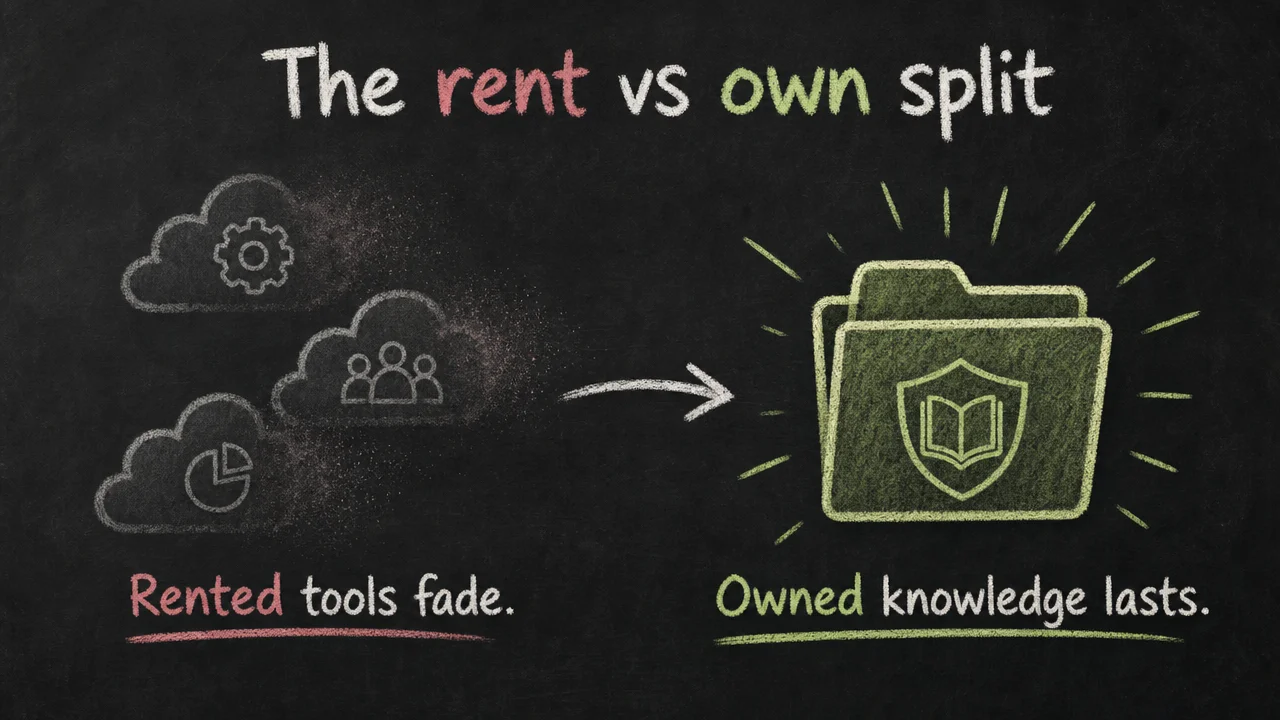
The rent vs own split
Treat the stack the way an operator treats capital goods.
Layer
Typical form
Ownership
Model
API or local weights you call this week
Rented capability
Tool / IDE agent
Claude Code, Cursor, Codex, browser agents
Rented interface
Framework
Orchestrators, skill packs, vendor “agent OS”
Rented shape
Knowledge base
Files you authored: rules, roles, runs, standards
Owned asset
Rent is not an insult. Rent is correct for things that move every quarter. You should not marry a model version or an IDE brand.
Ownership is correct for the decisions that keep work coherent: what “done” means, which pack owns which job, which paths are safe to edit, what failed last time, how a role loads its manuals.
More precisely: if the vendor disappears tomorrow, what still lets a competent person (or a new agent) continue the work? That residue is your knowledge base.
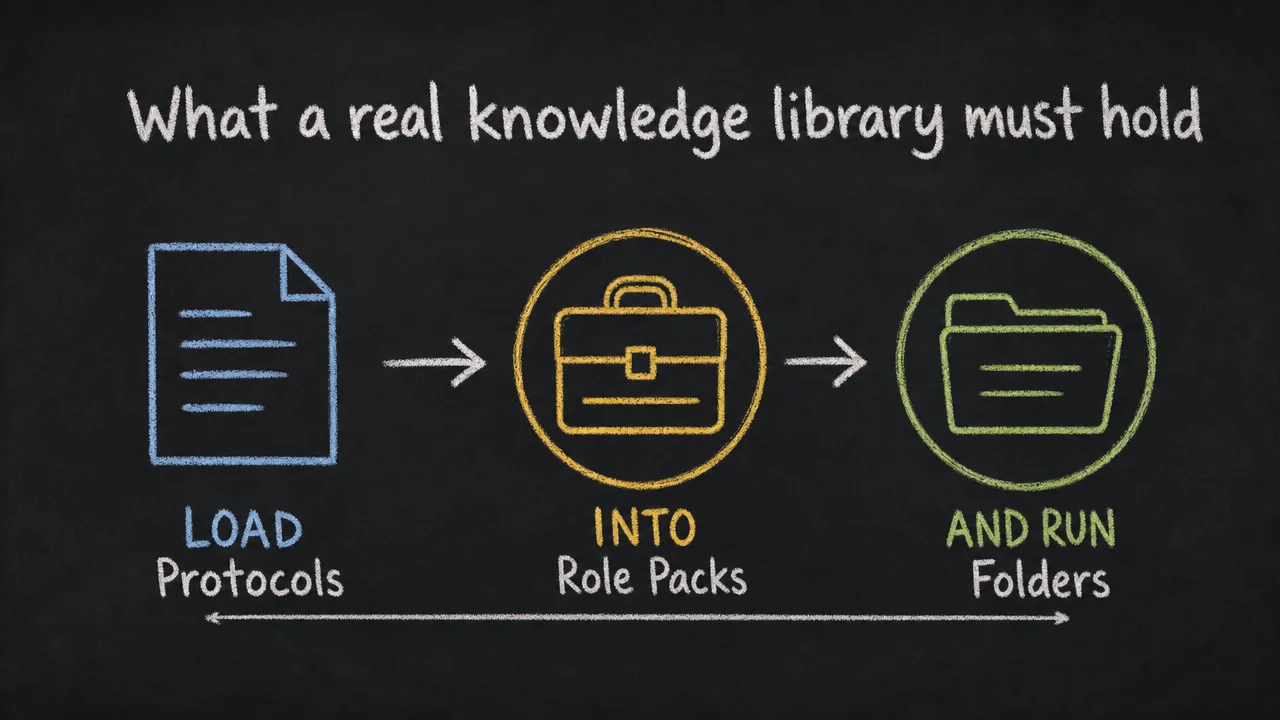
What a real knowledge library must hold
A folder of notes is not enough. A real knowledge library for AI work has four jobs. Miss one and you are back to paste theater.
1. Identity and load order
Something at the root tells the agent who it is and what to read first. In practice that is a short load protocol, not a novel. Deep packs hang under it: company roles, industry packs, workflow packages, standards.
On the AWP English vault used for this article (~/awp, inventory on 2026-08-06), that shape is concrete: 12 company role packs with their own load files, 44 workflow packages, 38 standards packages, and 1,060CLAUDE.md entry points under business/ alone. The point is not the brand. The point is structure that an agent can walk.
2. Role and trade knowledge
Separate how the studio works from what the trade sells. Role packs hold craft and ops manuals. Industry packs hold durable trade material. When you mix them into one chat paste, neither identity stays clear.
3. Run I/O as memory of work
Standing knowledge is not the same as this week’s task state. Work lands in dated run directories: inputs, work, outputs, handoffs. That is how you stop the agent from inventing a prior decision that never made it onto disk.
4. English-on-disk (or one language contract)
If the camera, the site, and the agent share one vault, path names and durable files stay in one language. Mixed roots make both humans and agents lose the map.
Have you verified it: can a new session, with only the vault open, reconstruct the current job without your morning monologue?
Numbers from one live vault (not a pitch deck)
Counts below are from a single local inventory of ~/awp on 2026-08-06. They are not industry benchmarks. They are proof that a file library can be large and still navigable if the load protocol is short.
Metric
Count
Markdown files (excl. sync trash / node_modules)
15,259
Workflow packages
44
Standards packages
38
Company role packs (with load files)
12
WORKFLOW.md files under workflows
220
If your library is 80 files, the same design still applies. Scale is optional. SoR discipline is not.
Build the AI solution on the library — not the other way around
Why agents still fail without ownership
Agents fail in predictable ways when the library is missing. They invent a policy you “said last week.” They edit a path you marked off-limits. They restart a finished run because the prior artifact never landed on disk.
None of those failures is fixed by a smarter model alone. A smarter model with no SoR is a faster way to rewrite the wrong file.
Progressive disclosure is a load rule, not a slogan
Front-load the map. Defer the manuals. Put usage next to tools. Keep run state out of the standing rules.
When every session dumps the whole tree into the prompt, you recreate the morning monologue inside the model. The library is still on disk, but you stopped using it as a library.
Most “AI knowledge” products invert the order. They sell retrieval first and treat files as fuel for a hosted index. That can help search. It fails as system of record when the index and the authored rules diverge.
The working order for a real knowledge library is:
Author the decisions as files.
Load only what the job needs (progressive disclosure).
Run work into a folder the team can audit.
Optionally index or embed for speed — without letting the index become truth.
Your agents then become thin operators on top of owned structure: open the pack, follow the load file, write the artifact back to the run path, report the absolute path.
That is an AI solution for a real knowledge library. Not a demo where the model remembers nothing and you pretend the chat is the company.
What this is not
Not “never use cloud tools.” Use them. Just do not store the company’s judgment only inside them.
Not “dump the whole library into the prompt.” Load order exists so you do not.
Not a ranking of vendors. Vendor UIs change. Your disk layout can stay.
Not a promise that files alone make agents smart. Bad files still produce bad actions. Ownership means you can fix the file once.
A one-week install you can actually finish
Do not redesign the universe. Install a minimum library and force one job through it.
Create one root load file: role, hard constraints, “read next” list.
Create one pack directory for the job (even if it is only three manuals).
Create one run folder with 01-input / 02-work / 03-output.
Start the agent with “read the load file; do not invent paths.”
End the day by writing what changed back into the pack or the run note.
If step 5 fails three days in a row, the problem is process, not model choice.
FAQ
What do I own when I use AI tools every day?
You own the knowledge base you wrote on disk: rules, roles, run records, and decisions. Models and frameworks are rented interfaces. They will be replaced. Files you maintain can outlast the replacement.
Is a local knowledge base just another RAG product?
No. RAG is a retrieval tactic. A knowledge library is the system of record for how work is done. You can add search later. You cannot recover from a week of decisions that only lived in chat logs.
How do I start without rewriting my whole company?
One job. One load file. One run path. One week of honest write-back. Expand only after the loop holds.
Closing
Rent the model. Rent the IDE. Rent the framework if it earns its keep.
Own the library.
Write the judgment down. Teach the agent to open it. Put the artifact back on disk. That is how AI work stops resetting every morning — and how a knowledge base becomes a real solution instead of a slogan.
Monitoring a competitor who publishes no feed is the case every RSS guide skips. Twenty-one platforms sorted by which of three jobs they do, and the finished setup is business process automation you own outright, with no seat licence to renew.
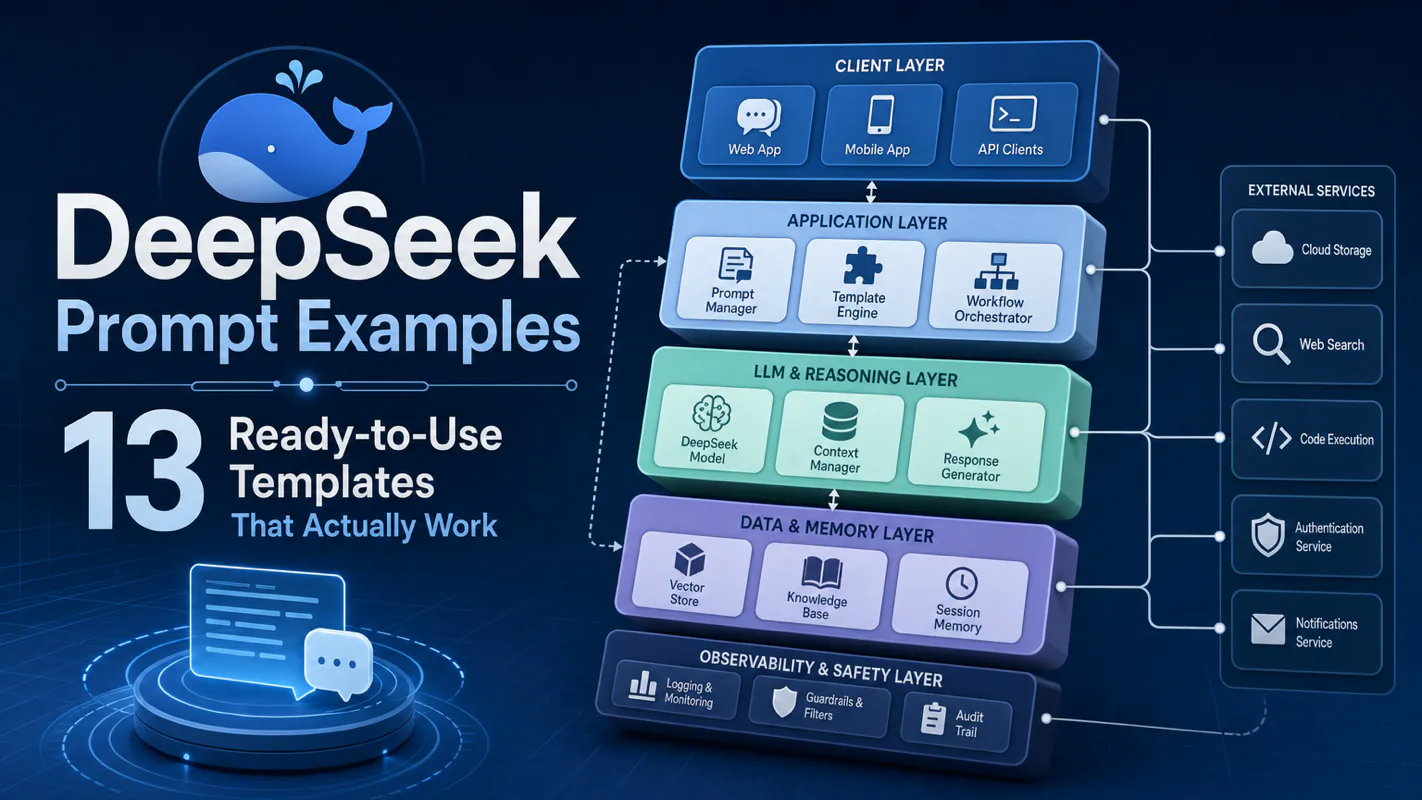
Forty supplier emails in the inbox, one spreadsheet due by noon — that is the job these templates were built for. 13 DeepSeek prompts that turn an AI assistant for business into a repeatable one: extraction, summarization, SQL, translation, and structured JSON output.
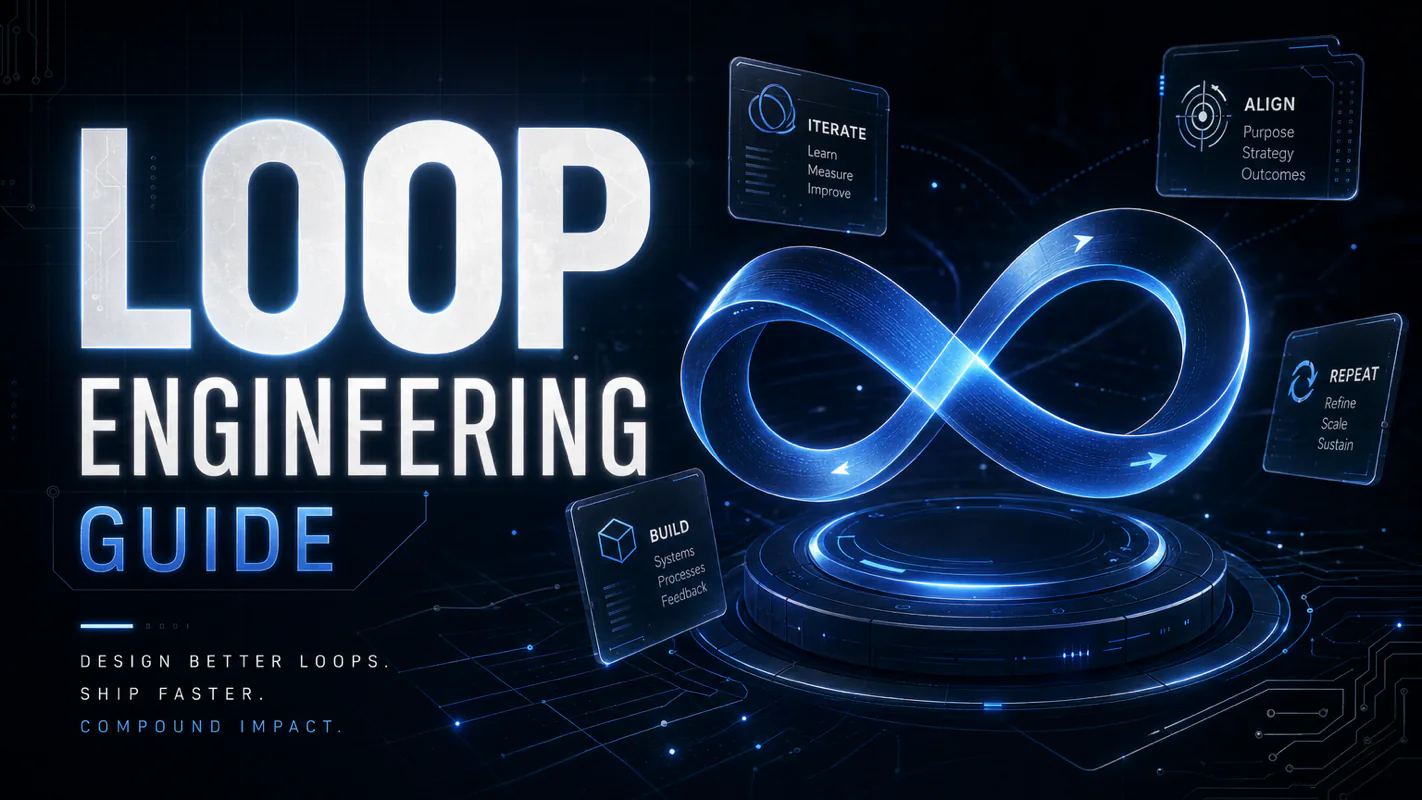
Code volume grew 180%. Shipped output grew 30%. That gap is the price of never defining what done means. After pulling apart 136 open-source loops, the failure was identical every time, no terminal condition, and the fix turns out to be a business question rather than a technical one.
Buy the model and you have bought the smallest part. Tool injection, permission enforcement, context compression and validation loops are where the measurable gains sit — and where workflow automation software vendors say the least.