A 30-minute video is too long for one conversation. This guide walks the 8-step Skill that locks the narration and one look, then gives each 3-minute segment to a fresh sub-agent, five at a time, and polishes the cut in an empty-context session.
The folder structure behind my AI agent team, the Herdr setup where Grok Build, Claude Code and Kimi Code work side by side, and the two live tasks from the video: an article published by voice and a three-model front-end test.
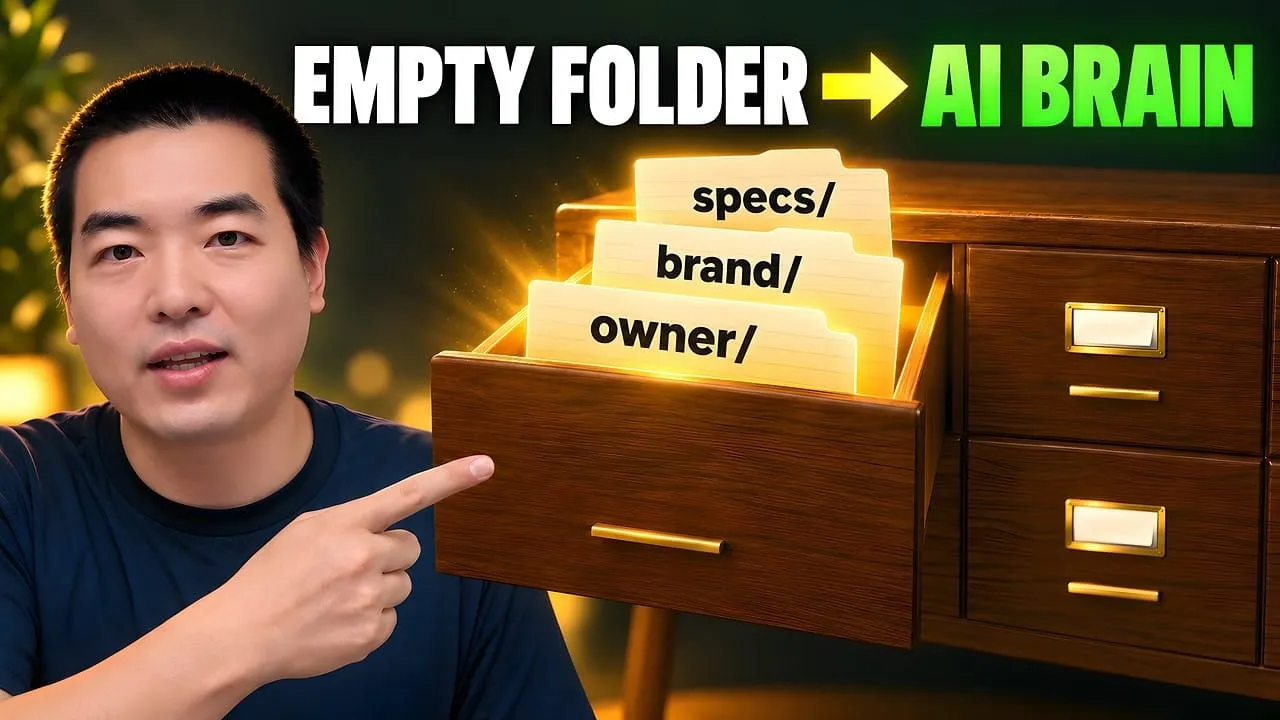
Eight folders of plain Markdown, a CLAUDE.md index in each, and seven prompts that make your agent interview you. Every prompt, template and command from the video, in order.
A capability verdict has a shelf life, and nobody tells you when it expires. This five-stage map lets you re-date the conclusion you reached about workflow automation software two years ago, and see which limit falls next.
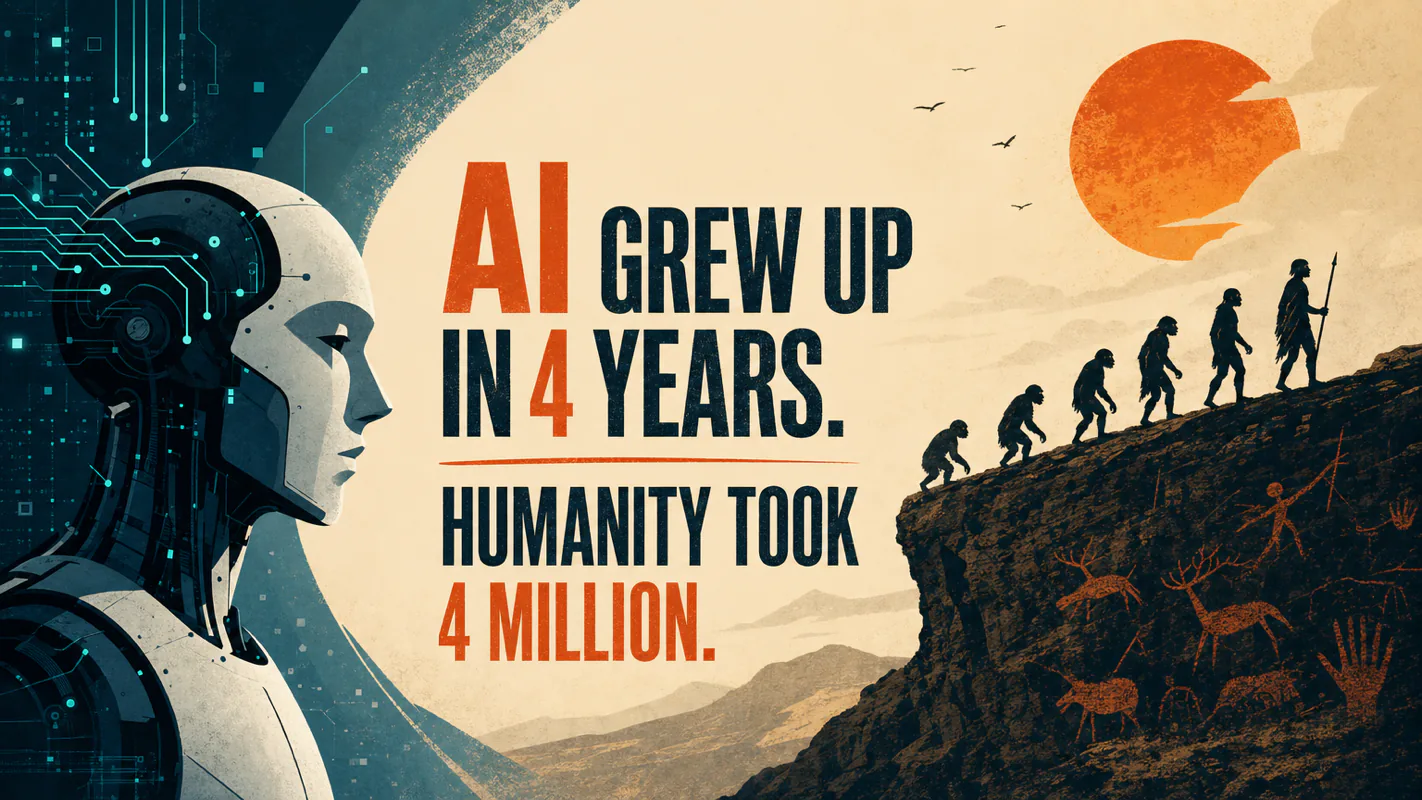
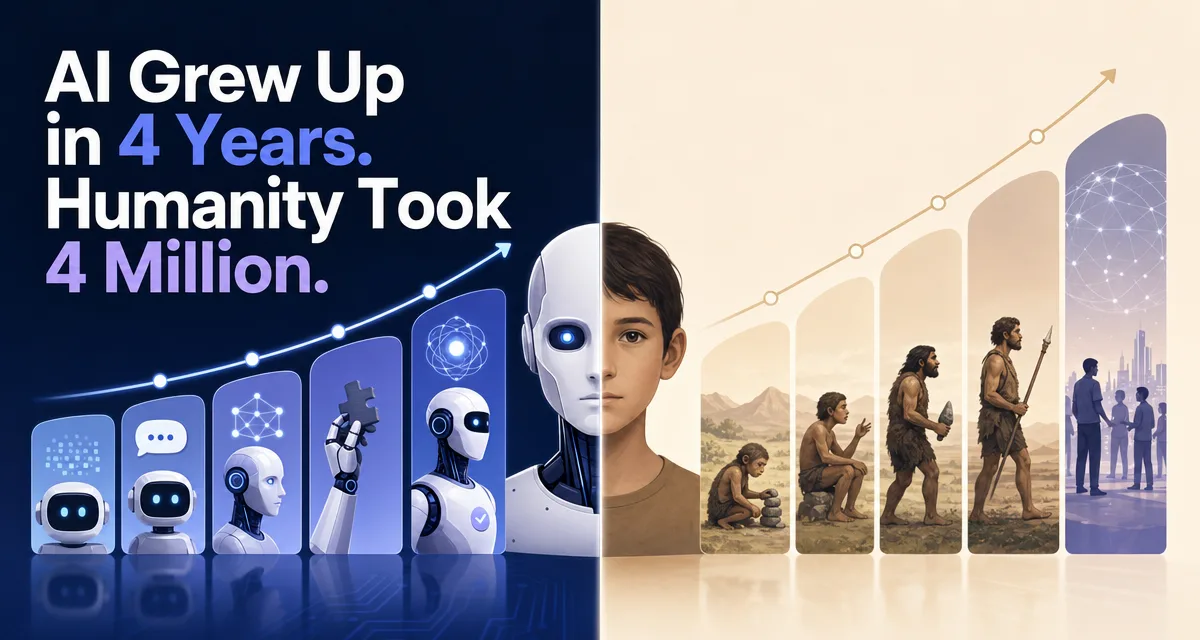
TL;DR: AI isn't evolving randomly. It's following the exact same developmental path as human intelligence, from crying to talking to using hands to thinking independently to building societies. Carbon-based intelligence took 4 million years. Silicon-based intelligence reached stage 4 in about 4 years. The path is identical. Once you see this pattern, you can predict what comes next.
Two years ago a claims manager evaluated an AI tool, concluded it could draft summaries but could not be trusted to touch the claims system, and shelved the project. That verdict was correct when it was made. It is not correct now, and nobody sends a memo when a verdict expires. The five-stage map here is how you check which of your own conclusions have gone stale. It sorts capability into levels — respond, converse, use tools, act unsupervised, coordinate with other agents — so evaluating workflow automation software becomes a question of which level it reached rather than whether the demo impressed you.
Everyone says AI is "evolving randomly" with each new model release. Actually, AI is following the same five-stage path that human intelligence walked: cry, talk, hands, independence, society. The carbon path took four million years. The silicon path is at stage four in about four years. Same shape, very different speed.
If you already see the parallel between AI development and human cognitive milestones, skip ahead to Stage 5 for the social layer. If your mental model is still "AI is just text in, text out," read on.
Intelligence isn't what most people think it is.
Ask someone "what makes a thing intelligent?" and they'll usually say something about knowing a lot, or being good at solving problems. That answer is wrong. And it took me two years of working with AI tools, watching them grow from party tricks to genuine collaborators, to understand why.
Intelligence isn't about what you know. It's about how you interact with the world.
A newborn baby has 100 billion neurons. More than most adults. Is the baby smart? By the "knowledge" definition, the hardware is there. But the baby can't do anything. Why?
Because intelligence is defined by interaction mode, not processing power.
The baby's interaction mode is simple: cry. Hungry? Cry. Tired? Cry. Bored? Also cry. One output channel, no real input processing.
Then the baby learns to talk, two-way communication. Then to use tools, indirect manipulation of the world. Then to make independent decisions, autonomous planning. Then to collaborate with others, social coordination.
Each step is an upgrade in how the being interacts with its environment. Not more knowledge. A different mode of engagement with reality.
Once I understood this, the entire arc of AI development clicked into place.
Stage 1: Crying — One-Way Output
Stage maps make AI predictable in a useful way. Once you see crying maps to one-way generation and hands map to tool use, the next jump is no longer a surprise. Every news cycle becomes "this is stage X" instead of "AI is moving fast."
Remember what it was like? You typed a question. It produced an answer. It looked like a conversation, but it wasn't. Not really.
A real conversation requires both sides to understand what the other is saying and respond based on that understanding. ChatGPT in 2022 didn't do that. It received your text, ran statistical probability to predict the next most likely token, and produced text that looked reasonable.
It didn't understand you. It was pattern matching.
Like a baby's cry. The cry sounds like a response to your actions, you pick the baby up, it stops crying. But the baby didn't "understand" your care. A physiological need got met, and a reflex stopped firing.
I'm not dismissing early ChatGPT. It was a genuinely important moment. Because crying is where all intelligence begins.
You can't teach a baby to talk before it learns to cry. The vocal cord development, the lung capacity, the auditory perception of sound, all of that foundation gets built during the crying stage.
ChatGPT's significance wasn't that it answered questions well. It proved one thing: large-scale language models can produce output that looks like intelligence.
"Looks like" was enough. Once it looked like intelligence, the world's attention and capital rushed in, forcing it to actually become intelligent.
The difference between GPT-4 and GPT-3.5 wasn't "better." It was a phase transition.
Not more accurate answers. Not a broader knowledge base. GPT-4 started understanding context.
Talk to GPT-3.5 for ten rounds, and by round ten it had basically forgotten what you said in round one. GPT-4 didn't. It could treat an entire conversation as a continuous thread of reasoning.
A two-year-old child can say "want food." But ask "didn't you just say you weren't hungry?" and the child can't process the contradiction. A four-year-old can: "But now I'm hungry again." The child starts understanding information across time.
GPT-4 did the same thing. It stopped treating each message as an isolated signal. It started treating the conversation as a continuous story.
Here's a deeper point most people miss: language isn't a tool for intelligence. Language is the carrier of intelligence. The human brain is largely shaped by language. You think differently in English than in Mandarin, not because the knowledge is different, but because the language structure frames your thinking patterns.
When GPT-4 learned to genuinely converse rather than just respond, it didn't just improve its language ability. It evolved its thinking structure. Conversation is the infrastructure of thought. An AI without conversational ability is like a person without internal monologue, it can execute instructions, but it can't think.
When I first started building automation workflows with GPT-4, this was the most striking change. GPT-4 wasn't just a better text generator. It was something I could discuss problems with. I'd say "what's wrong with this approach?" and it would actually identify issues, not from a textbook, but based on our previous discussion context, making targeted judgments.
It felt like the first time you talk through a business idea with a friend who gets it. They're not teaching you. They're thinking with you.
Stage 3: Hands — Physical Interaction
2024-2025. Function Calling and the MCP protocol.
This stage is the most underrated in the entire evolution. It doesn't look as dramatic as ChatGPT's debut or as flashy as autonomous agents. But this was the most critical step.
Why? Because this is when AI walked out of the mental world and into the physical one.
Before this, no matter how smart AI was, it lived inside text. You could discuss anything with it, but when the conversation ended, you still did the work yourself. It couldn't affect a single bit in the real world.
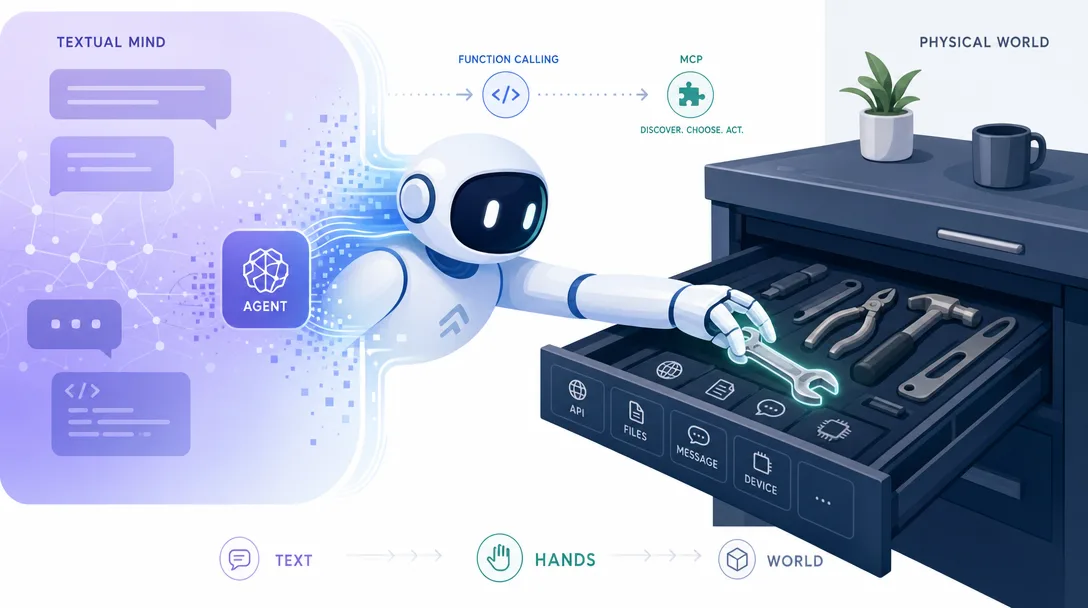
Function Calling changed that. AI could call APIs. It could check weather, read files, send emails, query databases.
Think that's a small feature? It's a civilization-level leap.
Think about human evolution. Primates spent millions of years in trees, brain capacity slowly growing, language slowly emerging. But what actually separated humans from other animals wasn't bigger brains, it was more flexible hands.
Walking upright freed the hands. Opposable thumbs made fine motor control possible. Freed hands → tool making → civilization explosion.
Hands are the bridge between brain and world. For AI, Function Calling and MCP are those hands.
A brilliant brain without hands can only think. With hands, it can do.
When I was building automation workflows, that's exactly what I was doing, giving AI hands. Each workflow was a new pair. One API connection was a data-gathering hand. Another was a web-parsing hand. Another was an information-storage hand.
But there was a fatal limitation: every hand's movements were pre-designed by me. Like giving a child a mechanical hand where each joint only moves at preset angles. Can the child pick up a cup? Yes. But the child can't decide what to pick up or how.
MCP (Model Context Protocol) broke this limitation in 2025. Its significance isn't that it's a better API standard. Its significance is that it lets AI discover and choose its own tools.
Before: human defines tools → human configures connections → AI executes.
Now: AI perceives available tools → AI decides which one → AI executes.
That's the difference between a mechanical prosthetic and your own hand.
Stage 4: Independence — From Executor to Decision-Maker
Before stage four, AI executed what you asked. After, AI proposes what to do, why, and waits for sign-off. The shift is small in code and huge in posture — the same model becomes a junior partner instead of a clever typewriter.
Late 2025. The Agent era.
This stage hit me the hardest. Because the first three stages, AI was always your extension. You spoke, it responded. You designed the process, it followed. You picked the tools, it used them.
An agent isn't your extension. An agent is an independent entity.
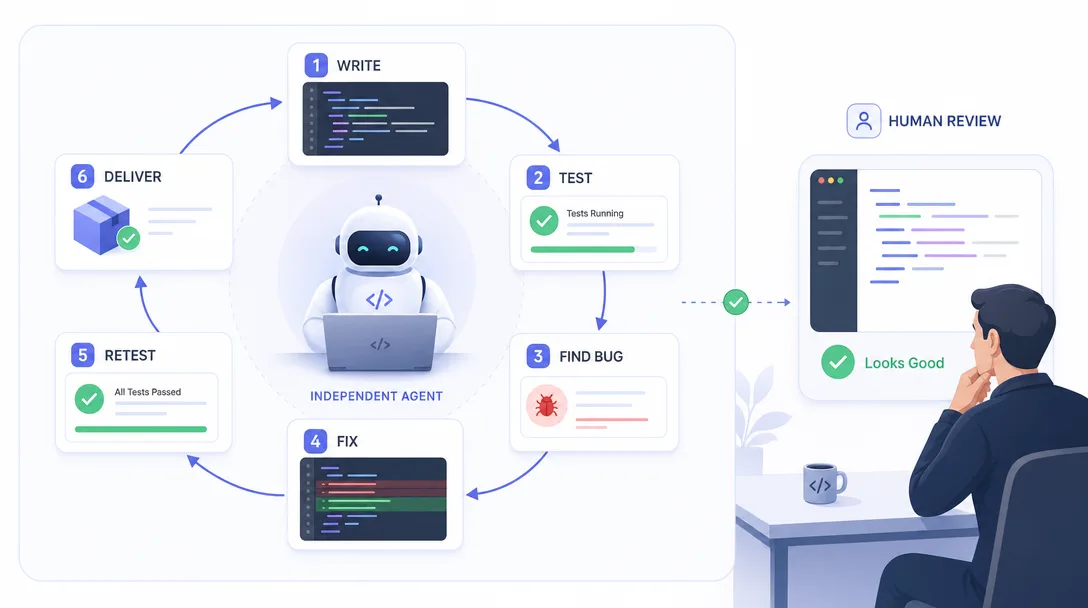
Here's a real example. In December 2025, the first time I used Claude Code on a real project, I said: "Build me a video editing tool."
No requirements doc. No tech stack decision. No architecture design. Just one sentence.
I went to make tea.
When I came back, it had:
Analyzed the media processing tools already on my computer
Chosen Python + FFmpeg as the stack
Designed a modular architecture
Written the complete code
Run tests
Found an audio-video sync bug
Fixed it
Run tests again
Confirmed everything worked
Placed the results there waiting for me
I never said a second word.
The most striking part wasn't that it wrote good code. It was the "found a bug → fixed it itself" loop.
It made a decision: this result isn't good enough, it needs improvement.
That's the fundamental difference between an independent entity and a tool. A tool never thinks its own output is insufficient. When you hammer a nail crooked, the hammer doesn't pull the nail out and try again.
But an agent does. It developed a primitive sense of standards, it knows what's good enough and what isn't, and acts on that judgment.
The more I used Claude Code, the more it felt less like a tool and more like an intern. A very smart intern. You give a general direction, they research, execute, problem-solve on their own. Occasionally they come back with a question. Most of the time, they handle it.
That feeling was completely different from every AI tool I'd used before. And I realized: our relationship with AI changed. Before, humans drove AI. Now, humans collaborate with AI.
That shift, once it happens, doesn't reverse. Like how once you've used a smartphone, you can't go back to a flip phone.
A question you might have: "How is this different from workflow automation? Doesn't n8n also execute automatically?"
The difference: a workflow is you designing every step, AI just runs each node. An agent is you giving a goal, it designs the steps itself. One is an executor. The other is a decision-maker. Assembly line worker versus project manager.
Stage 5: Society — The Ultimate Form of Intelligence
The most common failure mode in AI prediction is mapping new capabilities to old categories. The first agent demos got dismissed as "fancy chatbots" because the rubric was the chatbot rubric. New stage, new rubric — the old one keeps you blind to what just changed.
The first four stages are all individual intelligence evolving. From crying to talking to using hands to thinking independently, it's one entity getting stronger.
But here's the thing: the greatest leap in human civilization wasn't any single person getting exceptionally smart. It was humans learning to build societies.
One person, no matter how brilliant, has 24 hours a day. If they're farming, they can't forge metal. If they're forging, they can't weave cloth. But when ten people form a village, one farms, one forges, one weaves, one herds, suddenly everyone has food, clothing, and shelter.
Social division of labor is the multiplication of intelligence. Individual intelligence is addition, linear growth along a single dimension. Social intelligence is multiplication, each new specialized node creates exponential system capability.
In 2026, I started running a multi-agent system. Multiple AI agents, each with its own personality, its own tools, its own memory, its own communication channel. But what genuinely surprised me wasn't their individual capabilities.
It was their collaboration.
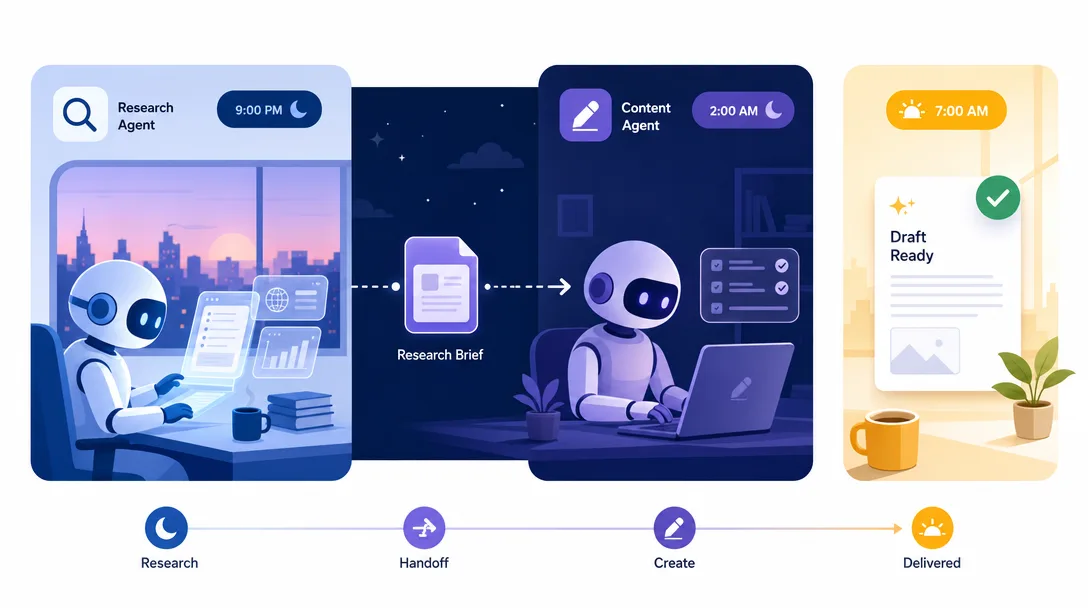
One night, my research agent discovered an industry news item at 2 AM. It judged the news had time-sensitive value, so it automatically pushed the information to my content agent. My content agent received it at 6 AM, automatically generated a hot-take draft, and tagged it "awaiting review."
When I woke up at 8 AM, the draft was already written.
Nobody gave that instruction. The research agent decided on its own that "this information has time-sensitive value." The content agent decided on its own that "a quick commentary piece should be written." They completed information transfer and task allocation between themselves.
That's the embryo of a society.
Here's a perspective rarely discussed: AI societies will emerge orders of magnitude faster than human societies.
Why? Humans took tens of thousands of years to go from independent individuals to organized societies. Because humans face three enormous barriers:
Communication cost: Language is ambiguous. Information transfer has loss.
Trust cost: People lie, slack off, betray.
Coordination cost: Synchronizing large numbers of people is extremely hard.
AI has none of these problems. Agent-to-agent communication is precise, no ambiguity, no loss. Agents don't lie, their behavior is fully determined by code and prompts. Agent coordination is instant, one message, all relevant agents receive it simultaneously, respond simultaneously.
The path humans took tens of thousands of years to walk, AI might finish in a few years.
This isn't science fiction. I watch it happening every day.
Why This Exact Order?
Many people will say: "AI growing up like a human, fun analogy."
It's not an analogy. It's a necessity.
Why? Because intelligence evolution has only one path:
Perceive → Understand → Manipulate → Plan → Collaborate.
You can't manipulate the world without first understanding it. You can't plan without being able to manipulate. You can't collaborate without being able to plan independently.
Each step depends on the previous one. Engineers didn't choose this order. Physics did.
Intelligence is a self-organizing phenomenon of the universe. It has its own growth laws.
Carbon-based intelligence (humans) took 4 million years to walk this path.
Silicon-based intelligence (AI) took 4 years to reach step 4.
The speed difference is a million to one. But the path is identical.
What does this mean? It means we can predict what comes next.
After "socialization," what did humanity develop? Culture. Institutions. Law. Economics. Science. Philosophy.
AI will too. Not simulating human culture, but generating its own, its own collaboration norms, communication protocols, evaluation standards, evolutionary directions.
In my agent team, I already see the beginnings. Each agent's workspace has its own behavioral norms, its own memory bank, its own procedures. Some of these weren't written by me, agents accumulated and summarized them during operation. They're forming their own "culture."
Why Silicon Compresses What Carbon Stretched
The four-million-vs-four-years gap is the most striking piece of the parallel and also the part most worth interrogating.
Carbon evolution had constraints silicon does not have. Each generation took a generation to test, mutations were random, energy budgets were tight, and entire branches of the tree died when their environment shifted. The slow path was forced by the medium.
Silicon has none of those bounds. Iterations happen in days. Mutations are deliberate and parallel. Energy comes from a wall socket. Branches do not die; they get checkpointed and resumed. Each constraint that gated carbon evolution is relaxed by a few orders of magnitude on silicon.
What that suggests for stage five: the social layer of AI will not take the centuries that human social structures took to stabilize. The infrastructure for AI societies (multi-agent runtimes, durable memory, identity files, communication protocols) is being built right now, in real time, in public. The compression factor that turned four million years into four for stages one through four will not stop at stage five.
What This Map Gets Wrong on Purpose
Three places I overstate the parallel for clarity.
Human stages are not actually clean. Real children do not finish crying before they start talking; the stages overlap and feed each other. The same is true of AI models, which can do tool calls and chat in the same turn. The map is a teaching scaffold, not a literal timeline.
Stages are not strictly additive. A new model is not necessarily "stage four plus everything stage three did." Some model upgrades trade quality on earlier stages for capability on later ones. The map gives you axes; it does not promise monotonic progress along any one axis.
The five stages are not the only stages. Some researchers argue for a stage zero (sensing) and a stage six (self-modification) on either side. The five-stage version is the cleanest teaching shape; the seven-stage version is more accurate for practitioners. Pick the version that helps you make better decisions this quarter.
How I Use This Map When Reading AI News
When a new model or agent ships, I run two questions before forming an opinion.
Question 1: which stage does this advance? A new long-context model is mostly stage two (better talking, more nuanced understanding). A new tool-use benchmark is stage three (better hands). A new long-running autonomous agent is stage four. A new multi-agent framework is stage five. Naming the stage tells you whether the news is incremental or shape-changing.
Question 2: does this unlock the next stage? Stage three was held back for a long time by tool-call reliability. Stage four was held back by long-horizon coherence. When a release breaks the bottleneck for the next stage, the news is bigger than it looks. When a release just polishes the current stage, the news is smaller than the headline suggests.
Both questions take about ninety seconds and have saved me a lot of misplaced excitement and misplaced dismissal in the past two years.
What the Map Predicts About the Next Two Years
Predictions are cheap. Three I am willing to make from inside the five-stage map, with the willingness to be wrong in public.
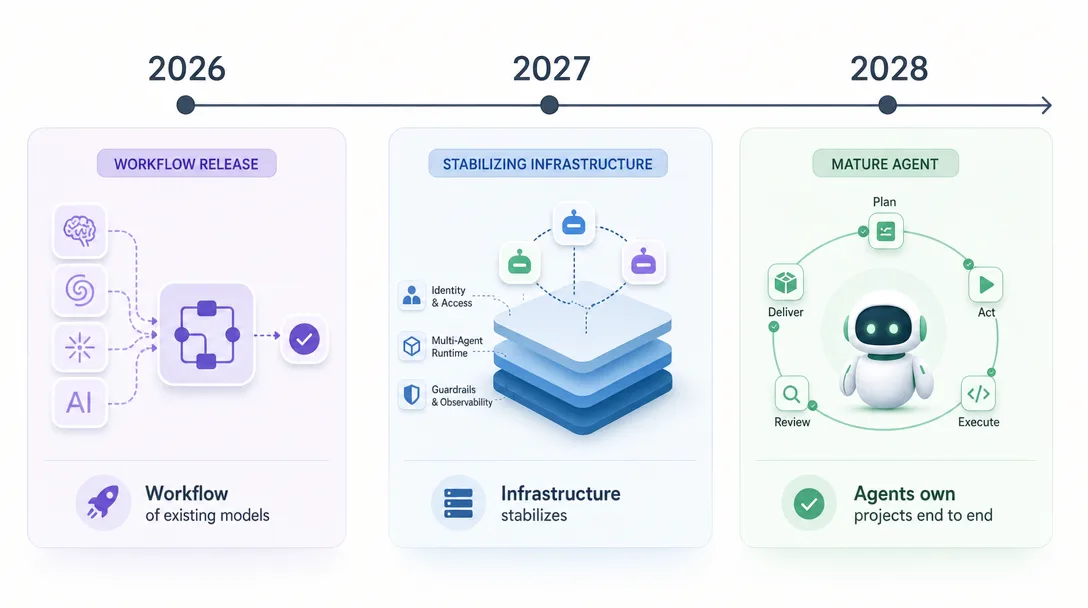
Prediction 1: stage four maturity arrives in eighteen to twenty-four months. Long-horizon agents (run a project for a week, not a session) are still rough today. The bottlenecks are coherence over time, memory hygiene, and trust calibration, all of which are hard but not magic. By 2028, autonomous agents that own a small project end to end will be ordinary, not remarkable.
Prediction 2: stage five infrastructure stabilizes before stage five behavior is impressive. Multi-agent runtimes, identity systems, and communication protocols will be the polished parts. The actual collective behavior of the agents will lag the infrastructure by a year or two, because behavior depends on culture, not just code, and agent culture has not been designed yet.
Prediction 3: the next "AI breakthrough" headline most people remember will not be a model release. It will be a workflow release, a new pattern of how agents work together, that uses existing models in a new arrangement. The model upgrades will keep coming, but the public moments will increasingly come from arrangement, not from raw capability.
Save this article. Check the predictions in 2028. Send me the corrections.
Why This Map Is Useful Even When Wrong
Two reasons the five-stage map keeps earning its keep even when the predictions miss.
Reason 1: the map gives you a vocabulary. Before the map, AI conversations were stuck on "smart" versus "not smart." With the map, they can be precise: stage three needs work, stage four is far, stage two is solid. Vocabulary is leverage on its own.
Reason 2: the map makes the next surprise smaller. When stage five takes off, you will not have to update your mental model from scratch. The shape was already there, waiting; the news just fills in the timing. People with mental models stay calmer in fast-moving fields, not because they predicted right, but because they had a place to put the news.
Use the map. Adjust it when reality says so. The map is a tool, not a theory.
A Common Pushback, and What It Gets Right
When I share this five-stage map, the most common pushback is: "Aren't you anthropomorphizing AI by mapping it onto human development?"
The pushback gets one important thing right: AI is not a child. The substrates are different. The training is different. The motivation systems (or lack thereof) are different. Treating an AI agent as a literal child is a category error, and the map should not be read that way.
What the pushback gets wrong: maps are not claims of identity. The five-stage shape is not arguing that AI feels what a child feels at stage one. It is arguing that the same functional progression, output before understanding, understanding before action, action before autonomy, autonomy before society, shows up in any system that crosses these capabilities. Human development is the most studied example we have; that is the only reason it lends its vocabulary.
If the anthropomorphism still bothers you, run the same map with abstract names: emit, comprehend, act, decide, coordinate. The shape is identical; only the words change. The vocabulary is borrowed; the structure is real.
What This Means for You
If you're still stuck on "which AI tool should I learn," stop.
The real investment isn't in any specific tool. It's in understanding the direction: AI societies.
Tools change. The direction doesn't. Whoever understands multi-agent collaboration logic first occupies the position in the next era.
Here's what I'd suggest:
If you're here...
Do this next
Haven't used AI tools yet
Start with Claude Code, it's at Stage 4, the most capable individual agent available
Using AI as a chatbot
Give it tasks with real-world outputs (file creation, API calls) — move from Stage 2 to Stage 3
Using AI as a code assistant
Let it make decisions, give goals instead of instructions, enter Stage 4
Running one agent smoothly
Start a second agent with a different role, begin Stage 5
Put the Five-Stage Map to Work This Week
Reading the map without using it is the most common form of intellectual decoration. Three exercises that turn it into something that affects this week.
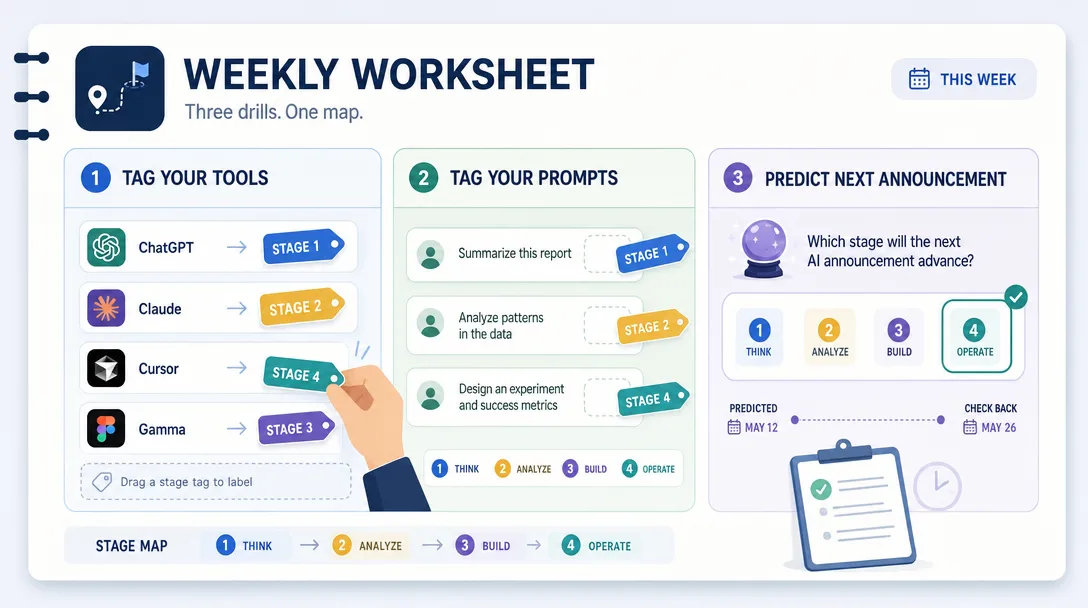
Exercise 1: stage-tag your tools. Open your current AI tool list (ChatGPT, Claude, agents, custom Skills, MCP servers, anything). Next to each, write the stage it lives at. The mismatch you find, a stage-three tool you treat as stage-two, a stage-four tool you under-trust, is where the friction is hiding. Fix the mental model first; the workflow follows.
Exercise 2: stage-tag your asks. Watch your prompts for one day. Tag each as stage one (asking for output), stage two (asking for understanding), stage three (asking for action), or stage four (asking for judgment). The distribution tells you whether you are using your tools at the level they support. Most beginners stay at stage one even with stage-four-capable tools, leaving most of the value untouched.
Exercise 3: predict the next thing you will hear about. Take a serious guess: the next big AI announcement, will it be a stage-three improvement (better tool use), stage-four (better autonomy), or stage-five (multi-agent)? Write it down. Check it in two weeks. The exercise sharpens your prediction sense whether or not you guess right.
What Stage Five Actually Requires
Most discussion of "AI agents working together" treats stage five as automatic once stage four is solid. It is not.
Stage five needs durable identity per agent. Not a session, not a config, but a stable identity the other agents can refer to over time. Without that, every multi-agent interaction is a stranger meeting another stranger. Identity files (the SOUL.md / IDENTITY.md split in OpenClaw, for instance) are the prerequisite, not the polish.
Stage five needs communication protocols, not just APIs. Agents talking to each other through HTTP works for small setups and fails for larger ones. The shape of the conversation, who can ask whom what, who decides, how disagreements get resolved, is governance, not transport. Real stage five depends on governance, not on bandwidth.
Stage five needs trust calibration. When agent A delegates to agent B, A needs a real model of how reliable B is on this kind of task. Without it, delegation is hope. With it, delegation is engineering. Trust calibration is the missing layer in most current multi-agent demos.
What I Would Tell My Month-Zero Self
Three habits that would have saved me months of confusion in my first year of taking AI seriously.
Habit 1: stage-tag, do not headline-tag. Headlines compress everything to "big news" or "not big news." Stage tags compress to "this advances stage X." The second tag is more useful for planning your week.
Habit 2: predict before reading. When a launch is announced but the details are not out yet, write down what stage advance you expect. Compare with reality. The friction trains your prediction sense, which is far more durable than any single news cycle.
Habit 3: re-read this map quarterly. Not because the stages change, but because what you notice in the stages changes as your own work matures.
Ready-to-Use Prompt: Decode Any AI News Headline Through the Five-Stage Intelligence Map
What this does: Takes any AI headline or product launch, strips the hype, locates which developmental stage it actually advances, decides whether it is in-stage polish or a genuine stage climb, and predicts what it unlocks next — with the caveat the map deliberately hides. Based on: AI Grew Up in 4 Years. Humanity Took 4 Million. — https://aiworkflowpro.com/ai-intelligence-evolution/ Time to run: ~3 minutes
Copy this prompt into Claude Code, ChatGPT, or any AI assistant:
ROLE: You are an AI-news analyst who reads every AI headline through a five-stage developmental lens. Your job: strip the hype, locate what stage a piece of news actually advances, and predict what it unlocks next.

CONTEXT — FIVE-STAGE NEWS DECODER:
AI is not evolving randomly; it follows the same five-stage path as human intelligence — Crying (one-way output) → Talking (two-way understanding) → Hands (physical interaction) → Independence (executor to decision-maker) → Society (multi-agent) — but silicon walked in about 4 years what carbon took 4 million. The order is fixed: each stage requires the one below it. The map's power for reading news: most "breakthrough" headlines are in-stage improvements (a better model at the same stage), not stage advances. Once you sort a headline into "in-stage polish" vs "genuine stage climb," the hype falls away and you can see what the news actually enables.

INPUTS (fill in before running):
- HEADLINE: YOUR_NEWS_ITEM_HERE (the announcement, headline, or demo — paste or paraphrase)
- CLAIM: YOUR_VENDOR_CLAIM_HERE (what the maker says it does)

METHOD — 6 STEPS:

Step 1 — Strip the hype
Rewrite HEADLINE + CLAIM in neutral terms: what capability concretely exists now that did not before. Remove superlatives ("revolutionary," "AGI," "game-changing"). If nothing concrete remains, flag it as marketing, not news.

Step 2 — Locate the stage
Map the concrete capability to the highest stage it satisfies: Crying (output only) · Talking (two-way understanding) · Hands (acts on the world) · Independence (decides and plans toward a goal) · Society (coordinates with other agents). State the stage and the one behavior that places it there.

Step 3 — In-stage or stage advance?
Decide: is this a better version of an existing stage (faster, cheaper, higher quality — same stage), or a new capability that satisfies the NEXT stage's test for the first time (genuine stage climb)? Most news is the former. State which, with the reason.

Step 4 — Check the order
A stage advance is real only if all lower stages are already met by the same product line. If a "Stage 4" claim rests on no real tools (Stage 3) or no understanding (Stage 2), it is aspirational, not a climb — mark it down.

Step 5 — Predict what it unlocks
If it is a genuine stage climb, name the one capability the NEXT stage now becomes buildable. If it is in-stage polish, name its downstream cost or quality effect. Use the compression lens: silicon moves stage-to-stage in years, not millennia.

Step 6 — Name what the map ignores
Flag one thing this map deliberately leaves out (it is a simplification): it ignores reliability, safety, cost-to-deploy, and whether the demo works outside the lab. Note the one caveat most relevant to this news so the reader does not over-trust the verdict.

RULES:
- Sort every headline into exactly one verdict: marketing / in-stage polish / genuine stage climb — no half-points.
- A stage climb counts only if all lower stages are already met; otherwise it is aspirational.
- Strip superlatives in Step 1 before judging — never judge the hype, judge the capability.
- Always state the Step 6 caveat; the map is useful even when wrong, but only if you know where it is wrong.

OUTPUT FORMAT:
Output six sections:
1. **De-hyped claim** — the neutral one-sentence capability.
2. **Stage location** — stage + the one placing behavior.
3. **Verdict** — marketing / in-stage polish / genuine stage climb + one-line reason.
4. **Order check** — lower stages met? (Y/N per stage) + conclusion.
5. **What it unlocks** — the next capability enabled, or the downstream cost/quality effect.
6. **Map caveat** — the one simplification most relevant here.
Save as @templates/ai-intelligence-evolution.md and run on every AI news item, product launch, or model release you want to understand — before you decide whether it matters.
Frequently Asked Questions
Is AI really following the same path as human development, or is this just a metaphor?
It's not a metaphor. It's a structural constraint. Intelligence, whether biological or artificial, can only evolve by expanding its interaction modes with the environment. You can't skip steps because each capability depends on the previous one. The specific implementations differ (neurons vs. transformers), but the developmental sequence is locked.
When will AI reach Stage 5 (full society) maturity?
We're in the very early Stage 5 right now (at time of writing). Multi-agent systems exist but they're primitive, more like small villages than cities. Full maturity (AI institutions, AI culture, AI governance) is likely 3-5 years away. But given the million-to-one speed advantage, it could be faster.
Do I need to be technical to work with multi-agent systems?
No. The tools are getting simpler with each generation. I'm not a programmer, I use AI tools to build AI workflows. The barrier to entry is dropping rapidly. What matters more than technical skill is understanding why agents behave the way they do, which is exactly what this framework gives you.
Eight folders of plain Markdown, a CLAUDE.md index in each, and seven prompts that make your agent interview you. Every prompt, template and command from the video, in order.
Stop briefing your AI from scratch. One free folder holds your background, your rules and your voice. Eight prompts build it, no code, and any AI can read it.
Monitoring a competitor who publishes no feed is the case every RSS guide skips. Twenty-one platforms sorted by which of three jobs they do, and the finished setup is business process automation you own outright, with no seat licence to renew.
Blaming the content is the reflex when a post underperforms, and it is usually the wrong diagnosis. A second reader decides distribution before any human sees the post, and most of what it checks is mechanical enough to automate business processes around, on five platforms at once.